
Enhanced with market attractiveness analysis, total addressable market evaluation, company benchmarking matrices, interactive Excel dashboards, expanded supply chain intelligence, emerging startup coverage, and detailed product insights, The Business Research Company’s 2026 market reports deliver more actionable and strategically valuable research.
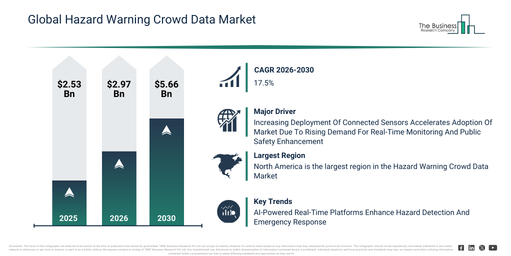
Hazard Warning Crowd Data Market Growth From $2.97 Billion In 2026 To $5.66 Billion By 2030 At A CAGR Of 17.5%
The hazard warning crowd data market size has experienced rapid growth in recent years. It is forecast to expand from $2.53 billion in 2025 to $2.97 billion in 2026, achieving a compound annual growth rate (CAGR) of 17.3%. The historic period’s expansion is attributable to increasing smartphone penetration, the development of social media-based reporting, the widening of urban monitoring systems, a growing need for real-time safety information, and the implementation of cloud-based analytics platforms.
The hazard warning crowd data market is projected for significant expansion in the upcoming years. This market is set to reach $5.66 billion by 2030, exhibiting a compound annual growth rate (CAGR) of 17.5%. Factors driving this expansion during the forecast period include greater investments in public safety technologies, the expanding utilization of AI-driven risk prediction, the growth of smart city initiatives, a rising need for integrated safety intelligence, and a heightened emphasis on proactive hazard mitigation. Key trends anticipated for the forecast timeframe encompass the increasing embrace of crowd-sourced hazard reporting platforms, a surge in the implementation of real-time alert and notification systems, enhanced integration of geospatial risk analytics, the proliferation of predictive hazard intelligence tools, and a sharpened focus on data accuracy and trust.
Download A Free Sample Report For Comprehensive Market Insights:
Hazard Warning Crowd Data Market Growth Drivers: What Factors Are Accelerating Expansion?
The hazard warning crowd data market is projected to see growth driven by the increasing deployment of connected sensors. Connected sensors are defined as internet-enabled devices integrated into homes, wearables, energy systems, appliances, and security solutions, which collect, transmit, and share real-time data to support monitoring, automation, and intelligent decision-making. The expansion in the use of these sensors is fueled by the swift development of Internet of Things (IoT) infrastructure and a rising demand for real-time data and automation across various industries. Organizations and cities are incorporating sensor networks to oversee operations, boost efficiency, enable predictive maintenance, improve situational awareness, and support data-driven decision-making in sectors like manufacturing, logistics, smart cities, and safety systems. Hazard warning crowd data enhances connected sensors by aggregating and analyzing real-time inputs from IoT devices, wearables, cameras, and environmental sensors, which facilitates faster risk detection, improved situational awareness, and timely alerts, ultimately strengthening public safety, emergency response, and crowd management effectiveness. A notable illustration is from September 2025, when Eurostat, the Luxembourg-based statistical office of the European Union (EU), reported that in 2024, 76% of EU internet users utilized internet-connected devices; this included 67% adopting smart home entertainment solutions, followed by wearables (32%), smart energy management systems (15%), smart home appliances (14%), and internet-connected home safety and security systems (13%). Therefore, the increasing deployment of connected sensors is a primary catalyst for the growth of the hazard warning crowd data market.
Hazard Warning Crowd Data Market Segment Breakdown: Which Categories Generate The Most Revenue?
The hazard warning crowd data market covered in this report is segmented –
1) By Component: Software; Hardware; Services
2) By Deployment: Cloud; On Premises; Hybrid
3) By Data Source: Mobile Devices; Social Media; Surveillance Systems; Sensors
4) By Application: Public Safety; Disaster Management; Event Management; Transportation; Urban Planning; Other Applications
5) By End User: Government; Emergency Services; Transportation Authorities; Event Organizers; Enterprises
Subsegments:
1) By Software: Real-Time Alert Processing; Crowd Data Management; Hazard Analysis Tools
2) By Hardware: Sensors And Detectors; Communication Devices; Data Storage Systems
3) By Services: Consulting And Implementation; Maintenance And Support; Training And Education
Hazard Warning Crowd Data Market Trends: What Is Shaping Future Industry Growth?
Major companies operating in the hazard warning crowd data market are concentrating on creating advanced solutions, such as AI-driven real-time interoperability and alert management platforms, to address the growing need for dynamic, real-time collection of hazard data, rapid response coordination, and better public safety during emergencies, natural disasters, and major events. These platforms leverage artificial intelligence and machine learning to swiftly and precisely process and distribute crowd and hazard information from various sources, including mobile devices, sensors, and surveillance systems, significantly outperforming traditional methods that relied on manual reporting and less integrated communication systems; this capability empowers authorities to proactively identify threats and manage responses. For instance, in January 2026, RapidSOS, a US-based public safety AI firm, launched Real Time Interoperability with HARMONY AI, an advanced feature designed to streamline emergency coordination by allowing live call summaries, AI-generated transcripts, and crucial data to move effortlessly across jurisdictional boundaries in real time; this technology considerably boosts situational awareness for emergency dispatchers and first responders by securely linking and sharing contextual data from various streams, thereby drastically cutting down response times and improving public safety outcomes.
Hazard Warning Crowd Data Market Key Players And Strategic Industry Positioning
Major companies operating in the hazard warning crowd data market are Siemens AG, Honeywell International Inc., Hexagon AB, Environmental Systems Research Institute Inc., HERE Global B.V., TomTom International B.V., Everbridge Inc., Genetec Inc., AccuWeather Inc., Dataminr Inc., Mapbox Inc., AlertMedia Inc., INRIX Inc., Crowd Connected Ltd., HAAS Alert Inc., Ushahidi Inc., CrowdStrike Holdings Inc., Swarm Technologies Inc., HazView LLC, and Alertus Technologies.
Access The Complete Hazard Warning Crowd Data Market Report:
#Hazard Warning Crowd Data Market Largest Region: Which Geography Holds The Highest Market Share?
North America was the largest region in the hazard warning crowd data market in 2025. Asia-Pacific is expected to be the fastest-growing region in the forecast period. The regions covered in the hazard warning crowd data market report are Asia-Pacific, South East Asia, Western Europe, Eastern Europe, North America, South America, Middle East, Africa.
Get in touch with us:
The Business Research Company: https://www.thebusinessresearchcompany.com/
Americas: +1 310-496-7795
Asia: +44 7882 955267 & +91 8897263534
Europe: +44 7882 955267
Email us at: marketing@tbrc.info
Follow us on:
LinkedIn: https://in.linkedin.com/company/the-business-research-company
YouTube: https://www.youtube.com/channel/UC24_fI0rV8cR5DxlCpgmyFQ
Global Market Model: https://www.thebusinessresearchcompany.com/global-market-model

Wasay has over a decade of experience in market research, data modelling, and analytics, with prior experience at GlobalData and Decision Tree Consulting Services. At The Business Research Company , he leads research operations across syndicated studies, customized consulting engagements, and the Global Market Model platform. His professional experience includes supporting organizations such as Boston Consulting Group, KPMG, and Ernst & Young. Wasay holds a degree in Electronics and Communications Engineering, postgraduate management qualifications from International Management Institute Belgium and Indian School of Business and Entrepreneurship, and completed the Integrated Program in Business Analytics from Indian Institute of Management Indore.