
Enhanced with market attractiveness analysis, total addressable market evaluation, company benchmarking matrices, interactive Excel dashboards, expanded supply chain intelligence, emerging startup coverage, and detailed product insights, The Business Research Company’s 2026 market reports deliver more actionable and strategically valuable research.
Heat Network Optimization Market Expansion From $4.77 Billion In 2026 To $7.78 Billion In 2030
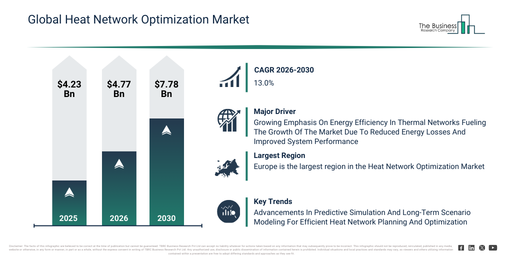
The heat network optimization market has demonstrated rapid expansion in recent years. This market is set to expand from $4.23 billion in 2025 to $4.77 billion in 2026, achieving a compound annual growth rate (CAGR) of 12.8%. Historically, this growth can be attributed to several factors including the expansion of district heating infrastructure, a heightened focus on energy efficiency in thermal systems, the deployment of smart heat meters, increasing operational cost pressures on utilities, and the early adoption of network monitoring software.
The heat network optimization market is anticipated to experience substantial expansion over the upcoming years. This market is projected to attain $7.78 billion by 2030, exhibiting a compound annual growth rate (CAGR) of 13.0%. This growth during the forecast period is propelled by factors such as escalating investments in smart thermal infrastructure, the increasing integration of AI-based optimization tools, the proliferation of low-carbon district heating networks, the rising adoption of predictive maintenance solutions, and a heightened regulatory emphasis on energy efficiency. Furthermore, significant trends expected in this period encompass the growing implementation of real-time heat network monitoring, an increase in the application of predictive heat demand forecasting, enhanced integration of advanced control and balancing solutions, the expansion of data-driven network optimization services, and a greater commitment to reducing thermal losses.
Download A Free Sample Report For Comprehensive Market Insights:
Heat Network Optimization Market Growth Momentum: Which Factors Are Influencing Demand?
The increasing requirement for energy efficiency within thermal networks is anticipated to boost the expansion of the heat network optimization market. Energy efficiency in thermal networks refers to the minimization of energy wastage and enhanced delivery of warmth from its source to end-users through superior design, equipment, and operational practices. This escalating demand for energy efficiency in thermal networks is fueled by more stringent decarbonization targets, rising energy expenses, and the necessity to streamline heat generation and distribution. This is because utilities and network operators are striving to lessen heat losses, enhance system performance, and incorporate renewable and waste-heat sources to ensure a dependable, cost-effective, and environmentally sound thermal energy supply. Heat network optimization improves energy efficiency in thermal networks by intelligently synchronizing heat supply with demand, as sophisticated monitoring, control, and analytical tools reduce distribution losses, refine temperature regulation, and facilitate more judicious use of energy resources. This culminates in reduced fuel consumption, lower emissions, and improved overall system performance. For instance, in March 2024, data from the Department for Energy Security and Net Zero, a UK-based government agency, showed that in 2023, around 318,600 energy efficiency measures were enacted via various schemes, marking a 49% rise compared to 2022. Consequently, the growing need for energy efficiency in thermal networks is propelling the growth of the heat network optimization market.
Heat Network Optimization Market Segment Analysis And Revenue Opportunities
The heat network optimization market covered in this report is segmented –
1) By Component: Software; Hardware; Services
2) By Deployment Mode: On-Premises; Cloud
3) By Application: District Heating; District Cooling; Industrial Processes; Residential Buildings; Commercial Buildings
4) By End User: Utilities; Industrial; Commercial; Residential; Other End Users
Subsegments:
1) By Software: Network Optimization Platforms; Energy Management Software; Demand Forecasting Software; Analytics And Reporting Software; Control And Monitoring Software
2) By Hardware: Smart Meters; Sensors And Actuators; Control Valves; Heat Exchangers; Communication Devices
3) By Services: Installation And Integration Services; Consulting And Advisory Services; Maintenance And Support Services; Optimization And Performance Services; Training And Education Services
Heat Network Optimization Market Trends Reshaping Industry Growth
Leading companies operating in the heat network optimization market are progressively rolling out sophisticated simulation and predictive modeling solutions, such as next-generation district heating simulation software, to satisfy the growing demand for precise performance predictions, strategic development, and economical network management. These advanced tools utilize in-depth system models, historical information, and scenario assessments, allowing operators to evaluate long-term heat production, network dynamics, supply approaches, and investment consequences, thereby offering significantly richer understanding compared to conventional spreadsheet planning or fixed hydraulic computations, which typically miss dynamic forecasting and integrated scenario examination. For instance, in February 2025, Kelvin Green, a Germany-based sustainable energy solutions provider, introduced HeatSim, a state-of-the-art district heating simulation software tool at E-world 2025. This software is designed to assist heat network operators in modeling hourly heat generation and investigating operational and investment possibilities for periods extending up to 20 years. HeatSim’s primary functionalities encompass lifecycle cost efficiency, analysis of tariff and procurement strategies, proactive operational scheduling, assessment of subsidy and tariff effects, and insights for network optimization that can guide choices on heat pump integration and temperature regulation, ultimately boosting both financial and operational performance for sustainable district heating systems.
Heat Network Optimization Market Leading Players Shaping Industry Direction
Major companies operating in the heat network optimization market are E.ON SE, ENGIE SA, Siemens AG, Veolia Environnement SA, Schneider Electric SE, Honeywell International Inc., ABB Ltd, Centrica plc, Johnson Controls International plc, Trane Technologies plc, Emerson Electric Co., Danfoss A/S, Fortum Oyj, Ramboll Group A/S, Itron Inc., COWI A/S, Kelvion Holding GmbH, Kamstrup A/S, NODA Intelligent Systems GmbH, and Sycous Limited.
Access The Complete Heat Network Optimization Market Report:
Heat Network Optimization Market Geographic Analysis: Where Is Demand Growing The Fastest?
Europe was the largest region in the heat network optimization market in 2025. Asia-Pacific is expected to be the fastest-growing region in the forecast period. The regions covered in the heat network optimization market report are Asia-Pacific, South East Asia, Western Europe, Eastern Europe, North America, South America, Middle East, Africa.
Get in touch with us:
The Business Research Company: https://www.thebusinessresearchcompany.com/
Americas: +1 310-496-7795
Asia: +44 7882 955267 & +91 8897263534
Europe: +44 7882 955267
Email us at: marketing@tbrc.info
Follow us on:
LinkedIn: https://in.linkedin.com/company/the-business-research-company
YouTube: https://www.youtube.com/channel/UC24_fI0rV8cR5DxlCpgmyFQ
Global Market Model: https://www.thebusinessresearchcompany.com/global-market-model

Wasay has over a decade of experience in market research, data modelling, and analytics, with prior experience at GlobalData and Decision Tree Consulting Services. At The Business Research Company , he leads research operations across syndicated studies, customized consulting engagements, and the Global Market Model platform. His professional experience includes supporting organizations such as Boston Consulting Group, KPMG, and Ernst & Young. Wasay holds a degree in Electronics and Communications Engineering, postgraduate management qualifications from International Management Institute Belgium and Indian School of Business and Entrepreneurship, and completed the Integrated Program in Business Analytics from Indian Institute of Management Indore.