Through market attractiveness analysis, total addressable market evaluation, company benchmarking matrices, interactive Excel dashboards, expanded supply chain intelligence, emerging startup coverage, and detailed product insights, The Business Research Company’s 2026 market reports provide more actionable and strategically valuable research.
Automotive Adaptive Cruise Control Market Growth Analysis: How Will Revenue Expand During The Forecast Period?
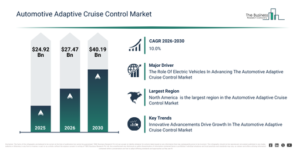
The automotive adaptive cruise control market has experienced significant growth in recent years. It is projected to expand from $24.92 billion in 2025 to $27.47 billion in 2026, at a compound annual growth rate (CAGR) of 10.2%. Historically, this growth can be attributed to the rising usage of conventional cruise control systems, the early adoption of radar-based sensors, the reliance on CAN and LIN networks, the increased deployment of ACC in passenger vehicles, and its initial integration into commercial vehicles.
The automotive adaptive cruise control market is anticipated to experience substantial expansion in the coming years. This market is projected to reach $40.19 billion by 2030, exhibiting a compound annual growth rate (CAGR) of 10.0%. This expansion during the forecast period is driven by factors such as the increasing embrace of connected and AI-enhanced ACC systems, the implementation of sophisticated ECUs and MCUs, their integration into intelligent vehicle networks, broader use in commercial vehicles, and the increasing availability of ACC solutions from both original equipment manufacturers and the aftermarket. Key developments expected within this period involve the incorporation of AI-driven adaptive cruise control, the widespread use of radar and lidar sensor technologies, the growth of connected adaptive cruise control systems, the uptake of smart ECU and MCU solutions, and the rollout of automated vehicle speed control mechanisms.
Download A Free Sample Report For Comprehensive Market Insights:
Automotive Adaptive Cruise Control Market Growth Momentum: Which Factors Are Influencing Demand?
The surging demand for electric vehicles is anticipated to drive the future growth of the automotive adaptive cruise control market. Electric vehicles (EVs) are automobiles powered predominantly or entirely by electricity stored in rechargeable batteries. Automotive Adaptive Cruise Control integrates into electric vehicles, delivering key advantages such as improved safety and enhanced driver convenience, thereby elevating the overall electric vehicle experience by making driving safer, more efficient, and less frustrating. As an illustration, a January 2024 report from Kelley Blue Book, a US-based automotive company, revealed that in 2023, a record 1.2 million car buyers in the United States selected electric vehicles, constituting 7.6% of the entire U.S. vehicle market, an increase from 5.9% in 2022. Thus, the escalating demand for electric vehicles is propelling the expansion of the automotive adaptive cruise control market.
Automotive Adaptive Cruise Control Market Segmentation Trends And Revenue Drivers
The automotive adaptive cruise control market covered in this report is segmented –
1) By Component: LIN, CAN, ECU, MCU, Wire harness
2) By Technology: RADAR Sensor, LIDAR Sensor
3) By Mode Of Operation: Normal Adaptive Cruise Control System, Connected Adaptive Cruise Control System
4) By Vehicle: Passenger Vehicle, Commercial Vehicle
5) By Distribution Channel: OEM, Aftermarket
Subsegments:
1) By LIN (Local Interconnect Network): LIN Transceivers, LIN Controllers
2) By CAN (Controller Area Network): CAN Transceivers, CAN Controllers
3) By ECU (Electronic Control Unit): Adaptive Cruise Control ECUs, Centralized ECUs
4) By MCU (Microcontroller Unit): 8-bit MCUs, 16-bit MCUs, 32-bit MCUs
5) By Wire Harness: Adaptive Cruise Control Wire Harnesses, Connector Assemblies for Wire Harnesses
Automotive Adaptive Cruise Control Market Trends: What Is Shaping Future Industry Growth?
Key players within the automotive adaptive cruise control market are concentrating on developing innovative technological solutions, such as magnet-free inductive position sensing, to improve motor control accuracy, enhance system reliability, and reduce costs in electric and hybrid vehicle applications. Magnet-free inductive position sensing describes a method that ascertains the position or movement of a target using electromagnetic induction instead of magnets, providing high accuracy, durability, and immunity to magnetic interference. For example, in October 2023, Renesas, a Japan-based semiconductor company, unveiled an induction motor position sensing technology that optimizes performance across various applications, including electric vehicles and industrial automation. By accurately identifying the rotor’s position, this technology boosts torque output, decreases energy consumption, and enhances overall system reliability. Its implementation is especially crucial in advanced automotive systems, such as electric drivetrains and adaptive cruise control, thereby reinforcing Renesas’s standing in the automotive technology market.
#Automotive Adaptive Cruise Control Market Industry Leaders: Which Organizations Are Driving Competition?
Major companies operating in the automotive adaptive cruise control market are Magna International Inc, Continental AG, Denso Corporation, Hitachi Automotive Systems Ltd., Robert Bosch GmbH, Valeo SA, HyundAI Motor Company, ZF Friedrichshafen AG, Mando Corporation, Nidec Elesys America Corporation, Velodyne Lidar, Knorr-Bremse AG, Eaton Corporation plc, ADVICS Co Ltd, Visteon Corporation, Autoliv Inc., Delphi Automotive LLP, WABCO Holdings Inc., TRW Automotive Holdings Corp., Hella KGaA Hueck & Co., Mobileye N.V., Gentex Corporation, Aptiv plc, Infineon Technologies AG, NXP Semiconductors N.V., Texas Instruments Inc., STMicroelectronics N.V., Analog Devices Inc., Renesas Electronics Corporation, ON Semiconductor Corporation, Maxim Integrated Products Inc., Melexis NV, Sensata Technologies Inc., TE Connectivity Ltd., Panasonic Corporation, Toshiba Corporation
Access The Complete Automotive Adaptive Cruise Control Market Report:
Automotive Adaptive Cruise Control Market Geographic Landscape: Which Region Dominates Industry Growth?
North America will be the largest region in the automotive adaptive cruise control market in 2025. The regions covered in the automotive adaptive cruise control market report are Asia-Pacific, South East Asia, Western Europe, Eastern Europe, North America, South America, Middle East, Africa.
Get in touch with us:
The Business Research Company: https://www.thebusinessresearchcompany.com/
Americas: +1 310-496-7795
Asia: +44 7882 955267 & +91 8897263534
Europe: +44 7882 955267
Email us at: marketing@tbrc.info
Follow us on:
LinkedIn: https://in.linkedin.com/company/the-business-research-company
YouTube: https://www.youtube.com/channel/UC24_fI0rV8cR5DxlCpgmyFQ
Global Market Model: https://www.thebusinessresearchcompany.com/global-market-model

Wasay has over a decade of experience in market research, data modelling, and analytics, with prior experience at GlobalData and Decision Tree Consulting Services. At The Business Research Company , he leads research operations across syndicated studies, customized consulting engagements, and the Global Market Model platform. His professional experience includes supporting organizations such as Boston Consulting Group, KPMG, and Ernst & Young. Wasay holds a degree in Electronics and Communications Engineering, postgraduate management qualifications from International Management Institute Belgium and Indian School of Business and Entrepreneurship, and completed the Integrated Program in Business Analytics from Indian Institute of Management Indore.