Through market attractiveness analysis, total addressable market evaluation, company benchmarking matrices, interactive Excel dashboards, expanded supply chain intelligence, emerging startup coverage, and detailed product insights, The Business Research Company’s 2026 market reports provide more actionable and strategically valuable research.
Bluetooth Low Energy Devices Market Growth Analysis: How Will Revenue Expand During The Forecast Period?
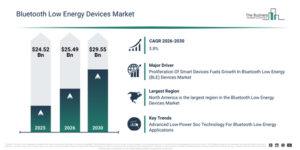
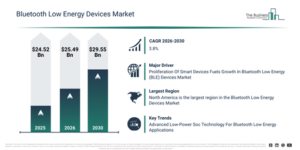
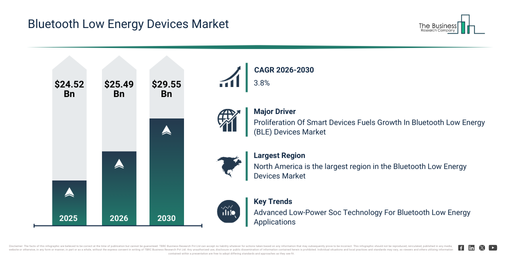
The market size for bluetooth low energy devices has demonstrated consistent growth in recent years. It is projected to expand from $24.52 billion in 2025 to $25.49 billion in 2026, driven by a compound annual growth rate (CAGR) of 4.0%. The growth observed in the past can be attributed to several factors including the expansion of wireless sensor networks, the increasing prevalence of smartphones, the demand for low-power communication standards, early integration into fitness wearables, and the wider availability of bluetooth-enabled consumer devices.
The market for Bluetooth Low Energy devices is projected to experience consistent expansion over the upcoming years. It is anticipated to reach $29.55 billion by 2030, driven by a compound annual growth rate (CAGR) of 3.8%. This growth during the forecast period can be attributed to the rapid expansion of IoT ecosystems, increasing adoption of smart healthcare solutions, development in connected automotive applications, enhanced deployment of smart retail infrastructure, and advancements in low-power semiconductor design. Major trends observed in this period include the rising use of BLE in smart home devices, its growing integration into wearable electronics, an increasing application of BLE for medical monitoring, the expansion of BLE-based asset and location tracking, and a heightened demand for ultra-low power wireless connectivity.
Download A Free Sample Report For Comprehensive Market Insights:
Bluetooth Low Energy Devices Market Growth Drivers: What Factors Are Accelerating Expansion?
The increasing spread of smart devices is anticipated to drive the expansion of the bluetooth low-energy devices market in the future. Smart devices are internet-linked electronic gadgets capable of gathering, processing, and sending data, which facilitates automation, remote management, and improved features over conventional devices. The uptake of smart devices has risen significantly because of their effortless incorporation into everyday routines, fostering a move towards interconnected ways of living. Bluetooth low energy devices allow smart devices to accomplish effective wireless communication using very little power, thereby boosting connectivity and utility in diverse uses like wearables, home automation, and health tracking. For example, a study conducted by Secure Data Recovery, a US-based expert data recovery firm, reported in November 2023 that the usage of smart home devices among Americans saw a substantial rise, with the proportion of U.S. households employing this technology growing from 6.9% to 22.3% in 2023. Connecticut, Utah, and Maryland are prominent states in smart home adoption, with 28.2%, 27.8%, and 27.6% of their residents utilizing smart technology, respectively. Consequently, the widespread use of smart devices is fueling the expansion of the Bluetooth low-energy devices market.
Bluetooth Low Energy Devices Market Segmentation: How Is The Market Structured Across Key Categories?
The bluetooth low energy devices market covered in this report is segmented –
1) By Product Type: Module, Chipset
2) By Mode: Single Mode, Dual Mode
3) By Application: Automotive, Consumer Electronics, Healthcare, Building And Retail, Other Applications
Subsegments:
1) By Module: Integrated Modules, Standalone Modules, System-On-Module (SoM)
2) By Chipset: Single-Mode Chipset, Dual-Mode Chipset, Multi-Mode Chipset
Bluetooth Low Energy Devices Market Trends: What Is Shaping Future Industry Growth?
Leading companies in the bluetooth low energy (BLE) devices market are concentrating on developing innovative system-on-chip (SoC) solutions to offer advanced functionality to end users. An SoC is an integrated circuit that merges multiple electronic components and functionalities onto a single chip, encompassing all essential elements for Bluetooth communication. For instance, in May 2025, Renesas Electronics Corporation, a Japan-based semiconductor manufacturer, unveiled a Bluetooth Low Energy SoC featuring an Arm Cortex-M0+ microcontroller integrated with a radio transceiver, memory, and peripherals. The Renesas DA14533 BLE SoC achieves ultra-low power consumption, with an active transmission current of approximately 3.1 mA, a reception current of 2.5 mA, and a hibernation mode current of around 500 nA, making it perfect for battery-powered automotive applications. Its single crystal oscillator design, coupled with an integrated DC-DC buck converter, lessens the demand for external components and reduces overall system costs.
Bluetooth Low Energy Devices Market Competitive Landscape And Leading Companies
Major companies operating in the bluetooth low energy devices market are Amazon Inc., Apple Inc., Samsung Electronics Co. Ltd, Huawei Technologies Co. Ltd., Sony Corporation, Lenovo Group Ltd, Panasonic Corporation, Qualcomm Incorporated, Telefonaktiebolaget LM Ericsson, Nokia Corporation, Toshiba Corporation, Texas Instruments Incorporated, Koninklijke Philips NV, MediaTek Inc., Tokyo Denki Kagaku Kōgyō Corporation, Infineon Technologies AG, Murata Manufacturing Co. Ltd, NXP Semiconductors N.V., Microchip Technology Incorporated, Cypress Semiconductor Corporation, Silicon Laboratories Inc, Nordic Semiconductor ASA, Espressif Systems, Atmosic Technologies, Telink Semiconductor
Access The Complete Bluetooth Low Energy Devices Market Report:
Bluetooth Low Energy Devices Market Geographic Landscape: Which Region Dominates Industry Growth?
North America was the largest region in the bluetooth low energy devices market in 2025. Asia-Pacific is expected to be the fastest-growing region in the forecast period. The regions covered in the bluetooth low energy devices market report are Asia-Pacific, South East Asia, Western Europe, Eastern Europe, North America, South America, Middle East, Africa.
Get in touch with us:
The Business Research Company: https://www.thebusinessresearchcompany.com/
Americas: +1 310-496-7795
Asia: +44 7882 955267 & +91 8897263534
Europe: +44 7882 955267
Email us at: marketing@tbrc.info
Follow us on:
LinkedIn: https://in.linkedin.com/company/the-business-research-company
YouTube: https://www.youtube.com/channel/UC24_fI0rV8cR5DxlCpgmyFQ
Global Market Model: https://www.thebusinessresearchcompany.com/global-market-model

Wasay has over a decade of experience in market research, data modelling, and analytics, with prior experience at GlobalData and Decision Tree Consulting Services. At The Business Research Company , he leads research operations across syndicated studies, customized consulting engagements, and the Global Market Model platform. His professional experience includes supporting organizations such as Boston Consulting Group, KPMG, and Ernst & Young. Wasay holds a degree in Electronics and Communications Engineering, postgraduate management qualifications from International Management Institute Belgium and Indian School of Business and Entrepreneurship, and completed the Integrated Program in Business Analytics from Indian Institute of Management Indore.