Enhanced with market attractiveness analysis, total addressable market evaluation, company benchmarking matrices, interactive Excel dashboards, expanded supply chain intelligence, emerging startup coverage, and detailed product insights, The Business Research Company’s 2026 market reports deliver more actionable and strategically valuable research.
Dynamic Vision Sensors Market CAGR Analysis And Future Market Development
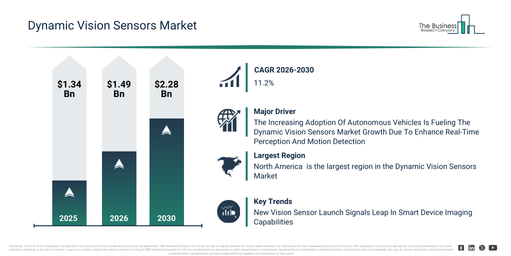
The dynamic vision sensors market has experienced swift expansion recently. This market is projected to expand from $1.34 billion in 2025 to $1.49 billion in 2026, demonstrating a compound annual growth rate (CAGR) of 11.2%. Historically, this growth has stemmed from several factors, including the increasing integration of machine vision in industrial automation, the inherent limitations of frame-based sensors in high-speed settings, a rising need for low-power vision solutions, progress in neuromorphic engineering research, and initial deployment in robotics and surveillance applications.
The dynamic vision sensors market is projected to experience substantial expansion over the next few years. It is anticipated to achieve a valuation of $2.28 billion by 2030, growing at a compound annual growth rate (CAGR) of 11.2%. This growth throughout the forecast period is fueled by the increased adoption of autonomous robots and vehicles, a rising need for real-time edge vision processing, the integration of DVS with AI accelerators, the growing demand for energy-efficient sensing technologies, and broadening applications within smart manufacturing and healthcare. Key trends during this period are expected to include ultra-low-latency vision processing, event-based sensing designed for high-speed motion capture, reductions in data bandwidth and power consumption, sensor fusion with conventional imaging systems, and the miniaturization of vision sensors for embedded systems.
Download A Free Sample Report For Comprehensive Market Insights:
Dynamic Vision Sensors Market Expansion Supported By Key Demand Factors
The projected expansion of the dynamic vision sensors market is linked to the rising prevalence of autonomous vehicles. These self-driving vehicles operate and navigate independently, relying on a combination of sensors, cameras, artificial intelligence, and machine learning algorithms, thus requiring no human involvement. The growing acceptance of autonomous vehicles stems from progress in artificial intelligence (AI) and light detection and ranging (LiDAR) sensor technologies, which improve real-time decision-making and environmental awareness, leading to safer and more efficient journeys. Dynamic vision sensors (DVS) are instrumental for autonomous vehicles, delivering rapid, low-latency visual data essential for accurate real-time motion detection and obstacle tracking, even when lighting conditions are difficult. For example, reports from June 2024 by the Organisation for Economic Co-operation and Development (OECD), a France-based intergovernmental transport body, indicate that governments and cities broadened their autonomous vehicle (AV) testing and pilot initiatives in 2023 compared to 2022, facilitating larger trials for shared automated shuttles and robotaxi services. Additionally, in June 2023, the U.S. National Highway Traffic Safety Administration, a US-based government safety agency, noted an increase in advanced driver-assistance systems (ADS) testing and safety-focused research, signifying a rise in operational trials during 2023 compared with 2022. Consequently, the expanding use of autonomous vehicles is a key factor propelling the expansion of the dynamic vision sensors market.
Dynamic Vision Sensors Market Segmentation: How Is The Market Structured Across Key Categories?
The dynamic vision sensors market covered in this report is segmented –
1) By Component: Hardware, Software, Services
2) By Technology: Event, Frame, Hybrid (Event + Frame), Time-Of-Flight, Complementary Metal-Oxide-Semiconductor (CMOS), Other Technologies
3) By Functionality: Three-Dimensional (3D) Vision Sensing, Two-Dimensional (2D) Vision Sensing, Image Processing, Motion Detection
4) By Application: Machine Vision, Robotics, Autonomous Vehicles, Security Systems
5) By End-User: Automotive, Consumer Electronics, Industrial, Healthcare, Robotics, Other End-Users
Subsegments:
1) By Hardware: Image Sensors, Lens Modules, Processing Units, Power Supply Units, Interface Components
2) By Software: Firmware, Driver Software, Image Processing Software, Computer Vision Algorithms, Analytics Platforms
3) By Services: Installation Services, Maintenance Services, Consulting Services, Integration Services, Training Services
Dynamic Vision Sensors Market Innovation Trends: Which Developments Are Transforming The Industry?
Major companies within the dynamic vision sensors market are concentrating on creating advanced products, such as ultra-low-power event-based vision sensors, to improve real-time motion detection and energy efficiency. These ultra-low-power event-based vision sensors function as cameras that detect alterations in a scene asynchronously, focusing solely on moving objects while using very little energy. Their utility lies in enabling quicker, more efficient motion detection and lowering device power consumption. For example, in October 2023, Prophesee SA, a France-based semiconductor manufacturing firm, introduced the GenX320 event-based metavision sensor, recognized as the industry’s smallest and most power-efficient event-based vision sensor. The GenX320 incorporates a 320×320 6.3μm pixel BSI stacked design within a compact 3x4mm die, providing a 1/5” optical format. It offers microsecond-level timestamping for events, on-chip intelligent power management that decreases consumption to as little as 36 µW, and includes support for deep sleep and standby modes. Furthermore, the sensor facilitates straightforward integration with standard SoCs via MIPI or CPI interfaces, features on-chip data preprocessing, and generates AI-ready histogram outputs compatible with various AI accelerators.
Dynamic Vision Sensors Market Competitive Landscape And Leading Companies
Major companies operating in the dynamic vision sensors market are Samsung Electronics Co. Ltd., Sony Group Corporation, Infineon Technologies AG, STMicroelectronics N.V., Analog Devices Inc., ON Semiconductor Corporation, Pepperl+Fuchs SE, Himax Technologies Inc., GalaxyCore Inc., Austrian Institute of Technology GmbH, PixArt Imaging Inc., IDS Imaging Development Systems GmbH, Prophesee S.A., pmdtechnologies ag, SynSense AG, Innatera Nanosystems B.V., iniLabs AG, CenturyArks Co. Ltd., AlpsenTek Co. Ltd., Zivid AS
Access The Complete Dynamic Vision Sensors Market Report:
Dynamic Vision Sensors Market Largest Region By Revenue And Market Share
North America was the largest region in the dynamic vision sensors market in 2025. Asia-Pacific is expected to be the fastest-growing region in the forecast period. The regions covered in the dynamic vision sensors market report are Asia-Pacific, South East Asia, Western Europe, Eastern Europe, North America, South America, Middle East, Africa.
Get in touch with us:
The Business Research Company: https://www.thebusinessresearchcompany.com/
Americas: +1 310-496-7795
Asia: +44 7882 955267 & +91 8897263534
Europe: +44 7882 955267
Email us at: marketing@tbrc.info
Follow us on:
LinkedIn: https://in.linkedin.com/company/the-business-research-company
YouTube: https://www.youtube.com/channel/UC24_fI0rV8cR5DxlCpgmyFQ
Global Market Model: https://www.thebusinessresearchcompany.com/global-market-model

Wasay has over a decade of experience in market research, data modelling, and analytics, with prior experience at GlobalData and Decision Tree Consulting Services. At The Business Research Company , he leads research operations across syndicated studies, customized consulting engagements, and the Global Market Model platform. His professional experience includes supporting organizations such as Boston Consulting Group, KPMG, and Ernst & Young. Wasay holds a degree in Electronics and Communications Engineering, postgraduate management qualifications from International Management Institute Belgium and Indian School of Business and Entrepreneurship, and completed the Integrated Program in Business Analytics from Indian Institute of Management Indore.