Enhanced with market attractiveness analysis, total addressable market evaluation, company benchmarking matrices, interactive Excel dashboards, expanded supply chain intelligence, emerging startup coverage, and detailed product insights, The Business Research Company’s 2026 market reports deliver more actionable and strategically valuable research.
#Electric Vehicle (EV) Batteries Market Size And Revenue Forecast Through 2030
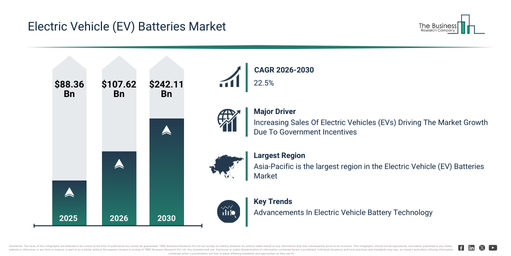
The market for electric vehicle (EV) batteries has experienced significant growth over recent years. It is anticipated to increase from $88.36 billion in 2025 to $107.62 billion in 2026, achieving a compound annual growth rate (CAGR) of 21.8%. This historical expansion can be linked to the increasing adoption of passenger electric vehicles, the development of lithium-ion manufacturing capacity, advancements in cell energy density along with cost reductions, supportive government incentives for electrification, and the growth in global EV charging infrastructure.
The electric vehicle (EV) batteries market size is projected to experience substantial growth over the coming years, anticipated to reach $242.11 billion by 2030, exhibiting a compound annual growth rate (CAGR) of 22.5%. This expansion during the forecast period can be attributed to the proliferation of gigafactories and localized cell manufacturing, a rise in demand for solid-state and advanced battery technologies, more stringent regulations concerning battery recycling and producer obligations, the expansion of commercial EV fleets and heavy-duty electric vehicles, and the increasing adoption of battery-as-a-service and subscription models. Key trends expected within the forecast period encompass developments in high-energy-density cell chemistries, compatibility with rapid-charging infrastructure, the expansion of markets for battery second-life and repurposing, the vertical integration of battery cell production, and a focus on cell-to-pack as well as pack-level thermal management.
Download A Free Sample Report For Comprehensive Market Insights:
Electric Vehicle (EV) Batteries Market Growth Drivers: What Factors Are Accelerating Expansion?
The electric vehicle (EV) batteries market is anticipated to expand moving forward, driven by the rising sales of electric vehicles (EVs). Specifically, electric vehicle sales encompass the volume of battery electric vehicles and plug-in hybrid electric vehicles acquired by consumers for use in transport. This increase in EV sales is attributable to governmental policy support and financial stimuli, where federal tax credits and state-level rebates decrease the initial expense of EVs, thereby enhancing their affordability and availability for a wider consumer base. The expanding adoption of electric vehicles necessitates advanced battery systems, given that every EV needs a substantial lithium-ion battery pack for its power, consequently generating a corresponding demand for battery production and provision. As an illustration, in January 2024, data from the U.S. Department of Energy, a federal agency based in the US, showed that plug-in electric vehicle sales climbed from 6.8% of all light-duty vehicle sales in 2022 to 9.1% in 2023, marking a 2.3 percentage point rise in market share. Consequently, the growing sales of electric vehicles (EVs) are fueling the expansion of the electric vehicle (EV) batteries market.
Electric Vehicle (EV) Batteries Market Segment Breakdown: Which Categories Generate The Most Revenue?
The electric vehicle (EV) batteries market covered in this report is segmented –
1) By Battery Type: Lithium-Ion, Lead-Acid, Nickel-Metal Hydride, Others
2) By Vehicle Type: Passenger Vehicles, Commercial Vehicles
3) By Propulsion: Battery Electric Vehicle (BEV), Plug-In Hybrid Electric Vehicle (PHEV), Hybrid Electric Vehicles, Fuel Cell Electric Vehicles.
Subsegments:
1) By Lithium-Ion Batteries: Lithium Iron Phosphate (LiFePO4), Lithium Nickel Manganese Cobalt (NMC), Lithium Nickel Cobalt Aluminum Oxide (NCA), Lithium Manganese Oxide (LMO), Other Lithium-Ion Variants
2) By Lead-Acid Batteries: Flooded Lead-Acid (FLA), Absorbed Glass Mat (AGM), Gel Lead-Acid
3) By Nickel-Metal Hydride Batteries: Standard Nickel-Metal Hydride, Advanced Nickel-Metal Hydride
4) By Others: Solid-State Batteries, Flow Batteries, Other Emerging Battery Technologies
Electric Vehicle (EV) Batteries Market Innovation Trends: Which Developments Are Transforming The Industry?
Major companies in the electric vehicle (EV) batteries market are developing sophisticated products, such as lithium iron phosphate (LiFePO4) batteries, to deliver superior safety, extended cycle life, thermal stability, and high discharge capabilities. A lithium iron phosphate (LiFePO4) battery is a rechargeable lithium-ion battery type renowned for its safety, thermal resilience, long cycle life, and strong power output, making it suitable for applications in electric vehicles, renewable energy storage, and portable devices. For example, in June 2024, Geely, a China-based automobile manufacturer, launched its Aegis Short Blade Battery. This Aegis Short Blade Battery offers an energy density of 192 Wh/kg and an impressive cycle life of up to 3,500 cycles, enabling it to power vehicles for approximately 1 million kilometers with minimal range impact. With a service life extending up to 50 years, this battery significantly boosts the longevity and residual value of used cars. It effectively addresses the high internal resistance issue found in many long blade batteries by employing long, thin carbon nanotubes to create a “highway” for ion transmission, along with additives that enhance film permeability for easier lithium ion movement between electrodes. Consequently, the Aegis Short Blade Battery provides excellent fast-charging performance, achieving 80 percent capacity in an average charging time of just 17 minutes and 4 seconds at a charging rate of 2.45 C, in contrast to the 26 minutes and 1.61 C rate typical of other long blade batteries of similar capacity.
Electric Vehicle (EV) Batteries Market Key Players And Strategic Industry Positioning
Major companies operating in the electric vehicle (EV) batteries market are LG Energy Solution Ltd, Samsung SDI Co. Ltd, SK Innovation Co. Ltd, Panasonic Corporation, Contemporary Amperex Technology Co. Ltd, BYD Co. Ltd, GS Yuasa Corporation, Tianneng Power International Ltd, SVOLT Energy Technology Co, Ltd, EVTronic, Britishvolt, Aceleron, Williams Advanced Engineering, Zenobe, Northvolt, Verkor, Italvolt, Fortum, ElecSys, Volkswagen, BMW, Groupe Renault, SAFT, AKOM, InoBat Auto, Ligier Group, Polaris Industries, Skoda Auto, Proterra, BMZ Inc, Microvast, Romeo Power, Quantumscape Corporation, Horwin, Byvin, HDK Electric Vehicles, Shandong Shifeng (Group), Speedway Electric, Eleksa EV, Melex Electrovehicles, Mazibuko Motor Company, El Nasr Automotive Manufacturing Company, Jet Motors
Access The Complete Electric Vehicle (EV) Batteries Market Report:
Electric Vehicle (EV) Batteries Market Regional Outlook: Where Are The Largest Opportunities Located?
Asia-Pacific was the largest region in the electric vehicle batteries market in 2025. Western Europe was the second-largest region in the global electric vehicle batteries market share. The regions covered in the electric vehicle (EV) batteries market report are Asia-Pacific, South East Asia, Western Europe, Eastern Europe, North America, South America, Middle East, Africa.
Get in touch with us:
The Business Research Company: https://www.thebusinessresearchcompany.com/
Americas: +1 310-496-7795
Asia: +44 7882 955267 & +91 8897263534
Europe: +44 7882 955267
Email us at: marketing@tbrc.info
Follow us on:
LinkedIn: https://in.linkedin.com/company/the-business-research-company
YouTube: https://www.youtube.com/channel/UC24_fI0rV8cR5DxlCpgmyFQ
Global Market Model: https://www.thebusinessresearchcompany.com/global-market-model

Wasay has over a decade of experience in market research, data modelling, and analytics, with prior experience at GlobalData and Decision Tree Consulting Services. At The Business Research Company , he leads research operations across syndicated studies, customized consulting engagements, and the Global Market Model platform. His professional experience includes supporting organizations such as Boston Consulting Group, KPMG, and Ernst & Young. Wasay holds a degree in Electronics and Communications Engineering, postgraduate management qualifications from International Management Institute Belgium and Indian School of Business and Entrepreneurship, and completed the Integrated Program in Business Analytics from Indian Institute of Management Indore.