Delivering more actionable and strategically valuable research, The Business Research Company’s 2026 market reports feature market attractiveness analysis, total addressable market evaluation, company benchmarking matrices, interactive Excel dashboards, expanded supply chain intelligence, emerging startup coverage, and detailed product insights.
Electric Vehicle (EV) Sensor Market Forecast Highlighting Growth From $11.57 Billion To $18.05 Billion
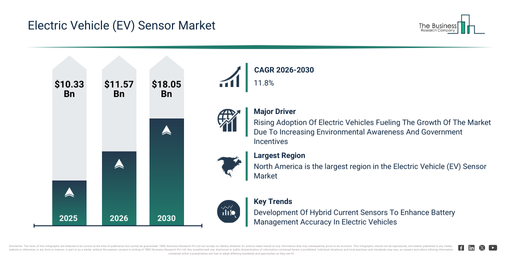
The electric vehicle (EV) sensor market has experienced substantial expansion in recent years. Its size is projected to escalate from $10.33 billion in 2025 to $11.57 billion in 2026, progressing at a compound annual growth rate (CAGR) of 12.1%. The increase observed historically stems from the heightened integration of temperature sensing in EVs, the development of pressure and current measurement solutions, an initial demand for overseeing safety and efficiency, the broadening of battery management systems, and an increase in motor control sensing.
The electric vehicle (EV) sensor market is projected to experience substantial expansion over the coming years. Its valuation is anticipated to reach $18.05 billion by 2030, demonstrating a compound annual growth rate (CAGR) of 11.8%. This anticipated growth during the forecast period is fueled by several factors, including the escalating production of bev, hev, and phev models, a heightened need for sophisticated position and speed sensors, stricter EV safety regulations, the growing intricacy of power electronics, and the proliferation of intelligent vehicle platforms. Key developments expected within this period involve the greater integration of EV-focused sensors, the implementation of AI-driven vehicle sensing technologies, an increase in IoT-enabled vehicle diagnostic solutions, enhancements in autonomous mobility safety systems, and a wider deployment of digital sensor monitoring.
Download A Free Sample Report For Comprehensive Market Insights:
Electric Vehicle (EV) Sensor Market Development Factors: Which Trends Are Supporting Demand?
The increasing integration of electric vehicles (EVs) is anticipated to boost the expansion of the electric vehicle (EV) sensors market moving forward. An electric vehicle (EV) functions as a form of transportation primarily or entirely powered by electricity, utilizing electric motors instead of internal combustion engines. The rising adoption of electric vehicles stems from growing environmental awareness and governmental incentives promoting clean and sustainable transport. EV sensors are instrumental in monitoring and controlling crucial operations such as battery performance, motor speed, temperature, and safety systems, ensuring efficient and reliable vehicle operation. For example, in April 2024, the International Energy Agency (IEA), a France-based intergovernmental organization, reported that new electric car registrations in China reached 8.1 million in 2023, signifying a 35% increase compared to 2022. Thus, the escalating adoption of electric vehicles is propelling the growth of the electric vehicle (EV) sensors market.
Electric Vehicle (EV) Sensor Market Segment Outlook: Which Categories Are Expanding The Fastest?
The electric vehicle (EV) sensor market covered in this report is segmented –
1) By Product Type: Temperature Sensors, Current Sensors, Position Sensors, Pressure Sensors, Speed Sensors
2) By Propulsion: Battery Electric Vehicles (BEVs), Hybrid Electric Vehicles (HEVs), Plug-In Hybrid Electric Vehicles (PHEVs)
3) By Sales Channel: OEM (Original Equipment Manufacturer), Aftermarket
Subsegments:
1) By Temperature Sensors: Thermocouples, Thermistors, Infrared Sensors
2) By Current Sensors: Hall Effect Sensors, Shunt Resistors, Rogowski Coils
3) By Position Sensors: Linear Position Sensors, Rotary Position Sensors, Magnetic Position Sensors
4) By Pressure Sensors: Absolute Pressure Sensors, Gauge Pressure Sensors, Differential Pressure Sensors
5) By Speed Sensors: Wheel Speed Sensors, Engine Speed Sensors, Transmission Speed Sensors
Electric Vehicle (EV) Sensor Market Strategic Trends: What Is Defining The Next Phase Of Growth?
Major companies in the electric vehicle (EV) sensor market are focusing on developing innovative solutions, such as hybrid current sensors that combine shunt-based and Hall-effect technologies. This initiative aims to meet the escalating demand for greater battery management system accuracy, stricter safety standards (ASIL-D), reduced physical size, and lower system costs in EVs. A hybrid current sensor integrates a low-resistance shunt element, which measures high currents through voltage drop, with an open-loop Hall-effect transducer, which provides galvanic isolation and magnetic field sensing. Unlike conventional single-technology sensors, this solution delivers both direct high-current measurement and isolated sensing within one module, enabling more compact integration and redundant measurement paths for safety-critical applications. For example, in June 2025, LEM International SA, a Switzerland-based sensor manufacturer, introduced the Hybrid Supervising Unit (HSU), an innovative sensor unit for EV battery management systems that unifies both shunt and Hall-effect technologies in a single component. The HSU features a shunt resistance of 25 µΩ, supports current measurement up to ±2,000 A for 10 seconds, and operates within a temperature range of –40 °C to +125 °C. Its Hall-effect section ensures galvanic isolation with an accuracy of ~2 % at 500 A and ~5 % at 2,000 A. Designed for standard busbar footprints (84×36×3 mm for HSU00 and 84×20×3 mm for HSU01), the HSU empowers system developers to achieve ASIL-D safety levels while simultaneously decreasing bill of material (BOM) cost, physical footprint, and integration effort.
Electric Vehicle (EV) Sensor Market Key Companies And Competitive Benchmarking
Major companies operating in the electric vehicle (EV) sensor market are Denso Corporation, Infineon Technologies AG, NXP Semiconductors N.V., Texas Instruments Incorporated, LEM Holding SA, Kohshin Electric Corporation, Vishay Intertechnology Inc., Allegro MicroSystems Inc., Amphenol Corporation, ams-OSRAM AG, Analog Devices Inc., Melexis NV, Sensata Technologies Inc., STMicroelectronics N.V., Renesas Electronics Corporation, TE Connectivity, Continental AG, Robert Bosch GmbH, ZF Friedrichshafen AG, Valeo SA, CTS Corporation, Honeywell International Inc., Kistler Group, Methode Electronics Inc., Panasonic Corporation, TDK Corporation, Aptiv plc, AVX Corporation, Bourns Inc., Hella Inc.
Access The Complete Electric Vehicle (EV) Sensor Market Report:
Electric Vehicle (EV) Sensor Market Geographic Analysis: Where Is Demand Growing The Fastest?
North America was the largest region in the electric vehicle (EV) sensor market in 2025. The regions covered in the electric vehicle (EV) sensor market report are Asia-Pacific, South East Asia, Western Europe, Eastern Europe, North America, South America, Middle East, Africa.
Get in touch with us:
The Business Research Company: https://www.thebusinessresearchcompany.com/
Americas: +1 310-496-7795
Asia: +44 7882 955267 & +91 8897263534
Europe: +44 7882 955267
Email us at: marketing@tbrc.info
Follow us on:
LinkedIn: https://in.linkedin.com/company/the-business-research-company
YouTube: https://www.youtube.com/channel/UC24_fI0rV8cR5DxlCpgmyFQ
Global Market Model: https://www.thebusinessresearchcompany.com/global-market-model

Wasay has over a decade of experience in market research, data modelling, and analytics, with prior experience at GlobalData and Decision Tree Consulting Services. At The Business Research Company , he leads research operations across syndicated studies, customized consulting engagements, and the Global Market Model platform. His professional experience includes supporting organizations such as Boston Consulting Group, KPMG, and Ernst & Young. Wasay holds a degree in Electronics and Communications Engineering, postgraduate management qualifications from International Management Institute Belgium and Indian School of Business and Entrepreneurship, and completed the Integrated Program in Business Analytics from Indian Institute of Management Indore.