Delivering more actionable and strategically valuable research, The Business Research Company’s 2026 market reports feature market attractiveness analysis, total addressable market evaluation, company benchmarking matrices, interactive Excel dashboards, expanded supply chain intelligence, emerging startup coverage, and detailed product insights.
Electrical And Electronics Ceramics Market Size Forecast: How Large Could The Market Become By 2030?
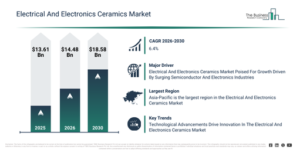
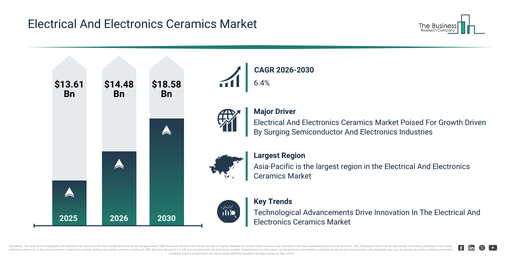
The market size for electrical and electronics ceramics has experienced robust growth in recent years. This market is anticipated to expand from $13.61 billion in 2025 to $14.48 billion in 2026, achieving a compound annual growth rate (CAGR) of 6.4%. The historical increase can be attributed to various factors, such as a rise in the adoption of ceramics in consumer electronics, greater utilization for automotive electronic components, an increase in medical device applications, the expansion of energy storage and conversion applications, and their growing use in industrial and optical applications.
The electrical and electronics ceramics market is anticipated to undergo significant expansion over the next few years. This sector is forecast to reach $18.58 billion by 2030, demonstrating a compound annual growth rate (CAGR) of 6.4%. This projected growth can be attributed to an increase in advanced ceramic material production, rising deployment in high-performance electronics, the expansion of ceramic coatings and composites, broader applications in wearable and mobile devices, and increasing integration into smart devices. Prominent trends for the forecast period include the incorporation of AI into electronic ceramics, the adoption of smart manufacturing for ceramics, the deployment of IoT-enabled ceramics monitoring, the implementation of predictive maintenance for electronic components, and the expansion of high-performance ceramic applications.
Download A Free Sample Report For Comprehensive Market Insights:
Electrical And Electronics Ceramics Market Growth Drivers: What Factors Are Accelerating Expansion?
The expansion of the semiconductor and electronics industry is projected to drive the future growth of the electrical and electronics ceramics market. Semiconductors are defined as substances possessing resistance levels intermediate to those of conductors and insulators. They find extensive application within the electronics sector and in electronic components like diodes, transistors, and integrated circuits. Electrical ceramics, also identified as piezoelectric ceramics, are increasingly favored in consumer electronics, owing to their straightforward manufacturing into diverse shapes and dimensions, significantly contributing to the miniaturization of electromechanical features. For example, in February 2025, the Semiconductor Industry Association, a U.S.-based non-profit trade association, reported that worldwide semiconductor sales reached $627.6 billion in 2024, marking a 19.1% rise compared to 2023. Consequently, the expanding semiconductor and electronics sectors are expected to fuel the growth of the electrical and electronics ceramics market in the immediate future.
Electrical And Electronics Ceramics Market Segmentation: How Is The Market Structured Across Key Categories?
The electrical and electronics ceramics market covered in this report is segmented –
1) By Product: Monolithic Ceramics, Ceramics Matrix Composites, Ceramics Coatings, Other Products
2) By Material: Alumina Ceramics, Titanate Ceramics, Zirconia Ceramics, Silica Ceramics, Other Materials
3) By End-User: Home Appliances, Power Grids, Medical Devices, Mobile Phones, Other End-Users
Subsegments:
1) By Monolithic Ceramics: Alumina Ceramics, Zirconia Ceramics, Silicon Nitride Ceramics, Barium Titanate Ceramics
2) By Ceramic Matrix Composites: Carbon Fiber Reinforced Ceramics, Silicon Carbide Matrix Composites, Oxide Matrix Composites
3) By Ceramic Coatings: Thermal Barrier Coatings, Wear-resistant Coatings, Electrical Insulation Coatings
4) By Other Products: Piezoelectric Ceramics, Ferrite Ceramics, Transparent Ceramics
Electrical And Electronics Ceramics Market Trends: What Is Shaping Future Industry Growth?
Prominent companies operating in the electrical and electronics ceramics market are concentrating on developing technologically advanced products, such as high-performance ceramic substrates for power electronics, to improve efficiency, reliability, and thermal management across various electronic applications. High-performance ceramic substrates for power electronics are defined as advanced materials engineered to support electronic circuits and components, particularly in environments involving high temperatures and high voltages. For instance, in June 2024, CeramTec, a Germany-based chemical industry company, unveiled a new ceramic substrate named Sinalit, fabricated from silicon nitride (Si3N4), with the aim of expanding its portfolio in the power electronics sector. This innovative product demonstrates high thermal conductivity and excellent electrical insulation properties, rendering it appropriate for a multitude of applications. Sinalit is slated to be showcased at the upcoming PCIM Europe trade fair in Nuremberg, signifying CeramTec’s commitment to delivering advanced solutions within the ceramics industry.
Electrical And Electronics Ceramics Market Competitive Landscape And Leading Companies
Major companies operating in the electrical and electronics ceramics market are CeramTec GmbH, CoorsTek Inc., Kyocera Corporation, Mantec Technical Ceramics Ltd., Morgan Advanced Materials plc, NGK Spark Plug Co. Ltd., Rauschert Steinbach GmbH, Vinayak Techno Ceramics, Ravikiran Ceramics Pvt. Ltd., Anoop Ceramics, Aum Metals And Techno-Ceramics Private Limited, Ceradyne Inc., TDK Corporation, Hitachi Metals Ltd., Toshiba Materials Co. Ltd., Corning Gilbert Inc., Saint-Gobain Ceramic & Plastics Inc., Ferro Electronic Materials Systems, Murata Manufacturing Co. Ltd., Taiyo Yuden Co., Ltd., Maruwa Co. Ltd., KEMET Corporation, Vishay Intertechnology Inc., AVX Corporation, Yageo Corporation, Samsung Electro-Mechanics Co. Ltd., Superior Technical Ceramics, American Technical Ceramics Corp.
Access The Complete Electrical And Electronics Ceramics Market Report:
Electrical And Electronics Ceramics Market Leading Geography: Which Region Generates The Most Revenue?
Asia-Pacific was the largest region in the electrical and electronics ceramics market in 2025. Asia-Pacific is expected to be the fastest-growing region in the electrical and electronics ceramics market during the forecast period. The regions covered in the electrical and electronics ceramics market report are Asia-Pacific, South East Asia, Western Europe, Eastern Europe, North America, South America, Middle East, Africa.
Get in touch with us:
The Business Research Company: https://www.thebusinessresearchcompany.com/
Americas: +1 310-496-7795
Asia: +44 7882 955267 & +91 8897263534
Europe: +44 7882 955267
Email us at: marketing@tbrc.info
Follow us on:
LinkedIn: https://in.linkedin.com/company/the-business-research-company
YouTube: https://www.youtube.com/channel/UC24_fI0rV8cR5DxlCpgmyFQ
Global Market Model: https://www.thebusinessresearchcompany.com/global-market-model

Wasay has over a decade of experience in market research, data modelling, and analytics, with prior experience at GlobalData and Decision Tree Consulting Services. At The Business Research Company , he leads research operations across syndicated studies, customized consulting engagements, and the Global Market Model platform. His professional experience includes supporting organizations such as Boston Consulting Group, KPMG, and Ernst & Young. Wasay holds a degree in Electronics and Communications Engineering, postgraduate management qualifications from International Management Institute Belgium and Indian School of Business and Entrepreneurship, and completed the Integrated Program in Business Analytics from Indian Institute of Management Indore.