Delivering more actionable and strategically valuable research, The Business Research Company’s 2026 market reports feature market attractiveness analysis, total addressable market evaluation, company benchmarking matrices, interactive Excel dashboards, expanded supply chain intelligence, emerging startup coverage, and detailed product insights.
Electromagnetic Compatibility (EMC) Filtration Market Forecast: What Market Value Is Expected By 2030?
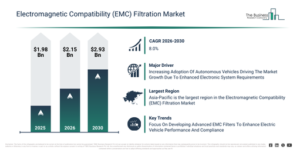
The electromagnetic compatibility (EMC) filtration market has witnessed robust expansion over the past few years. This market is expected to increase from $1.98 billion in 2025 to $2.15 billion in 2026, achieving a compound annual growth rate (CAGR) of 8.3%. The historical drivers for this growth include the early incorporation of passive filters into consumer electronics, the deployment of active power filters in industrial apparatus, the expanding telecommunication infrastructure necessitating EMC compliance, regulatory benchmarks for EMI suppression, and the innovation of hybrid filters for automotive applications.
The electromagnetic compatibility (emc) filtration market is projected to experience robust expansion over the coming years. This market is set to reach $2.93 billion by 2030, exhibiting a compound annual growth rate (CAGR) of 8.0%. Factors contributing to this anticipated growth include a surging demand for electric mobility options, the proliferation of IoT-enabled smart devices, growing industrial automation, an increase in healthcare electronics needing EMC protection, and innovations in high-frequency and high-performance filtration technologies. Key trends anticipated during this period involve the integration of sophisticated passive and active EMC filters within electronic devices, the implementation of hybrid EMC filtration systems for industrial machinery, a greater reliance on surface mount and thin film technologies for creating compact filters, an expanding application of EMC filters in automotive and consumer electronics, and a need for high-performance EMC filtration within telecommunication networks.
Download A Free Sample Report For Comprehensive Market Insights:
#Electromagnetic Compatibility (EMC) Filtration Market Growth Factors: Which Forces Are Supporting Market Expansion?
The future expansion of the electromagnetic compatibility (EMC) filtration market is anticipated due to the growing integration of autonomous vehicles. These self-driving vehicles operate without direct human input, leveraging sophisticated sensors, artificial intelligence, and electronic control systems for navigation and decision-making. The increasing adoption of autonomous vehicles is fueled by rapid urbanization and smart city development, as expanding urban populations seek intelligent transport systems that enhance safety, reduce congestion, and facilitate smooth communication between vehicles and urban infrastructure. This growing adoption consequently boosts the need for EMC filtration systems, given that these vehicles depend on numerous interconnected electronic sensors and critical safety systems which necessitate strong electromagnetic interference suppression to operate flawlessly. For example, data from the National Highway Traffic Safety Administration, a US-based government agency, indicated in December 2024 that approximately 4.5 million self-driving vehicles are projected to be in operation on U.S. roads by 2030. Consequently, the rising prevalence of autonomous vehicles is a key factor boosting the electromagnetic compatibility (EMC) filtration market.
Electromagnetic Compatibility (EMC) Filtration Market Segment Breakdown: Which Categories Generate The Most Revenue?
The electromagnetic compatibility (emc) filtration market covered in this report is segmented –
1) By Type: Passive Filters, Active Filters, Hybrid Filters
2) By Technology: Surface Mount Technology, Through-Hole Technology, Thin Film Technology, Thick Film Technology
3) By Distribution Channel: Direct Sales, Distributors, Online Sales Channels
4) By Application: Consumer Electronics, Automotive, Industrial, Telecommunications, Healthcare
5) By End-User: Aftermarket, Original Equipment Manufacturers (OEMs)
Subsegments:
1) By Passive Filters: Low-Pass Filters, High-Pass Filters, Band-Pass Filters, Band-Stop Filters, Power Line Filters, Feedthrough Filters
2) By Active Filters: Active Power Filters (APF), Tuned Active Filters, Hybrid Active Power Filters (HAPF), Shunt Active Filters, Series Active Filters
3) By Hybrid Filters: Series Hybrid Filters, Parallel Hybrid Filters, Active-Passive Combination Filters, Tuned Hybrid Filters
Electromagnetic Compatibility (EMC) Filtration Market Innovation Trends: Which Developments Are Transforming The Industry?
Leading entities in the electromagnetic compatibility (EMC) filtration market are concentrating on creating innovative offerings, such as inverter-generated noise suppressor EMC filters, to elevate system efficiency and ensure adherence to stringent regulatory standards. These inverter-generated noise suppressor EMC filters work by minimizing high-frequency noise from inverters during power conversion, thereby enhancing signal clarity and safeguarding electronic components from interference to maintain stable system performance. As an illustration, in September 2025, TDK Corporation, a Japan-based electronic components company, unveiled CarXield, a new standardized EMC filter series specifically crafted for automotive inverters. The CarXield series supports both 500 V and 1000 V systems, addressing the diverse voltage requirements of contemporary electric vehicles. This introduction aims to significantly reduce development time for mid-sized e-mobility manufacturers by providing pre-validated EMI solutions. CarXield decreases inverter-to-battery interference to improve electromagnetic compatibility and enhance electric drivetrain performance, while its compact, standardized design facilitates easy integration into various automotive systems and accelerates the introduction of new electric mobility solutions.
Electromagnetic Compatibility (EMC) Filtration Market Key Players And Strategic Industry Positioning
Major companies operating in the electromagnetic compatibility (emc) filtration market are Panasonic Holdings Corporation, ABB Ltd., TE Connectivity plc, TDK Corporation, Murata Manufacturing Co. Ltd., Delta Electronics Inc., Amphenol Corporation, Yageo Corporation, Bourns Inc., Vishay Intertechnology Inc., Littelfuse Inc., Taiyo Yuden Co. Ltd., Würth Elektronik GmbH & Co. KG, Murrelektronik GmbH, COSEL Co. Ltd., Emitech Micro Inc., Johanson Dielectrics Inc., Premo Corporation S.L., REO AG, Total EMC Products Ltd., Roxburgh EMC Ltd.
Access The Complete Electromagnetic Compatibility (EMC) Filtration Market Report:
Electromagnetic Compatibility (EMC) Filtration Market Geographic Analysis: Where Is Demand Growing The Fastest?
Asia-Pacific was the largest region in the electromagnetic compatibility (EMC) filtration market in 2025. Asia-Pacific is expected to be the fastest-growing region in the forecast period. The regions covered in the electromagnetic compatibility (emc) filtration market report are Asia-Pacific, South East Asia, Western Europe, Eastern Europe, North America, South America, Middle East, Africa.
Get in touch with us:
The Business Research Company: https://www.thebusinessresearchcompany.com/
Americas: +1 310-496-7795
Asia: +44 7882 955267 & +91 8897263534
Europe: +44 7882 955267
Email us at: marketing@tbrc.info
Follow us on:
LinkedIn: https://in.linkedin.com/company/the-business-research-company
YouTube: https://www.youtube.com/channel/UC24_fI0rV8cR5DxlCpgmyFQ
Global Market Model: https://www.thebusinessresearchcompany.com/global-market-model

Wasay has over a decade of experience in market research, data modelling, and analytics, with prior experience at GlobalData and Decision Tree Consulting Services. At The Business Research Company , he leads research operations across syndicated studies, customized consulting engagements, and the Global Market Model platform. His professional experience includes supporting organizations such as Boston Consulting Group, KPMG, and Ernst & Young. Wasay holds a degree in Electronics and Communications Engineering, postgraduate management qualifications from International Management Institute Belgium and Indian School of Business and Entrepreneurship, and completed the Integrated Program in Business Analytics from Indian Institute of Management Indore.