Delivering more actionable and strategically valuable research, The Business Research Company’s 2026 market reports feature market attractiveness analysis, total addressable market evaluation, company benchmarking matrices, interactive Excel dashboards, expanded supply chain intelligence, emerging startup coverage, and detailed product insights.
Electronic Measuring Instruments Market Forecast Highlighting Growth From $12.82 Billion To $16.72 Billion
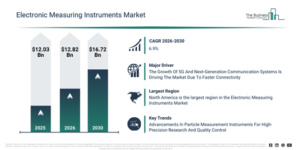
The electronic measuring instruments market size has experienced significant growth in recent years. It is anticipated to expand from $12.03 billion in 2025 to $12.82 billion in 2026, progressing at a compound annual growth rate (CAGR) of 6.5%. This historical growth can be attributed to several factors, including the increasing adoption of electronics in industrial applications, a rising need for precise measurements in research and development, the expansion of the consumer electronics industry, advancements in analog measurement technologies, and the demand for power quality testing.
The electronic measuring instruments market is projected to experience substantial expansion over the upcoming years. This market is forecast to reach $16.72 billion by 2030, exhibiting a compound annual growth rate (CAGR) of 6.9%. Factors contributing to this anticipated growth include the incorporation of AI and machine learning into measuring instruments, the advancement of smart manufacturing and Industry 4.0 applications, a surge in demand for IoT-enabled measurement tools, the wider scope of renewable energy monitoring, and the expanding adoption in electric vehicles and transportation electrification. Key trends expected during this period involve high-precision measurement tools, portable and compact devices, wireless and IoT-enabled measuring instruments, AI-powered instrumentation, and energy-efficient measurement solutions.
Download A Free Sample Report For Comprehensive Market Insights:
Electronic Measuring Instruments Market Demand Drivers: What Is Fueling Industry Growth?
The increasing prevalence of 5G and next-generation communication systems is anticipated to propel the expansion of the electronic measuring instruments market moving ahead. These systems represent the newest innovations in wireless communication, engineered to provide considerably quicker data transfer rates, reduced delays, enhanced connectivity, and superior dependability compared to older technologies. Their expansion is fueled by their capacity for elevated data speeds, which facilitate quicker, more dependable connections crucial for advanced applications and uninterrupted communication. Electronic measuring instruments support the development of 5G and next-gen communication systems through precise testing, calibration, and continuous monitoring of network elements, thereby guaranteeing optimal performance, dependability, and efficiency within high-speed communication infrastructure. As an illustration, in September 2025, 5G Americas, a US-based trade organization offering telecommunication services, stated that worldwide 5G connections exceeded 2.6 billion in Q2 2025, showing a 37% increase from the previous year. These connections are forecast to reach almost 9 billion by 2030, comprising 60% of all global wireless connections, indicating a much quicker adoption rate than prior wireless technologies. Consequently, the advancement of 5G and next-generation communication systems is a key driver for the electronic measuring instruments market.
Electronic Measuring Instruments Market Segmentation: How Is The Market Structured Across Key Categories?
The electronic measuring instruments market covered in this report is segmented –
1) By Type: Digital Instruments, Analog Instruments, Smart Instruments
2) By Technology: Digital Technology, Analog Technology, Hybrid Technology
3) By Application: Circuit Testing And Troubleshooting, Frequency And Phase Measurement, High-Voltage Testing, Power Quality Testing, Signal Analysis, Voltage And Current Measurement
4) By Sales Channel: Online, Offline
5) By End-User Industry: Aerospace And Defense, Automotive And Transportation, Consumer Electronics, Education And Research, Energy And Power, Healthcare, Industrial Manufacturing, Telecommunications
Subsegments:
1) By Digital Instruments: Digital Multimeters, Digital Oscilloscopes, Logic Analyzers, Spectrum Analyzers
2) By Analog Instruments: Analog Multimeters, Analog Oscilloscopes, Signal Generators, Analog Ammeters
3) By Smart Instruments: Wireless Measuring Devices, IoT-Enabled Instruments, AI-Powered Instruments, Portable Smart Sensors
Electronic Measuring Instruments Market Innovation Trends: Which Developments Are Transforming The Industry?
Leading companies within the electronic measuring instruments market are concentrating on creating particle measurement instruments, aiming to achieve accurate detection and improved efficiency in quality control as well as research applications. These instruments are designed to identify, quantify, and examine microscopic particles found in gases, liquids, or solids, supplying exact data concerning their size, concentration, and distribution. This capability elevates quality control, guarantees regulatory adherence, and aids in meticulous research and industrial operations. An illustrative example occurred in June 2024, when Advantest Corporation, a semiconductor test equipment provider from Japan, introduced WEL2100, which is a new addition to its nanoSCOUTER range of particle measuring equipment. The WEL2100 utilizes a precise nanopore sensor and microcurrent measurement technology to accurately and rapidly assess fine particles, including lipid nanoparticles, viruses, and exosomes. This device is capable of individually determining particle quantity, size, and zeta potential, and incorporates Advantest’s exclusive APT-Pore device to boost accuracy, particularly for particles under 30 nm. It is especially well-suited for applications in pharmaceutical and biotechnology research and development.
Electronic Measuring Instruments Market Competitive Landscape And Leading Companies
Major companies operating in the electronic measuring instruments market are Keysight Technologies, Fortive Corporation, Rohde & Schwarz, Fluke Corporation, National Instruments, Yokogawa Electric Corporation, Anritsu Corporation, Danaher Corporation, Hioki E.E. Corporation, Advantest Corporation, Teledyne Technologies, Good Will Instrument Co., B&K Precision, Rigol Technologies, Siglent Technologies, Agilent Technologies, FLIR Systems, Kikusui Electronics, Megger Group, Chauvin Arnoux, Ametek, Inc., Omicron Electronics GmbH
Access The Complete Electronic Measuring Instruments Market Report:
Electronic Measuring Instruments Market Geographic Analysis: Where Is Demand Growing The Fastest?
North America was the largest region in the electronic measuring instruments market in 2025. Asia-Pacific is expected to be the fastest-growing region in the forecast period. The regions covered in the electronic measuring instruments market report are Asia-Pacific, South East Asia, Western Europe, Eastern Europe, North America, South America, Middle East, Africa.
Get in touch with us:
The Business Research Company: https://www.thebusinessresearchcompany.com/
Americas: +1 310-496-7795
Asia: +44 7882 955267 & +91 8897263534
Europe: +44 7882 955267
Email us at: marketing@tbrc.info
Follow us on:
LinkedIn: https://in.linkedin.com/company/the-business-research-company
YouTube: https://www.youtube.com/channel/UC24_fI0rV8cR5DxlCpgmyFQ
Global Market Model: https://www.thebusinessresearchcompany.com/global-market-model

Wasay has over a decade of experience in market research, data modelling, and analytics, with prior experience at GlobalData and Decision Tree Consulting Services. At The Business Research Company , he leads research operations across syndicated studies, customized consulting engagements, and the Global Market Model platform. His professional experience includes supporting organizations such as Boston Consulting Group, KPMG, and Ernst & Young. Wasay holds a degree in Electronics and Communications Engineering, postgraduate management qualifications from International Management Institute Belgium and Indian School of Business and Entrepreneurship, and completed the Integrated Program in Business Analytics from Indian Institute of Management Indore.