Enhanced with market attractiveness analysis, total addressable market evaluation, company benchmarking matrices, interactive Excel dashboards, expanded supply chain intelligence, emerging startup coverage, and detailed product insights, The Business Research Company’s 2026 market reports deliver more actionable and strategically valuable research.
#Haptic Devices Market Size And Revenue Forecast Through 2030
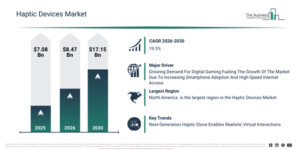
The haptic devices market has experienced rapid growth in recent years. It is anticipated to expand from $7.08 billion in 2025 to $8.47 billion in 2026, at a compound annual growth rate (CAGR) of 19.6%. The historical surge in this market can be attributed to enhancements in vibration actuators, a rise in demand from the gaming and entertainment sectors, the expansion of mobile and consumer electronics, early integration into automotive interfaces, and an increase in the adoption of AR/VR devices.
The haptic devices market is anticipated to experience substantial growth in the upcoming years. It is expected to expand to $17.15 billion by 2030, demonstrating a compound annual growth rate (CAGR) of 19.3%. This projected growth can be attributed to the proliferation of healthcare simulation tools, their implementation in remote collaboration platforms, integration with smart manufacturing systems, the emergence of tactile internet applications, and the increasing adoption of wearable technology. Notable trends during the forecast period include wearable haptic interfaces, multi-sensory feedback systems, remote haptic collaboration, the incorporation of haptics into healthcare simulation, and haptic-enabled robotics.
Download A Free Sample Report For Comprehensive Market Insights:
Haptic Devices Market Growth Momentum: Which Factors Are Influencing Demand?
The increasing need for digital gaming is anticipated to drive the haptic devices market expansion in the future. Digital gaming involves playing video games on electronic gadgets, including consoles, personal computers, and mobile devices. Its rising appeal largely stems from widespread smartphone use and readily available high-speed internet, allowing more individuals to play games. Haptic devices improve digital gaming by offering immersive tactile feedback, making games more authentic and captivating. They enhance user experience through simulating vibrations, textures, and forces, boosting interaction and pleasure. For example, in June 2024, as reported by the Interactive Games and Entertainment Association (IGEA), an Australia-based not-for-profit organisation, Australians spent $2.82 billion (AUD 4.4 billion) on video games and related hardware in 2023, representing a 5% increase from 2022, fueled by an 11% rise in digital game sales. Consequently, the escalating demand for digital gaming is propelling the haptic devices market’s growth.
#Haptic Devices Market Segment Landscape And Growth Potential
The haptic devices market covered in this report is segmented –
1) By Component: Hardware, Software
2) By Type: Active Haptic Devices, Passive Haptic Devices
3) By Usage: Graspable, Touchable, Wearable
4) By Feedback: Force Feedback, Vibrotactile Feedback, Electrotactile Feedback, Thermal Feedback, Other Feedbacks
5) By End-Use: Consumer Electronics, Entertainment, Gaming, Automotive, Aerospace And Defense, Healthcare, Automotive, Education, Other End-Uses
Subsegments:
1) By Hardware: Actuators, Sensors, Controllers
2) By Software: Haptic Rendering Software, Haptic Simulation Software, Middleware
Haptic Devices Market Growth Trends Influencing Competitive Dynamics
Leading companies within the haptic devices market are concentrating on creating technologically advanced products, such as next-generation haptic gloves, to facilitate realistic tactile interactions for training and simulation purposes. A next-generation haptic glove is an advanced wearable device that delivers precise tactile feedback and motion sensing, allowing users to experience and engage with virtual environments more naturally and realistically. For instance, in June 2024, WEART Haptics, an Italy-based haptic technology company, introduced its TouchDIVER Pro, a haptic glove designed to provide precise tactile feedback for immersive virtual experiences. It is engineered to bring lifelike tactile feedback to XR experiences, incorporating six actuation points across all fingers and the palm to simulate realistic force, texture, and thermal sensations. The device offers precise full-hand tracking with 0.6-degree accuracy, enabling natural and complex hand gestures in virtual environments. Furthermore, the glove supports various connectivity options, including WiFi, Bluetooth Low Energy, and tethered modes, making it versatile for standalone or PC-based setups.
Haptic Devices Market Competitive Landscape: Who Are The Leading Companies?
Major companies operating in the haptic devices market are TDK Corporation, Microchip Technology Inc., Cirrus Logic Inc., Synaptics Incorporated, 3D Systems Corporation, Tactile Labs, Immersion Corporation, Ultrahaptics, Quanser, Razer Inc., MPB Technologies, HaptX Inc., SenseGlove Inc., Haply Robotics, Sensel Inc., Boréas Technologies Inc., Woojer, bHaptics Inc., AITO, CyberGlove Systems LLC
Access The Complete Haptic Devices Market Report:
Haptic Devices Market Largest Region By Revenue And Market Share
North America was the largest region in the haptic devices market in 2025. Asia-Pacific is expected to be the fastest-growing region in the forecast period. The regions covered in the haptic devices market report are Asia-Pacific, South East Asia, Western Europe, Eastern Europe, North America, South America, Middle East, Africa.
Get in touch with us:
The Business Research Company: https://www.thebusinessresearchcompany.com/
Americas: +1 310-496-7795
Asia: +44 7882 955267 & +91 8897263534
Europe: +44 7882 955267
Email us at: marketing@tbrc.info
Follow us on:
LinkedIn: https://in.linkedin.com/company/the-business-research-company
YouTube: https://www.youtube.com/channel/UC24_fI0rV8cR5DxlCpgmyFQ
Global Market Model: https://www.thebusinessresearchcompany.com/global-market-model

Wasay has over a decade of experience in market research, data modelling, and analytics, with prior experience at GlobalData and Decision Tree Consulting Services. At The Business Research Company , he leads research operations across syndicated studies, customized consulting engagements, and the Global Market Model platform. His professional experience includes supporting organizations such as Boston Consulting Group, KPMG, and Ernst & Young. Wasay holds a degree in Electronics and Communications Engineering, postgraduate management qualifications from International Management Institute Belgium and Indian School of Business and Entrepreneurship, and completed the Integrated Program in Business Analytics from Indian Institute of Management Indore.