Delivering more actionable and strategically valuable research, The Business Research Company’s 2026 market reports feature market attractiveness analysis, total addressable market evaluation, company benchmarking matrices, interactive Excel dashboards, expanded supply chain intelligence, emerging startup coverage, and detailed product insights.
Multi-Axis Force Torque Sensor Market Expected To Reach $1.56 Billion By 2030 At 7.8% CAGR
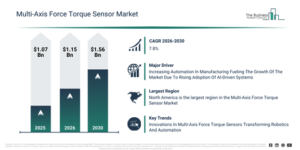
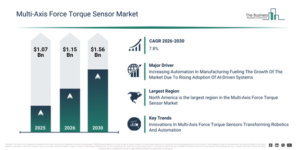
The multi-axis force torque sensor market size has shown robust growth in recent years. It is anticipated to increase from $1.07 billion in 2025 to $1.15 billion in 2026, at a compound annual growth rate (CAGR) of 7.9%. This historical growth can be attributed to the increasing adoption of robotics in manufacturing, the demand for precise load monitoring in aerospace, advancements in strain gauge technology, integration in automotive testing systems, and rising industrial automation.
The market size for multi-axis force torque sensors is anticipated to undergo significant expansion in the coming years. By 2030, its value is projected to reach $1.56 billion, advancing at a compound annual growth rate (CAGR) of 7.8%. This expansion during the outlook period stems from various factors, such as the increasing development of collaborative robotics (cobots), the growing output of electric vehicles, the integration into medical robotic systems, the adoption in AI-based predictive maintenance, and the rising requirements in smart manufacturing environments. Noteworthy trends expected over this period include advancements in high-precision force measurement, the emergence of miniaturized multi-axis sensors, solutions for wireless and remote monitoring, real-time load feedback systems, and customizable multi-axis sensor options.
Download A Free Sample Report For Comprehensive Market Insights:
Multi-Axis Force Torque Sensor Market Expansion Supported By Key Demand Factors
The expanding integration of automation within manufacturing operations is anticipated to stimulate the advancement of the multi-axis force torque sensor market. Automation in manufacturing encompasses the deployment of technology and control systems to manage production processes with minimal human involvement, thereby enhancing operational efficiency, product quality, and overall productivity. The surge in manufacturing automation is primarily driven by the imperative for elevated efficiency and productivity, reduced operational expenses associated with labor, and enhanced product quality and exactness. As industries strive to maintain their competitive edge, automation facilitates quicker production cycles, minimizes human errors, and elevates overall operational efficacy. A multi-axis force torque sensor specifically aids automation by empowering robots to detect and react to forces from multiple directions, consequently improving the precision, versatility, and safety of manufacturing processes. For instance, in September 2023, the International Federation of Robotics, a Germany-based professional non-profit organization, stated that 553,052 industrial robot installations were recorded in factories worldwide in 2023, indicating a 5% year-on-year growth compared to 2022. Consequently, the increasing adoption of automation in manufacturing processes is a key driver for the growth of the multi-axis force torque sensor market.
Multi-Axis Force Torque Sensor Market Segment Landscape: Which Areas Lead Market Development?
The multi-axis force torque sensor market covered in this report is segmented –
1) By Type: 2-Axis, 3-Axis, 6-Axis, Other Types
2) By Technology: Strain Gauge-Based Sensors, Piezoelectric Sensors, Capacitive Sensors, Optical Sensors, Other Technologies
3) By Application: Aerospace And Defense, Automotive, Consumer Electronics, Medical Devices, Robotics
4) By End-User: Original Equipment Manufacturers (OEMs), Research Institutions, Industrial Users, Service Providers, Government And Defense Sectors
Subsegments:
1) By 2-Axis Force Torque Sensors: Standard 2-Axis Sensors, Rotary 2-Axis Sensors, Customizable 2-Axis Sensors
2) By 3-Axis Force Torque Sensors: Standard 3-Axis Sensors, Rotary 3-Axis Sensors, High-Precision 3-Axis Sensors, Miniature 3-Axis Sensors
3) By 6-Axis Force Torque Sensors: Standard 6-Axis Sensors, High-Capacity 6-Axis Sensors, High-Precision 6-Axis Sensors, Embedded 6-Axis Sensors
4) By Other Types: Custom Multi-Axis Sensors, Wireless Multi-Axis Sensors, Capacitive Multi-Axis Sensors, Piezoelectric Multi-Axis Sensors
Multi-Axis Force Torque Sensor Market Transformation Trends: Which Innovations Are Driving Change?
Companies active in the multi-axis force torque sensor market are concentrating on developing novel solutions, including high-sensitivity multi-axis force-torque sensors, to improve accuracy and performance across a range of applications. A high-sensitivity multi-axis force-torque sensor is a precise instrument capable of accurately measuring forces and torques across multiple axes with very low noise, thereby facilitating exact control in robotics, aerospace, and industrial uses. For example, in March 2024, Bota Systems AG, a Swiss provider of multi-axis force-torque sensors, unveiled the SenseONE T5, which is a high-sensitivity variant of their existing SensONE multi-axis force-torque sensor. This latest sensor offers a sensitivity of 0.05 N / 0.002 Nm, an improvement that is three to five times greater than its forerunner, rendering it perfectly suited for tasks demanding meticulous force control. Created for collaborative robots handling small payloads of up to 5 kg, the SenseONE T5 is compact, lightweight, and features a high sampling rate of up to 2000 Hz. The SenseONE T5 is well-suited for intricate operations like precision assembly and quality testing, representing a considerable leap forward in robotic sensing technology.
Multi-Axis Force Torque Sensor Market Industry Leaders And Market Competition
Major companies operating in the multi-axis force torque sensor market are Minebeamitsumi Inc., Interface Inc., Hottinger Baldwin Messtechnik Gmbh, Universal Robots A/S, Pcb Piezotronics Inc., Kistler Instrumente Ag, ATI Industrial Automation Inc., OnRobot A/S, Futek Advanced Sensor Technology Inc., Amtab SE, Gtm Testing And Metrology Gmbh, Applied Measurements Ltd, A-Tech Instruments Ltd., Althen GmbH, Bcm Sensor Technologies Bv, Sens2b-Sensors, Metromatics Pty Ltd, Bota Systems AG, Adi Artech Transducers Pvt. Ltd., Nordbo Robotics A/S, Crane Electronics Ltd, Hypersen Technologies Co. Ltd
Access The Complete Multi-Axis Force Torque Sensor Market Report:
Multi-Axis Force Torque Sensor Market Geographic Distribution And Regional Opportunities
North America was the largest region in the multi-axis force torque sensor market in 2025. Asia-Pacific is expected to be the fastest-growing region in the forecast period. The regions covered in the multi-axis force torque sensor market report are Asia-Pacific, South East Asia, Western Europe, Eastern Europe, North America, South America, Middle East, Africa.
Get in touch with us:
The Business Research Company: https://www.thebusinessresearchcompany.com/
Americas: +1 310-496-7795
Asia: +44 7882 955267 & +91 8897263534
Europe: +44 7882 955267
Email us at: marketing@tbrc.info
Follow us on:
LinkedIn: https://in.linkedin.com/company/the-business-research-company
YouTube: https://www.youtube.com/channel/UC24_fI0rV8cR5DxlCpgmyFQ
Global Market Model: https://www.thebusinessresearchcompany.com/global-market-model

Wasay has over a decade of experience in market research, data modelling, and analytics, with prior experience at GlobalData and Decision Tree Consulting Services. At The Business Research Company , he leads research operations across syndicated studies, customized consulting engagements, and the Global Market Model platform. His professional experience includes supporting organizations such as Boston Consulting Group, KPMG, and Ernst & Young. Wasay holds a degree in Electronics and Communications Engineering, postgraduate management qualifications from International Management Institute Belgium and Indian School of Business and Entrepreneurship, and completed the Integrated Program in Business Analytics from Indian Institute of Management Indore.