Delivering more actionable and strategically valuable research, The Business Research Company’s 2026 market reports feature market attractiveness analysis, total addressable market evaluation, company benchmarking matrices, interactive Excel dashboards, expanded supply chain intelligence, emerging startup coverage, and detailed product insights.
Inductive Proximity Sensors Market Forecast: What Market Value Is Expected By 2030?
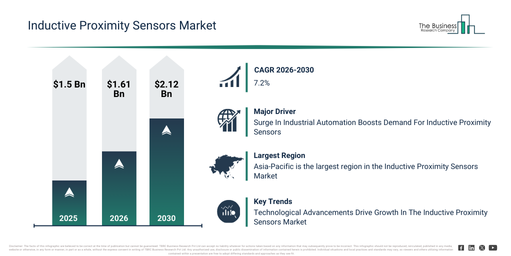
The inductive proximity sensors market has shown significant expansion in recent years. This market is expected to expand from $1.5 billion in 2025 to $1.61 billion in 2026, achieving a compound annual growth rate (CAGR) of 7.4%. The historical development of this market is attributable to the rise of industrial automation, the extensive use of non-contact sensing, the growth of manufacturing industries, an elevated focus on machine safety, and the adoption of programmable logic controllers.
The inductive proximity sensors market is anticipated to experience robust expansion over the coming years. This market is projected to reach $2.12 billion by 2030, exhibiting a compound annual growth rate (CAGR) of 7.2%. Factors contributing to this growth during the forecast period include the evolution of smart manufacturing systems, the increasing integration of robotics and cobots, a growing need for predictive maintenance, the expansion of electric vehicle production, and the advancement of aerospace and defense automation. Key trends emerging over the forecast horizon encompass the wider implementation of inductive sensors in factory automation, a heightened need for high precision metal detection, the expanding deployment of compact and miniature inductive sensors, the development of sensors offering extended sensing ranges, and the greater incorporation of sensors within harsh industrial environments.
Download A Free Sample Report For Comprehensive Market Insights:
#Inductive Proximity Sensors Market Demand Drivers Creating New Revenue Opportunities
Anticipated expansion in industrial automation is set to boost the inductive proximity sensors market in the future. This automation involves deploying robotics, machinery, and control systems to automate tasks usually done by people, thereby improving productivity, quality, and safety across diverse sectors. The surge in industrial automation stems from a demand for increased productivity, quality, and safety, complemented by progress in robotics, artificial intelligence (AI), and communication technologies, which have made automation more efficient and economical. Within industrial automation, inductive proximity sensors are employed for the non-contact identification of metallic items, ensuring accuracy and effectiveness in numerous manufacturing procedures. For example, in September 2025, the International Federation of Robotics, a Germany-based non-profit organization, released a report (World Robotics) stating that 542,000 industrial robots were installed in 2024. This figure was more than double that of previous years, with annual installations having surpassed 500,000 for the fourth consecutive year. Consequently, the expansion of industrial automation is a key factor propelling the growth of the inductive proximity sensors market.
Inductive Proximity Sensors Market Segment Analysis And Revenue Opportunities
The inductive proximity sensors market covered in this report is segmented –
1) By Type: Negative-Positive-Negative (NPN) Inductive Proximity Sensor, Positive-Negative-Positive (PNP) Inductive Proximity Sensor, Shielded Sensors, Unshielded Sensors
2) By Technology: High-Frequency Oscillation Inductive Sensing, Eddy Current Suppression Inductive Sensing, Magnetic Field Variation Inductive Sensing, Coil-Based Inductive Sensing
3) By End User: Industrial, Automotive, Aerospace And Defense, Packaging, Other End-Users
Subsegments:
1) By Negative-Positive-Negative (NPN) Inductive Proximity Sensor: NPN NO (Normally Open) Sensors, NPN NC (Normally Closed) Sensors, NPN Standard Sensors, NPN High-Sensitivity Sensors, NPN High-Temperature Sensors
2) By Positive-Negative-Positive (PNP) Inductive Proximity Sensor: PNP NO (Normally Open) Sensors, PNP NC (Normally Closed) Sensors, PNP Standard Sensors, PNP High-Sensitivity Sensors, PNP High-Temperature Sensors
3) By Shielded Sensors: Rectangular Shielded Sensors, Cylindrical Shielded Sensors, Flat Shielded Sensors, Compact Shielded Sensors, High-Performance Shielded Sensors, Miniature Shielded Sensors
4) By Unshielded Sensors: Rectangular Unshielded Sensors, Cylindrical Unshielded Sensors, Flat Unshielded Sensors, Compact Unshielded Sensors, Miniature Unshielded Sensors, High-Performance Unshielded Sensors
Inductive Proximity Sensors Market Innovation Trends Driving Future Development
Leading firms within the inductive proximity sensors market are prioritizing the creation of sophisticated technological solutions, including input or output (IO)-link communications sensors, to maintain their competitive standing. Specifically, an IO-Link communications sensor denotes a device equipped with IO-Link technology, thereby offering improved functionality and communication features. As an illustration, in February 2023, Carlo Gavazzi Holding AG, an industrial automation company based in Switzerland, introduced its ICF Full-Metal Inductive Sensors. These intelligent sensors boast durable stainless-steel housing and IO-Link communications, aiming to boost uptime and enable smart monitoring in challenging conditions across sectors like agriculture, food and beverage, and machining. Such sensors provide a prolonged operational life, featuring washdown capabilities, resistance to impacts, and suitability for a broad temperature spectrum. Furthermore, they facilitate predictive maintenance by monitoring cyclic process data and offering customizable alarms, which helps guarantee continuous operations. With limitless configurations, the sensors deliver dependable detection for diverse applications, such as conveyor positioning and counting axle revolutions in machinery.
Inductive Proximity Sensors Market Leading Players Shaping Industry Direction
Major companies operating in the inductive proximity sensors market are Panasonic Corporation, Schneider Electric SE, Honeywell International Inc., Eaton Corporation plc, STMicroelectronics N.V., Fargo Controls Inc., Delta Electronics Inc., Rockwell Automation Inc., Omron Corporation, Keyence Corporation, IFM Electronic GmbH, SICK AG, Hans Turck GmbH & Co. KG, Pepperl+Fuchs SE, Baumer Holding AG, Datalogic S.p.A., Balluff GmbH, Altech Corporation, Carlo Gavazzi Holding AG, Autonics Corporation, Contrinex AG, Red Lion Controls (a Spectris company), KRIZ Sensors.
Access The Complete Inductive Proximity Sensors Market Report:
Inductive Proximity Sensors Market Geographic Analysis: Where Is Demand Growing The Fastest?
Asia-Pacific was the largest region in the inductive proximity sensors market in 2025. The regions covered in the inductive proximity sensors market report are Asia-Pacific, South East Asia, Western Europe, Eastern Europe, North America, South America, Middle East, Africa.
Get in touch with us:
The Business Research Company: https://www.thebusinessresearchcompany.com/
Americas: +1 310-496-7795
Asia: +44 7882 955267 & +91 8897263534
Europe: +44 7882 955267
Email us at: marketing@tbrc.info
Follow us on:
LinkedIn: https://in.linkedin.com/company/the-business-research-company
YouTube: https://www.youtube.com/channel/UC24_fI0rV8cR5DxlCpgmyFQ
Global Market Model: https://www.thebusinessresearchcompany.com/global-market-model

Wasay has over a decade of experience in market research, data modelling, and analytics, with prior experience at GlobalData and Decision Tree Consulting Services. At The Business Research Company , he leads research operations across syndicated studies, customized consulting engagements, and the Global Market Model platform. His professional experience includes supporting organizations such as Boston Consulting Group, KPMG, and Ernst & Young. Wasay holds a degree in Electronics and Communications Engineering, postgraduate management qualifications from International Management Institute Belgium and Indian School of Business and Entrepreneurship, and completed the Integrated Program in Business Analytics from Indian Institute of Management Indore.