Delivering more actionable and strategically valuable research, The Business Research Company’s 2026 market reports feature market attractiveness analysis, total addressable market evaluation, company benchmarking matrices, interactive Excel dashboards, expanded supply chain intelligence, emerging startup coverage, and detailed product insights.
Optical Transport Network (OTN) Hardware Market Expansion Outlook: What Revenue Opportunities Lie Ahead?
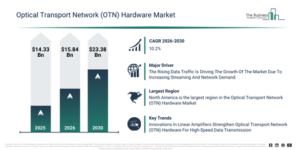
The market size for optical transport network (OTN) hardware has witnessed significant expansion in recent years. It is anticipated to increase from $14.33 billion in 2025 to $15.84 billion in 2026, demonstrating a compound annual growth rate (CAGR) of 10.5%. This historical growth can be attributed to several factors, including the rising global demand for telecom bandwidth, the expansion of fiber-optic infrastructure, the increased consumption of video streaming and cloud services, the deployment of early WDM and DWDM systems, and the growing adoption of OTN-based carrier networks.
The optical transport network (otn) hardware market is projected to experience swift expansion over the coming years, anticipated to reach $23.38 billion by 2030, demonstrating a compound annual growth rate (CAGR) of 10.2%. This anticipated growth is driven by several factors, including the escalating demand for hyperscale data center interconnect, the expansion of 5G backhaul and fronthaul capacity, a growing need for ultra-low latency optical transport, the swift uptake of coherent and pluggable optics, and the ongoing modernization of enterprise optical networks. Key trends identified for this forecast period encompass an increasing demand for high-capacity long-haul optical transport, a rising adoption of coherent optical transponders, a rapid shift towards reconfigurable and modular optical line systems, the expanding deployment of wavelength-division multiplexing solutions, and the broadening of optical packet transport platforms designed for multi-service networking.
Download A Free Sample Report For Comprehensive Market Insights:
#Optical Transport Network (OTN) Hardware Market Growth Drivers And Industry Catalysts
The escalating volume of data traffic is anticipated to fuel the growth of the optical transport network (OTN) hardware market in the foreseeable future. Data traffic refers to the quantity of digital information transmitted across various communication networks through different devices and applications. This rise in data traffic is largely due to more users streaming high-definition and on-demand videos, which demand substantial bandwidth and significantly increase overall network data usage. Data traffic impacts the demand and capabilities of optical transport network (OTN) hardware by dictating the volume, speed, and type of data requiring transmission, thus necessitating OTN equipment with enhanced capacity, faster switching, and efficient multiplexing to facilitate low-latency, reliable, and scalable optical communication. For instance, in June 2024, according to Ericsson, a Sweden-based telecommunications company, mobile network data traffic experienced a quarter-on-quarter growth of approximately 6 percent from the fourth quarter of 2023 to the first quarter of 2024. The total global mobile network data traffic for that month reached 145 exabytes (EB). Therefore, the increasing data traffic is a key driver for the expansion of the optical transport network (OTN) hardware market.
Optical Transport Network (OTN) Hardware Market Segmentation: How Is The Market Structured Across Key Categories?
The optical transport network (otn) hardware market covered in this report is segmented –
1) By Component: Transponders, Optical Line Cards, Optical Amplifiers, Optical Switches, Other Components
2) By Type: Optical Transport Network (OTN) Switching, Optical Transport Network (OTN) Transport, Optical Packet Platform Systems (P-OTS)
3) By Technology: Wavelength Division Multiplexing, Dense Wavelength Division Multiplexing, Coarse Wavelength Division Multiplexing
4) By Application: Telecommunications, Data Centers, Enterprises, Other Applications
5) By End-User: Banking Financial Services And Insurance, Information Technology And Telecommunications, Healthcare, Government, Other End-Users
Subsegments:
1) By Transponders: Wavelength Transponders, Coherent Transponders, Pluggable Transponders, Regenerative Transponders, Multirate Transponders
2) By Optical Line Cards: Line Interface Cards, Client Interface Cards, Multiplexing Line Cards, Reconfigurable Line Cards, High-Density Line Cards
3) By Optical Amplifiers: Erbium-Doped Fiber Amplifiers, Raman Amplifiers, Semiconductor Optical Amplifiers, Hybrid Optical Amplifiers, Inline Optical Amplifiers
4) By Optical Switches: Wavelength Selective Switches, Micro-Electro-Mechanical Systems Switches, Liquid Crystal Switches, Optical Cross-Connect Switches, Fiber Optic Mechanical Switches
5) By Other Components: Optical Transceivers, Multiplexers And Demultiplexers, Optical Splitters, Optical Network Interface Modules, Optical Monitoring Modules
Optical Transport Network (OTN) Hardware Market Innovation Trends: Which Developments Are Transforming The Industry?
Leading companies in the optical transport network (OTN) hardware market are focused on developing innovative products, such as linear amplifiers, to enhance network performance and meet the increasing demands of data traffic. A linear amplifier is an optical component designed to strengthen transmitted signals in a fiber optic network while preserving their original waveform, thereby ensuring signal integrity over long distances. For instance, Anritsu Corporation, a Japan-based telecommunications and measurement solutions provider, introduced its 140 Gbaud PAM4 wideband/high-output (2 Vpp) linear amplifier in July 2024. This product is engineered to improve high-speed optical transmission performance and support the evolving requirements of hyperscale data centers and ultra-fast networking applications. This amplifier boasts an exceptionally wide frequency response ranging from 200 kHz to 135 GHz at a –6 dB bandwidth, enabling it to amplify high-speed 140 Gbaud PAM4 optical signals, making it well-suited for the evaluation of advanced optical communication systems.
Optical Transport Network (OTN) Hardware Market Competitive Landscape And Leading Companies
Major companies operating in the optical transport network (otn) hardware market are Huawei Technologies Co. Ltd., NTT Corporation, Cisco Systems Inc., Sumitomo Electric Industries Ltd., Broadcom Inc., Fujitsu Limited, Telefonaktiebolaget LM Ericsson, Nokia Corporation, NEC Corporation, ZTE Corporation, Marvell Technology Inc., Juniper Networks Inc., Coherent Corp., Ciena Corporation, Lumentum Holdings Inc., Adtran Networks S.E., Ribbon Communications Inc., Thorlabs Inc., Acacia Communications Inc., SintAI Communication Co. LTD.
Access The Complete Optical Transport Network (OTN) Hardware Market Report:
#Optical Transport Network (OTN) Hardware Market Largest Region: Which Geography Holds The Highest Market Share?
North America was the largest region in the optical transport network (OTN) hardware market in 2025. Asia-Pacific is expected to be the fastest-growing region in the forecast period. The regions covered in the optical transport network (otn) hardware market report are Asia-Pacific, South East Asia, Western Europe, Eastern Europe, North America, South America, Middle East, Africa.
Get in touch with us:
The Business Research Company: https://www.thebusinessresearchcompany.com/
Americas: +1 310-496-7795
Asia: +44 7882 955267 & +91 8897263534
Europe: +44 7882 955267
Email us at: marketing@tbrc.info
Follow us on:
LinkedIn: https://in.linkedin.com/company/the-business-research-company
YouTube: https://www.youtube.com/channel/UC24_fI0rV8cR5DxlCpgmyFQ
Global Market Model: https://www.thebusinessresearchcompany.com/global-market-model

Wasay has over a decade of experience in market research, data modelling, and analytics, with prior experience at GlobalData and Decision Tree Consulting Services. At The Business Research Company , he leads research operations across syndicated studies, customized consulting engagements, and the Global Market Model platform. His professional experience includes supporting organizations such as Boston Consulting Group, KPMG, and Ernst & Young. Wasay holds a degree in Electronics and Communications Engineering, postgraduate management qualifications from International Management Institute Belgium and Indian School of Business and Entrepreneurship, and completed the Integrated Program in Business Analytics from Indian Institute of Management Indore.