Through market attractiveness analysis, total addressable market evaluation, company benchmarking matrices, interactive Excel dashboards, expanded supply chain intelligence, emerging startup coverage, and detailed product insights, The Business Research Company’s 2026 market reports provide more actionable and strategically valuable research.
Industrial Robot Battery Market Size Outlook: How Fast Will Revenue Grow Through 2030?
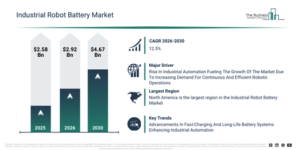
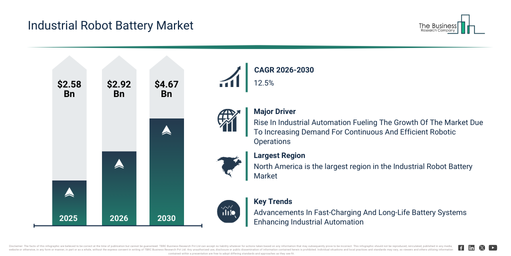
The industrial robot battery market size has experienced significant expansion in recent years. It is anticipated to increase from $2.58 billion in 2025 to $2.92 billion in 2026, demonstrating a compound annual growth rate (CAGR) of 12.8%. The historical growth can be credited to factors including the escalating adoption of industrial automation, the demand for reliable robotic operation, advancements in lithium-ion technology, the high energy requirements of robots, and the need for uninterrupted production.
The industrial robot battery market size is anticipated to undergo significant expansion in the coming years, projected to reach $4.67 billion by 2030, exhibiting a compound annual growth rate (CAGR) of 12.5%. This growth throughout the forecast period stems from factors such as the increasing deployment of collaborative robots (cobots), the surge in e-commerce and warehouse automation, the proliferation of advanced manufacturing facilities, the evolution of solid-state and high-capacity batteries, and their integration with predictive maintenance and smart factory systems. Prominent trends for the forecast period include the development of high energy density batteries, enhancements in long cycle life and durability, designs for batteries resistant to harsh environments, the provision of modular and scalable battery solutions for robots, and efficient battery management systems.
Download A Free Sample Report For Comprehensive Market Insights:
Industrial Robot Battery Market Growth Drivers: What Factors Are Accelerating Expansion?
The future expansion of the industrial robot battery market is anticipated, largely propelled by the increasing prevalence of industrial automation. This automation refers to the application of control systems, robots, and information technologies to manage machinery and processes in manufacturing and other sectors with minimal human involvement. Its growth is driven by the escalating demand for enhanced productivity and operational efficiency in manufacturing operations. Within industrial automation, robot batteries are crucial for delivering consistent, uninterrupted power to robotic systems, thereby enabling continuous and efficient performance without requiring fixed power sources. Illustrating this trend, in September 2024, figures from the International Federation of Robotics (IFR), a Germany-based non-profit organization, indicated that industrial robot installations in the UK grew by 51%, reaching 3,830 units. Meanwhile, in the Americas, more than 50,000 units were installed for the third consecutive year, amounting to 55,389 units in 2023. Thus, the expansion of industrial automation is a key factor driving the industrial robot battery market’s growth.
#Industrial Robot Battery Market Segment Landscape And Growth Potential
The industrial robot battery market covered in this report is segmented –
1) By Battery Type: Lithium-Ion Batteries, Nickel-Metal Hydride Batteries, Lead-Acid Batteries, Sodium-Ion Batteries, Other Battery Types
2) By Robot Type: Articulated Robots, Selective Compliance Articulated Robot Arm (SCARA) Robots, Delta Robots, Collaborative Robots (Cobots), Mobile Robots
3) By Capacity: Below 1,000 mAh, 1,000 mAh – 5,000 mAh, 5,000 mAh – 10,000 mAh, Above 10,000 mAh
4) By Application: Welding, Material Handling, Painting, Palletizing, Inspection And Quality Control
5) By End-Use Industry: Manufacturing, Logistics And Warehousing, Automotive, Electronics, Food And Beverage, Healthcare, Aerospace
Subsegments:
1) By Lithium-Ion Batteries: Nickel Manganese Cobalt (NMC), Lithium Iron Phosphate (LFP Or LiFePO₄), Nickel Cobalt Aluminum (NCA), Lithium Titanate Oxide (LTO), High-Energy Cells, High-Power Cells, Cylindrical Cells, Prismatic Cells, Pouch Cells, Module-Level (Pack) Configurations
2) By Nickel-Metal Hydride Batteries (NiMH): Standard (AA Or AAA style) Cylindrical Cells, Prismatic Industrial Cells, High-Capacity NiMH, Low-Self-Discharge NiMH, Hybrid Or Rapid-Charge NiMH, Module Or Pack Assemblies
3) By Lead-Acid Batteries: Flooded (Wet) Lead-Acid, Valve Regulated Lead-Acid (VRLA), Absorbent Glass Mat (AGM), Gel Lead-Acid, Enhanced Flooded Battery (EFB), Tubular Or OpzS Deep-Cycle, Starter Batteries, Deep-Cycle Industrial Packs
4) By Sodium-Ion Batteries: Layered-Oxide Cathode Sodium-Ion, Polyanionic (NASICON-Type) Sodium-Ion, Prussian-Blue Analogue Cathode, Aqueous Sodium-Ion, Solid-State Sodium-Ion, Cylindrical Or Prismatic Or Pouch Formats, Cell-Level And Pack-Level Configurations
5) By Other Battery Types: Lithium-Sulfur (Li-S), Solid-State Batteries, Flow Batteries, Zinc-ion Or Zinc-Air, Aluminum-Ion, Metal-Air, Supercapacitors Or Ultracapacitors, Fuel-Cell (Hydrogen) Hybrid Modules
Industrial Robot Battery Market Growth Trends Influencing Competitive Dynamics
Companies operating within the industrial robot battery market are concentrating on developing advanced and customized battery systems that offer longer lifespan, faster charging, and greater energy efficiency. This focus aims to support continuous robotic operations and meet the rising demand for automation across various industrial sectors. A fast-charging battery system allows for rapid power replenishment by optimizing energy transfer and minimizing charging time without compromising either safety or performance. For instance, in July 2025, Electrovaya Inc., a Canada-based battery technology company, unveiled multiple battery system products specifically for new robotic vehicle platforms. These platforms were developed in collaboration with three leading OEMs, two in the U.S. and one in Japan. These sophisticated battery systems are engineered for applications such as material handling and surveillance, providing extended operational periods, prolonged life cycles, and quick wireless charging to enable 24/7 functionality. This initiative underscores Electrovaya’s strategic focus on the expanding robotics market, leveraging its expertise in battery safety, durability, and performance. Initial deliveries are scheduled to begin in 2025, with a broader commercial rollout expected in the financial year 2026, aligning with the increasing demand for AI-driven automation.
Industrial Robot Battery Market Competitive Landscape: Who Are The Leading Companies?
Major companies operating in the industrial robot battery market are TotalEnergies SE, Tesla Inc., BYD Company Limited, Hitachi Ltd., Panasonic Holdings Corporation, Contemporary Amperex Technology Co. Limited (CATL), LG Chem Ltd., ABB Ltd., Samsung SDI Co. Ltd., Wanxiang Group Corporation, FANUC Corporation, Yaskawa Electric Corporation, Exide Technologies LLC, Stäubli International AG, VARTA AG, Ultralife Corporation, Hangzhou Iplusmobot Technology Co. Ltd., Bentork Motion Systems Co. Ltd., Artek Energy Solutions Pvt. Ltd.
Access The Complete Industrial Robot Battery Market Report:
Industrial Robot Battery Market Regional Analysis: Which Region Leads By Revenue?
North America was the largest region in the industrial robot battery market in 2025. Asia-Pacific is expected to be the fastest-growing region in the forecast period. The regions covered in the industrial robot battery market report are Asia-Pacific, South East Asia, Western Europe, Eastern Europe, North America, South America, Middle East, Africa.
Get in touch with us:
The Business Research Company: https://www.thebusinessresearchcompany.com/
Americas: +1 310-496-7795
Asia: +44 7882 955267 & +91 8897263534
Europe: +44 7882 955267
Email us at: marketing@tbrc.info
Follow us on:
LinkedIn: https://in.linkedin.com/company/the-business-research-company
YouTube: https://www.youtube.com/channel/UC24_fI0rV8cR5DxlCpgmyFQ
Global Market Model: https://www.thebusinessresearchcompany.com/global-market-model

Wasay has over a decade of experience in market research, data modelling, and analytics, with prior experience at GlobalData and Decision Tree Consulting Services. At The Business Research Company , he leads research operations across syndicated studies, customized consulting engagements, and the Global Market Model platform. His professional experience includes supporting organizations such as Boston Consulting Group, KPMG, and Ernst & Young. Wasay holds a degree in Electronics and Communications Engineering, postgraduate management qualifications from International Management Institute Belgium and Indian School of Business and Entrepreneurship, and completed the Integrated Program in Business Analytics from Indian Institute of Management Indore.