Through market attractiveness analysis, total addressable market evaluation, company benchmarking matrices, interactive Excel dashboards, expanded supply chain intelligence, emerging startup coverage, and detailed product insights, The Business Research Company’s 2026 market reports provide more actionable and strategically valuable research.
Plug-In Hybrid Electric Vehicle Battery Market Expansion From $16.71 Billion In 2026 To $35.02 Billion In 2030
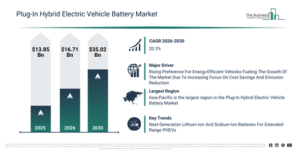
The plug-in hybrid electric vehicle battery market size has observed substantial growth in recent years. It is projected to expand from $13.85 billion in 2025 to $16.71 billion in 2026, demonstrating a compound annual growth rate (CAGR) of 20.6%. This historical expansion can be attributed to several factors, including escalating fuel prices, government incentives for electric vehicles (EVs), the limited availability of charging infrastructure, stricter environmental regulations, and the overall increase in hybrid vehicle adoption.
The plug-in hybrid electric vehicle battery market size is expected to experience substantial growth in the coming years. It is projected to reach $35.02 billion by 2030, demonstrating a compound annual growth rate (CAGR) of 20.3%. This expansion during the forecast period can be attributed to advancements in battery chemistry, the expansion of public charging networks, increasing consumer awareness about sustainability, cost reductions in battery production, and integration with smart grid technologies. Key trends anticipated in the forecast period include high-capacity rechargeable batteries, vehicle-to-grid (V2G) integration, fast charging technology, battery thermal management systems, and lightweight and compact battery designs.
Download A Free Sample Report For Comprehensive Market Insights:
Plug-In Hybrid Electric Vehicle Battery Market Growth Drivers: What Factors Are Accelerating Expansion?
The increasing consumer preference for energy-efficient vehicles is projected to boost the expansion of the plug-in hybrid electric vehicle battery market in the coming years. Energy-efficient vehicles are defined as automobiles that consume less fuel or electricity by employing advanced technologies to achieve better performance with reduced environmental impact. This rising preference for energy-efficient vehicles is primarily influenced by increasing fuel prices, as consumers seek options that can significantly lower their long-term operational expenses while still fulfilling their transportation needs. A plug-in hybrid electric vehicle battery proves beneficial for energy-efficient vehicles, allowing them to operate on electricity for shorter distances and utilize fuel for longer journeys, thereby decreasing overall energy consumption and emissions. For instance, in June 2025, according to the Department for Transport, a UK-based government department, the UK recorded 1,394,000 licensed zero-emission vehicles on its roads in 2024, indicating a 37% increase from 2023. This total included 1,287,000 zero-emission cars, marking a 38% rise over the previous year. Therefore, the growing inclination towards energy-efficient vehicles is a driving force behind the growth of the plug-in hybrid electric vehicle battery market.
Plug-In Hybrid Electric Vehicle Battery Market Segmentation: How Is The Market Structured Across Key Categories?
The plug-in hybrid electric vehicle battery market covered in this report is segmented –
1) By Battery Type: Lithium-Ion Battery, Lead-Acid Battery, Other Battery Types
2) By Vehicle Type: Passenger Vehicle, Light Commercial Vehicle
3) By Capacity: Less Than 10 kWh, 10-20 kWh, 20-30 kWh, Above 30 kWh
4) By Charging Infrastructure: Home Charging, Public Charging, Workplace Charging
Subsegments:
1) By Lithium-Ion Battery: Lithium Iron Phosphate Battery, Lithium Nickel Manganese Cobalt Oxide Battery, Lithium Cobalt Oxide Battery, Lithium Manganese Oxide Battery, Lithium Titanate Battery
2) By Lead-Acid Battery: Flooded Lead-Acid Battery, Sealed Lead-Acid Battery, Deep Cycle Lead-Acid Battery, Valve Regulated Lead-Acid Battery
3) By Other Battery Types: Nickel Metal Hydride Battery, Solid State Battery, Zinc Air Battery, Flow Battery
Plug-In Hybrid Electric Vehicle Battery Market Trends: What Is Shaping Future Industry Growth?
Leading companies in the plug-in hybrid electric vehicle battery market are concentrating on developing batteries capable of an extended all-electric range and ultra-fast charging. They are utilizing chemistries such as lithium-ion and sodium-ion to enable a pure electric range exceeding 400 km and achieve 4C charging rates, aiming for a competitive advantage. Lithium-ion and sodium-ion chemistries describe rechargeable battery technologies that use lithium or sodium ions for charge transfer, with lithium-ion providing high energy density and rapid charging, while sodium-ion offers lower costs and improved low-temperature performance. For example, in October 2024, Contemporary Amperex Technology Co., Limited, a China-based battery technology company, launched the Freevoy Super Hybrid Battery. This pioneering solution for hybrid vehicles, encompassing PHEVs and extended-range electric vehicles (EREVs), is the world’s first battery for hybrids to provide over 400 km of pure electric range and features 4C ultra-fast charging, allowing drivers to gain 280 km of range in just 10 minutes. It combines advanced lithium-ion and sodium-ion technologies, ensuring high performance even in extreme cold, while delivering enhanced efficiency, faster charging, and a longer range, thereby addressing consumer concerns about current hybrid vehicles’ limited range, slow charging, and poor cold-weather performance.
Plug-In Hybrid Electric Vehicle Battery Market Competitive Landscape And Leading Companies
Major companies operating in the plug-in hybrid electric vehicle battery market are BYD Company Limited, Hitachi Chemical Co. Ltd., Panasonic Holdings Corporation, SK Innovation Co. Ltd., LG Energy Solution Ltd., Toshiba Corporation, Johnson Matthey Battery Systems Engineering Limited, Samsung SDI Co. Ltd., Sunwoda Electronic Co. Ltd., Gotion High-Tech Co. Ltd., GS Yuasa International Ltd., EnerSys Inc., Exide Industries Limited, Saft Groupe S.A., A123 Systems LLC, Farasis Energy Inc., Northvolt AB, Electrovaya Inc., Valence Technology Inc., Blue Energy Co. Ltd.
Access The Complete Plug-In Hybrid Electric Vehicle Battery Market Report:
Plug-In Hybrid Electric Vehicle Battery Market Regional Analysis And Leading Geography
Asia-Pacific was the largest region in the plug-in hybrid electric vehicle battery market in 2025. Europe is expected to be the fastest-growing region in the forecast period. The regions covered in the plug-in hybrid electric vehicle battery market report are Asia-Pacific, South East Asia, Western Europe, Eastern Europe, North America, South America, Middle East, Africa.
Get in touch with us:
The Business Research Company: https://www.thebusinessresearchcompany.com/
Americas: +1 310-496-7795
Asia: +44 7882 955267 & +91 8897263534
Europe: +44 7882 955267
Email us at: marketing@tbrc.info
Follow us on:
LinkedIn: https://in.linkedin.com/company/the-business-research-company
YouTube: https://www.youtube.com/channel/UC24_fI0rV8cR5DxlCpgmyFQ
Global Market Model: https://www.thebusinessresearchcompany.com/global-market-model

Wasay has over a decade of experience in market research, data modelling, and analytics, with prior experience at GlobalData and Decision Tree Consulting Services. At The Business Research Company , he leads research operations across syndicated studies, customized consulting engagements, and the Global Market Model platform. His professional experience includes supporting organizations such as Boston Consulting Group, KPMG, and Ernst & Young. Wasay holds a degree in Electronics and Communications Engineering, postgraduate management qualifications from International Management Institute Belgium and Indian School of Business and Entrepreneurship, and completed the Integrated Program in Business Analytics from Indian Institute of Management Indore.