Enhanced with market attractiveness analysis, total addressable market evaluation, company benchmarking matrices, interactive Excel dashboards, expanded supply chain intelligence, emerging startup coverage, and detailed product insights, The Business Research Company’s 2026 market reports deliver more actionable and strategically valuable research.
Liquid-Crystal Display (LCD) Television Core Chip Market Growth Potential: How Will Market Size Change Through 2030?
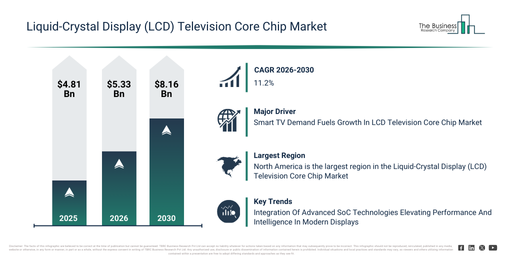
The market size for liquid-crystal display (lcd) television core chips has seen rapid expansion in recent years. It is anticipated to increase from $4.81 billion in 2025 to $5.33 billion in 2026, at a compound annual growth rate (CAGR) of 11.0%. This historical growth can be attributed to factors such as the increasing global adoption of LCD televisions, the shift from CRT and plasma displays, a growing consumer demand for flat panel televisions, enhancements in semiconductor fabrication processes, and a reduction in the cost of display components.
The market for liquid-crystal display (lcd) television core chips is projected to expand quickly over the coming years. This market is anticipated to reach $8.16 billion by 2030, exhibiting a compound annual growth rate (CAGR) of 11.2%. Several factors are contributing to this expansion during the projection period, including the growing adoption of smart and connected televisions, a surge in demand for 4k and 8k displays, the incorporation of AI-driven image enhancement, the proliferation of streaming and digital content services, and innovations in chip architectures that offer low power consumption and high performance. Key trends expected over the forecast horizon encompass the increasing integration of sophisticated image processing functionalities, the escalating uptake of high-resolution and large-screen televisions, a greater need for multifunction and system-on-chip solutions, the broadening of smart TV platforms and connectivity options, and a heightened emphasis on energy-efficient and compact core chips.
Download A Free Sample Report For Comprehensive Market Insights:
Liquid-Crystal Display (LCD) Television Core Chip Market Demand Drivers: What Is Fueling Industry Growth?
The increasing requirement for smart televisions (TVs) is projected to boost the expansion of the liquid-crystal display television core chip market in the future. Smart TVs are defined as televisions that possess internet connection and integrated interactive functionalities. The rising acceptance of smart TVs stems from the proliferation of streaming services, ongoing technological improvements, and shifting consumer desires for ease of use and entertainment options. Liquid-crystal display television core chips are essential for facilitating these capabilities, as they handle display signal processing, oversee connectivity, and support intelligent features like integrated applications and media playback. A specific example from December 2024, based on a report on television usage trends in the United Kingdom, shows that smart TV ownership climbed from 73.6% in Q2 2023 to 76.5% in Q2 2024. This report also indicated that over 75% of viewers utilized built-in apps on smart TVs, demonstrating consumers’ increasing dependence on smart television functionalities. Consequently, the expanding demand for smart televisions is a key factor propelling the growth of the liquid-crystal display (LCD) television core chip market.
Liquid-Crystal Display (LCD) Television Core Chip Market Segment Landscape: Which Areas Lead Market Development?
The liquid-crystal display (lcd) television core chip market covered in this report is segmented –
1) By Product Type: Liquid Crystal Display Driver Integrated Circuit, Liquid Crystal Display Controller Integrated Circuit, Power Management IC, Other Product Types
2) By Core Chip Type: 8-Bit Core, 16-Bit Core, 32-Bit Core, 64-Bit Core
3) By Application: Televisions, Monitors, Other Applications
Subsegments:
1) By Liquid Crystal Display Driver Integrated Circuit (LCD Driver IC): Tft-Icd Driver Ic Or Oled Driver Ic Or Led Driver Ic Or Full-Array Driver Ic
2) By Liquid Crystal Display Controller Integrated Circuit (LCD Controller IC): Timing Controller (T-Con) IC Or Signal Processing IC Or Image Processing IC
3) By Power Management IC (PMIC): Voltage Regulators Or Power Supply ICs Or Backlight Driver ICs Or Battery Management ICs
4) By Other Product Types: Display Interface ICs Or Audio ICs Or Touchscreen Controller ICs Or Image Sensor ICs
Liquid-Crystal Display (LCD) Television Core Chip Market Transformation Trends: Which Innovations Are Driving Change?
Leading companies in the liquid-crystal display (LCD) television core chip sector are concentrating on developing innovative technologies, such as smart TV system-on-chip (SoC) solutions, to boost performance and integrate advanced functionalities. Smart TV System-on-Chip (SoC) technologies are integrated circuits specifically designed for smart televisions, consolidating essential functions into a single, compact package to facilitate advanced features and capabilities. For instance, in February 2023, Koninklijke Philips N.V., a Netherlands-based technology company, introduced its latest Ambilight TV range, powered by the 7th Gen P5 AI processor, delivering enhanced picture quality and smarter Ambient Intelligence. The flagship OLED+908 incorporates the new META OLED panel, offering up to 2100 nits brightness, a 3.1-channel 80W Bowers & Wilkins sound system, and a three-sided Next Gen Ambilight. The OLED808 model further adds a 42” variant with improved gaming and sound features. Philips also rolled out The Xtra MiniLED series for premium performance at accessible prices and updated The One range with new 8808 and 8508 series. All models are equipped with Google TV OS and a refined European design for a more immersive experience.
Liquid-Crystal Display (LCD) Television Core Chip Market Industry Leaders And Market Competition
Major companies operating in the liquid-crystal display (lcd) television core chip market are Samsung Electronics Co. Ltd., Skyworth Group, Sony Corporation, Taiwan Semiconductor Manufacturing Company, Innolux Corporation, LG Corporation, Panasonic Corporation, Qualcomm Incorporated, Xiaomi Corporation, Broadcom Inc., Toshiba Corporation, Advanced Micro Devices, Sharp Corporation, Koninklijke Philips N.V., MediaTek Inc., Skyworth Group, Innolux Corporation, Hisense Group, Marvell Technology Group Ltd., Realtek Semiconductor Corporation, Novatek Microelectronics Corporation, TCL Corporation, Vizio Holding Corp., Himax Technologies Inc, CooCaa TV, Amlogic Inc.
Access The Complete Liquid-Crystal Display (LCD) Television Core Chip Market Report:
Liquid-Crystal Display (LCD) Television Core Chip Market Global Footprint: Which Region Holds Market Leadership?
North America was the largest region in the liquid-crystal display (LCD) television core chip market in 2025. Asia-Pacific is expected to be the fastest-growing region in the forecast period. The regions covered in the liquid-crystal display (lcd) television core chip market report are Asia-Pacific, South East Asia, Western Europe, Eastern Europe, North America, South America, Middle East, Africa.
Get in touch with us:
The Business Research Company: https://www.thebusinessresearchcompany.com/
Americas: +1 310-496-7795
Asia: +44 7882 955267 & +91 8897263534
Europe: +44 7882 955267
Email us at: marketing@tbrc.info
Follow us on:
LinkedIn: https://in.linkedin.com/company/the-business-research-company
YouTube: https://www.youtube.com/channel/UC24_fI0rV8cR5DxlCpgmyFQ
Global Market Model: https://www.thebusinessresearchcompany.com/global-market-model

Wasay has over a decade of experience in market research, data modelling, and analytics, with prior experience at GlobalData and Decision Tree Consulting Services. At The Business Research Company , he leads research operations across syndicated studies, customized consulting engagements, and the Global Market Model platform. His professional experience includes supporting organizations such as Boston Consulting Group, KPMG, and Ernst & Young. Wasay holds a degree in Electronics and Communications Engineering, postgraduate management qualifications from International Management Institute Belgium and Indian School of Business and Entrepreneurship, and completed the Integrated Program in Business Analytics from Indian Institute of Management Indore.