Delivering more actionable and strategically valuable research, The Business Research Company’s 2026 market reports feature market attractiveness analysis, total addressable market evaluation, company benchmarking matrices, interactive Excel dashboards, expanded supply chain intelligence, emerging startup coverage, and detailed product insights.
Massive MIMO Market Forecast: What Market Value Is Expected By 2030?
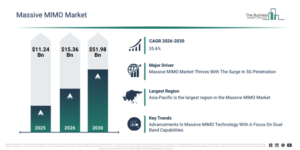
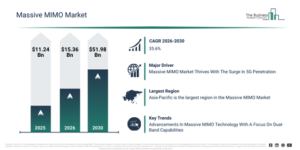
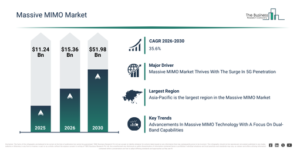
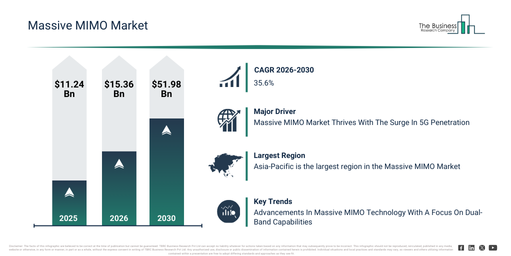
The massive mimo market size has observed substantial growth in recent years. It is anticipated to expand from $11.24 billion in 2025 to $15.36 billion in 2026, achieving a compound annual growth rate (CAGR) of 36.6%. The historical surge can be linked to the early adoption of lte mimo technologies, an increase in mobile broadband usage, a heightened demand for spectrum efficiency, expanded investment in operator infrastructure, and the rising utilization of multi-user mimo in dense environments.
The massive mimo market is poised for significant expansion in the coming years. Its valuation is projected to reach $51.98 billion by 2030, driven by a compound annual growth rate (CAGR) of 35.6%. This growth in the forecast period is attributed to the increasing deployment of 5G networks, a rising need for high-capacity antenna arrays, the proliferation of smart city connectivity initiatives, advancements in energy-efficient wireless systems, and the growing demand for improved user experience in densely populated areas. Key trends expected over the forecast period include the adoption of advanced digital beamforming systems, the expansion of IoT-integrated massive mimo networks, the development of AI-enhanced wireless optimization, progress in autonomous communication infrastructure, and the integration of intelligent manufacturing for antenna systems.
Download A Free Sample Report For Comprehensive Market Insights:
Massive MIMO Market Growth Momentum: Which Factors Are Influencing Demand?
The growing adoption of 5G technology is anticipated to boost the expansion of the massive MIMO market in the future. 5G, or fifth-generation wireless technology, represents the most recent advancement in cellular networks, engineered to provide substantial enhancements in speed, responsiveness, and connectivity compared to earlier versions such as 4G. Massive MIMO is vital for 5G penetration, as it considerably improves network capacity and data transfer rates, thereby allowing for the effective management of greater data traffic and varied connectivity requirements within future wireless communication systems. For example, data from May 2023 by Telefonaktiebolaget LM Ericsson, a Sweden-based information and communication technology firm, projected that 5G mobile subscriptions would reach 4.624 billion in 2028, a rise from 1.481 billion in 2023. Consequently, the expanding reach of 5G is a key factor fueling the growth of the massive MIMO market.
Massive MIMO Market Segment Analysis And Revenue Opportunities
The massive mimo market covered in this report is segmented –
1) By Technology: LTE Advanced, LTE Advanced Pro, 5G
2) By Type Of Antennas: 8T8R, 16T16R And 32T32R, 64T64R, 128T128R And Above
3) By Spectrum: Frequency Division Duplex (FDD), Time Division Duplexing (TDD), Other Spectrums
Subsegments:
1) By LTE Advanced: Single-User MIMO, Multi-User MIMO
2) By LTE Advanced Pro: Enhanced Multi-User MIMO, Carrier Aggregation With MIMO
3) By 5G: Sub-6 GHz Massive MIMO, Millimeter Wave Massive MIMO
Massive MIMO Market Innovation Trends Driving Future Development
Leading companies operating within the massive MIMO market are intensifying their efforts to introduce advanced wireless communication technology, such as dual-band Massive MIMO, to secure a competitive advantage. For instance, in February 2023, Nokia Corporation, a telecommunications firm based in Finland, introduced Habrok, its most recent generation of AirScale massive MIMO radios, at the Mobile World Congress 2023. This new radio forms part of Nokia’s continuous commitment to enhancing 5G network performance for mobile operators and enterprises globally. Powered by ReefShark, the Habrok radios provide superior energy efficiency and improved performance within a compact design. Developed to enhance network capacity, speed, and power consumption, these radios support multiple frequency bands, making them perfectly suited for both urban and rural deployments.
Massive MIMO Market Leading Players Shaping Industry Direction
Major companies operating in the massive mimo market are Samsung Electronics Co., Ltd., Huawei Technologies Co., Ltd., Ericsson AB, Nokia Corporation, ZTE Corporation, Fujitsu Limited, CommScope, Inc., Mavenir Systems, Inc., Comba Telecom Systems Holdings Limited, Airspan Networks, Inc., Mimosa Networks, Inc., Redline Communications Group Inc., Blue Danube Systems, Inc., Siklu Communication Ltd., Intel Corporation, Qualcomm Technologies, Inc., Analog Devices, Inc., Keysight Technologies, Inc., Ciena Corporation, Xilinx, Inc., NEC Corporation, Viavi Solutions Inc.
Access The Complete Massive MIMO Market Report:
#Massive MIMO Market Largest Region: Which Geography Holds The Highest Market Share?
Asia-Pacific was the largest region in the massive MIMO market in 2025. The regions covered in the massive mimo market report are Asia-Pacific, South East Asia, Western Europe, Eastern Europe, North America, South America, Middle East, Africa.
Get in touch with us:
The Business Research Company: https://www.thebusinessresearchcompany.com/
Americas: +1 310-496-7795
Asia: +44 7882 955267 & +91 8897263534
Europe: +44 7882 955267
Email us at: marketing@tbrc.info
Follow us on:
LinkedIn: https://in.linkedin.com/company/the-business-research-company
YouTube: https://www.youtube.com/channel/UC24_fI0rV8cR5DxlCpgmyFQ
Global Market Model: https://www.thebusinessresearchcompany.com/global-market-model

Wasay has over a decade of experience in market research, data modelling, and analytics, with prior experience at GlobalData and Decision Tree Consulting Services. At The Business Research Company , he leads research operations across syndicated studies, customized consulting engagements, and the Global Market Model platform. His professional experience includes supporting organizations such as Boston Consulting Group, KPMG, and Ernst & Young. Wasay holds a degree in Electronics and Communications Engineering, postgraduate management qualifications from International Management Institute Belgium and Indian School of Business and Entrepreneurship, and completed the Integrated Program in Business Analytics from Indian Institute of Management Indore.