Enhanced with market attractiveness analysis, total addressable market evaluation, company benchmarking matrices, interactive Excel dashboards, expanded supply chain intelligence, emerging startup coverage, and detailed product insights, The Business Research Company’s 2026 market reports deliver more actionable and strategically valuable research.
Printed Electronics Market CAGR Analysis And Future Market Development
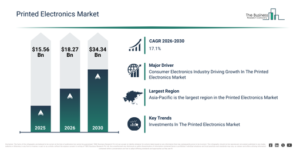
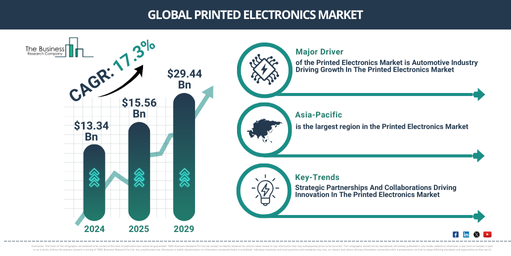
The printed electronics market has experienced substantial expansion in recent years. It is anticipated to increase from $15.56 billion in 2025 to $18.27 billion in 2026, exhibiting a compound annual growth rate (CAGR) of 17.4%. The historical rise can be attributed to several factors, including early adoption in flexible electronics, a rising demand for low-cost printed circuits, expanded use in smart packaging, growth in display and rfid printing, and a reliance on substrate-based manufacturing.
The printed electronics market is anticipated to experience substantial expansion over the coming years, projected to reach a valuation of $34.34 billion by 2030, demonstrating a compound annual growth rate (CAGR) of 17.1%. This projected growth throughout the forecast period stems from several factors, including the escalating requirement for wearable printed electronics, advancements in high-resolution printed displays, the broadening of printed battery applications, an increase in medical sensor integration, and the greater utilization of printed photovoltaics. Key developments anticipated during this period encompass the incorporation of sophisticated printed circuit technologies, the proliferation of cloud-enabled production platforms, the creation of IoT-integrated printed sensors, the expansion of sustainable printable materials, and progress in AI-assisted printing automation.
Download A Free Sample Report For Comprehensive Market Insights:
#Printed Electronics Market Demand Drivers Creating New Revenue Opportunities
The expanding consumer electronics sector is anticipated to drive the advancement of the printed electronics market. Consumer electronics encompasses electronic goods designed for everyday, non-business, or professional application by end-users. Within consumer electronics, printed electronics are utilized in the manufacturing of components like displays, sensors, and lighting systems. As an illustration, the Japan Electronics and Information Technology Industries Association, a trade body based in Japan, reported that in February 2024, the production of consumer electronic equipment reached $201.91 million (¥31,685 million), marking an increase from $149.27 million (¥23,425 million) in January 2023. Consequently, the expansion of the consumer electronics industry is projected to stimulate demand within the printed electronics market.
#Printed Electronics Market Segment Landscape And Growth Potential
The printed electronics market covered in this report is segmented –
1) By Technology: Inkjet, Screen, Gravure, Flexographic
2) By Material: Ink, Substrate
3) By Application: Displays, RFID Tags, Batteries, Photovoltaic Cells, Lighting, Other Applications
4) By End-Use Industry: Automotive & Transportation, Healthcare, Consumer Electronics, Aerospace & Defense, Construction & Architecture, Retail & Packaging, Other End User Industries
Subsegments:
1) By Inkjet: Drop-on-Demand Inkjet Printing, Continuous Inkjet Printing
2) By Screen: Flatbed Screen Printing, Rotary Screen Printing
3) By Gravure: Rotogravure Printing
4) By Flexographic: UV Flexography, Water-based Flexography
Printed Electronics Market Growth Trends Influencing Competitive Dynamics
Leading corporations within the printed electronics market are prioritizing strategic financial commitments. Such investments involve allocating resources to endeavors or ventures anticipated to offer sustained benefits for a company. For instance, in January 2023, Syenta, an Australian printed electronics startup, secured AU$ 3.7 million ($2.5 million) in seed funding, intended to accelerate the production of its multi-material 3D printers. These printers allow users to create advanced, operational electronic components like semiconductors, batteries, and sensors. Blackbird, an Australasian venture capital firm, spearheaded this transaction, having also recently guided an AU$ 35 million ($23.8 million) funding round for local bioprinting enterprise Inventia Life Science.
Printed Electronics Market Competitive Landscape: Who Are The Leading Companies?
Major companies operating in the printed electronics market are LG Display Co. Ltd., Samsung Electronics Co. Ltd., Molex LLC, Agfa-Gevaert Group, Palo Alto Research Center (PARC), BASF SE, DuPont de Nemours Inc., Xerox Corporation / Xerox Holdings Corporation, Jabil Inc., Bebop Sensors Inc., Sensing Tex S.L, E Ink Holdings Inc., Flex Ltd., Thin Film Electronics ASA, T+ink Inc., NovaCentrix Corp., Optomec Inc., Vorbeck Materials Corp., Cicor Management AG, Heidelberger Druckmaschinen AG, Henkel AG & Co. KGaA, InkTec Co. Ltd., Nissha Co. Ltd.
Access The Complete Printed Electronics Market Report:
Printed Electronics Market Largest Region By Revenue And Market Share
Asia-Pacific was the largest region in the printed electronics market in 2025, and it is also expected to be the fastest-growing region in the forecast period. The regions covered in the printed electronics market report are Asia-Pacific, South East Asia, Western Europe, Eastern Europe, North America, South America, Middle East, Africa.
Get in touch with us:
The Business Research Company: https://www.thebusinessresearchcompany.com/
Americas: +1 310-496-7795
Asia: +44 7882 955267 & +91 8897263534
Europe: +44 7882 955267
Email us at: marketing@tbrc.info
Follow us on:
LinkedIn: https://in.linkedin.com/company/the-business-research-company
YouTube: https://www.youtube.com/channel/UC24_fI0rV8cR5DxlCpgmyFQ
Global Market Model: https://www.thebusinessresearchcompany.com/global-market-model

Wasay has over a decade of experience in market research, data modelling, and analytics, with prior experience at GlobalData and Decision Tree Consulting Services. At The Business Research Company , he leads research operations across syndicated studies, customized consulting engagements, and the Global Market Model platform. His professional experience includes supporting organizations such as Boston Consulting Group, KPMG, and Ernst & Young. Wasay holds a degree in Electronics and Communications Engineering, postgraduate management qualifications from International Management Institute Belgium and Indian School of Business and Entrepreneurship, and completed the Integrated Program in Business Analytics from Indian Institute of Management Indore.