
Through market attractiveness analysis, total addressable market evaluation, company benchmarking matrices, interactive Excel dashboards, expanded supply chain intelligence, emerging startup coverage, and detailed product insights, The Business Research Company’s 2026 market reports provide more actionable and strategically valuable research.
Small Cells Market Size, Value And Growth Trends Through 2030
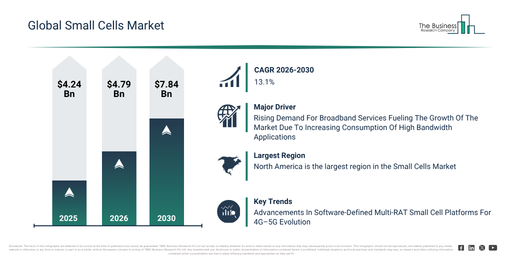
The small cells market has seen rapid expansion in recent years. This market is expected to expand from $4.24 billion in 2025 to $4.79 billion in 2026, achieving a compound annual growth rate (CAGR) of 12.9%. Historically, this growth can be attributed to factors such as increasing mobile data consumption, the expansion of urban population density, a rising demand for indoor connectivity, the early adoption of 4G LTE networks, and various telecom infrastructure modernization initiatives.
The small cells market size is expected to undergo substantial expansion in the coming years, with its value projected to reach $7.84 billion by 2030, demonstrating a compound annual growth rate (CAGR) of 13.1%. This anticipated growth during the forecast period is largely driven by factors such as the swift 5g rollout and subsequent network densification, the expanding ecosystem of iot and connected devices, a rising demand for ultra low latency applications, the development of smart cities and integrated infrastructure, and the increasing deployment of enterprise private networks. Major trends for this period include intensive urban network densification, the broadening of edge-based small cell deployments, the integration of 5g and 4g heterogeneous networks, efforts to optimize indoor connectivity for enterprises, and the growing adoption of private network and campus small cells.
Download A Free Sample Report For Comprehensive Market Insights:
https://www.thebusinessresearchcompany.com/sample_request?id=35466259&type=smp
Small Cells Market Expansion Drivers: What Is Shaping Future Growth?
The increasing requirement for broadband services is projected to stimulate the growth of the small cells market. Broadband signifies high-speed internet access that is consistently available and considerably faster than older dial-up connections, enabling efficient data transfer for digital interactions, media streaming, and cloud-based applications. The escalating demand for broadband services is primarily attributed to the growing usage of high-bandwidth applications, including video streaming, online gaming, and cloud computing. Small cells support broadband services by improving network capacity, extending coverage, and facilitating high-speed connectivity in densely populated and high-traffic areas. For instance, in May 2025, according to Ofcom, a UK-based communications regulator, the number of homes able to access gigabit-capable broadband increased to 25.9 million (86% of the United Kingdom’s 30.2 million homes), up from 25.0 million (83%) in July 2024, reflecting robust growth in broadband availability. Therefore, the rising demand for broadband services is driving the growth of the small cells.
Small Cells Market Segmentation And Category Breakdown
The small cells market covered in this report is segmented –
1) By Type: Femtocells, Picocells, Metrocells, Femto Hybrid Cells, Microcells
2) By Technology: Fourth Generation Long Term Evolution Small Cells, Fifth Generation Small Cells, Wireless Fidelity Small Cells, Long Term Evolution Unlicensed Small Cells, Citizens Broadband Radio Service Small Cells
3) By Deployment Mode: Managed Service, On Premise Solutions, Cloud Based Solutions, Distributed Antenna Systems, Self Deployable Units
4) By Application: Residential And Small Office Home Office, Enterprises, Other Applications
5) By End User Industry: Telecommunications, Healthcare, Retail, Hospitality, Transportation
Subsegments:
1) By Femtocells: Residential Femtocells, Enterprise Femtocells, Plug And Play Femtocells, Integrated Gateway Femtocells, Standalone Femtocells
2) By Picocells: Enterprise Picocells, Indoor Venue Picocells, Carrier Grade Picocells, High Capacity Picocells, Multi User Picocells
3) By Metrocells: Urban Street Metrocells, Dense Urban Metrocells, Outdoor Public Space Metrocells, High Traffic Area Metrocells, Pole Mounted Metrocells
4) By Femto Hybrid Cells: Hybrid Residential Cells, Hybrid Enterprise Cells, Dual Mode Hybrid Cells, Integrated Hybrid Cells, Multi Technology Hybrid Cells
5) By Microcells: Urban Microcells, Suburban Microcells, Outdoor Coverage Microcells, High Capacity Microcells, Wide Area Microcells
Small Cells Market Strategic Trends: What Is Defining The Next Phase Of Growth?
Major companies in the small cells market are concentrating on developing advanced technologies, such as software-defined multi-RAT small-cell platforms, to enhance network flexibility, scalability, and ensure a seamless evolution from 4G to 5G. These software-defined multi-RAT small-cell platforms represent integrated solutions that support multiple radio access technologies, including 4G LTE and 5G NR, within a single architecture, thereby enabling operators to optimize their deployments and transition networks efficiently. For example, in February 2026, Airspan Networks Holdings Inc., a US-based provider of wireless network solutions, launched AirUnity Small Cells, a software-defined small-cell portfolio specifically designed for both carrier and enterprise deployments. This platform is capable of supporting 4G LTE and 5G NR, including standalone and non-standalone modes, all within a single integrated baseband. It offers flexible deployment options across indoor and outdoor environments and accommodates both Split 2 and all-in-one architectures, empowering operators to adapt to diverse spectrum and network requirements while facilitating a software-upgradable transition from LTE to 5G.
Small Cells Market Competitive Analysis Of Major Industry Participants
Major companies operating in the small cells market are Samsung Electronics Co. Ltd.; Huawei Technologies Co. Ltd.; Cisco Systems Inc.; Broadcom Inc.; Qualcomm Incorporated; Fujitsu Limited; Telefonaktiebolaget LM Ericsson; NEC Corporation; Nokia Corporation; ZTE Corporation; Texas Instruments Incorporated; Corning Incorporated; Amphenol Corporation; American Tower Corporation; Comba Telecom Systems Holdings Limited; Ubiquiti Inc.; Mavenir Systems Inc.; Gemtek Technology Co. Ltd.; Parallel Wireless Inc.; Baicells Technologies Co. Ltd.; Octasic Inc.; Contela Inc.; Acceleran NV; Accuver Co. Ltd.
Access The Complete Small Cells Market Report:
https://www.thebusinessresearchcompany.com/report/small-cells-market-report
Small Cells Market Regional Analysis And Leading Geography
North America was the largest region in the small cells market in 2025. Asia-Pacific is expected to be the fastest-growing region in the forecast period. The regions covered in the small cells market report are Asia-Pacific, South East Asia, Western Europe, Eastern Europe, North America, South America, Middle East, Africa.
Get in touch with us:
The Business Research Company: https://www.thebusinessresearchcompany.com/
Americas: +1 310-496-7795
Asia: +44 7882 955267 & +91 8897263534
Europe: +44 7882 955267
Email us at: marketing@tbrc.info
Follow us on:
LinkedIn: https://in.linkedin.com/company/the-business-research-company
YouTube: https://www.youtube.com/channel/UC24_fI0rV8cR5DxlCpgmyFQ
Global Market Model: https://www.thebusinessresearchcompany.com/global-market-model

Wasay has over a decade of experience in market research, data modelling, and analytics, with prior experience at GlobalData and Decision Tree Consulting Services. At The Business Research Company , he leads research operations across syndicated studies, customized consulting engagements, and the Global Market Model platform. His professional experience includes supporting organizations such as Boston Consulting Group, KPMG, and Ernst & Young. Wasay holds a degree in Electronics and Communications Engineering, postgraduate management qualifications from International Management Institute Belgium and Indian School of Business and Entrepreneurship, and completed the Integrated Program in Business Analytics from Indian Institute of Management Indore.