
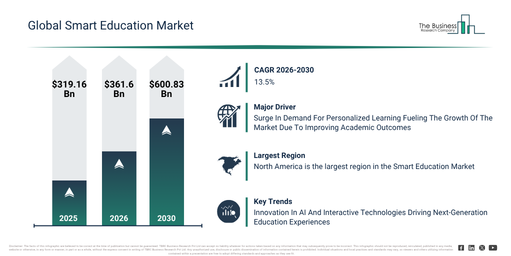
Enhanced with market attractiveness analysis, total addressable market evaluation, company benchmarking matrices, interactive Excel dashboards, expanded supply chain intelligence, emerging startup coverage, and detailed product insights, The Business Research Company’s 2026 market reports deliver more actionable and strategically valuable research.
Smart Education Market Size Outlook: How Fast Will Revenue Grow Through 2030?
The smart education market has seen swift expansion in recent years. Its size is expected to increase from $319.16 billion in 2025 to $361.6 billion in 2026, exhibiting a compound annual growth rate (CAGR) of 13.3%. The drivers behind this historical growth include greater internet availability in educational settings, the rising uptake of e-learning platforms, an increasing need for adaptable learning environments, the broadening of digital content libraries, and increased financial commitment to education technology infrastructure.
The smart education market is anticipated to experience substantial expansion in the coming years. Its valuation is projected to reach $600.83 billion by 2030, demonstrating a compound annual growth rate (CAGR) of 13.5%. This growth during the forecast period stems from the increasing need for adaptive learning solutions, the expanding implementation of cloud-based education platforms, the growing acceptance of immersive virtual learning environments, the broadening scope of data-driven education analytics, and an intensified focus on workforce upskilling and reskilling initiatives. Key trends anticipated within the same period encompass the wider embrace of personalized learning platforms, an escalating demand for real-time student performance tracking, the enhanced incorporation of gamified learning content, the proliferation of remote and hybrid learning frameworks, and a heightened emphasis on digital skill development programs.
Download A Free Sample Report For Comprehensive Market Insights:
https://www.thebusinessresearchcompany.com/sample_request?id=37243368&type=smp
Smart Education Market Growth Momentum: Which Factors Are Influencing Demand?
The escalating need for personalized learning experiences is set to drive the expansion of the smart education market. Personalized learning encompasses instructional strategies that adapt content, pace, and assessments to align with individual student requirements and capabilities. This surge in demand is fueled by the pursuit of enhanced academic outcomes, greater student engagement, and more learner-centric educational paradigms. Smart education supports personalized learning through the integration of adaptive technologies, artificial intelligence, and data analytics to tailor lessons, monitor progress, and dynamically adjust difficulty levels based on a learner’s performance. For instance, in June 2025, a study by the University of Chicago Education Lab, a US-based academic research organization, involving 17,330 students, indicated that personalized tutoring interventions yielded a 0.06–0.09 standard deviation improvement, which is equivalent to 1–2 months of additional learning. Simultaneously, programs with high participation rates showcased up to 38% higher math learning gains compared to non-participants. Therefore, the increasing demand for personalized learning experiences is a primary driver of growth in the smart education market.
Smart Education Market Segment Analysis And Revenue Opportunities
The smart education market covered in this report is segmented –
1) By Component: Hardware, Software, Services
2) By Technology: Artificial Intelligence, Augmented Reality And Virtual Reality, Big Data And Analytics, Cloud Computing, Internet Of Things
3) By Deployment Mode: Cloud Based Deployment, On Premises Deployment, Hybrid Cloud Models
4) By Application: Learning Management Systems, Virtual Classrooms, Content Digitization, Assessment And Evaluation, Simulation-Based Training, Education Analytics
5) By End-User: K-12 Schools, Higher Education, Enterprises, Government Institutions, Corporate Training
Subsegments:
1) By Hardware: Interactive Displays, Student Devices, Teacher Devices, Servers And Storage Devices, Networking Equipment, Sensors And Internet Connected Devices
2) By Software: Learning Management Platforms, Virtual Classroom Platforms, Content Authoring Tools, Assessment And Evaluation Software, Education Analytics Platforms, Student Information Systems
3) By Services: Consulting Services, Implementation And Integration Services, Training And Professional Development Services, Support And Maintenance Services, Content Development Services
Smart Education Market Trends Reshaping Industry Growth
Leading companies within the smart education market are concentrating on developing innovative solutions, such as AI-powered interactive flat panels, to foster individualized learning, boost classroom cooperation through data-driven teaching methods, optimize hybrid learning delivery, and provide expandable digital learning environments to a wider user base. These AI-enabled interactive flat panels represent advanced smart classroom screens, incorporating touch functionality, cloud connectivity, specialized annotation software, collaborative tools, and artificial intelligence capabilities to facilitate captivating lessons, instant engagement, and superior educational results compared to conventional whiteboards and projectors. A notable example occurred in November 2025, when the Canadian educational technology provider, SMART Technologies, unveiled its inaugural ‘Make in India’ SMART interactive flat panels for the education sector at DIDAC 2025. These panels are produced domestically for the Indian market, boasting excellent energy efficiency, which allows for economical implementation in educational establishments. They incorporate SMART Ink technology, facilitating smooth annotation across various file types, web pages, and applications, thereby promoting more engaging instructional experiences. With Lumio’s artificial intelligence integration, this system empowers educators to develop customized lessons, group activities, and dynamic classroom sessions. The solution supports user-friendly teaching processes, multi-user touch features, and flexible deployment across schools, higher education institutions, and corporate training settings in need of sophisticated digital learning frameworks.
Smart Education Market Leading Players Shaping Industry Direction
Major companies operating in the smart education market are upGrad Education Private Limited, Anthology Inc., Simplilearn Solutions Private Limited, LEAD School Private Limited, MasterClass Inc., Vedantu Innovations Private Limited, D2L Corporation, Go1.com Pty Ltd., InterviewBit Technologies Private Limited, Age of Learning Inc., Degreed Inc., Kajabi LLC, Thinkific Labs Inc., Classplus, Adda247, Teachmint Technologies Private Limited, ClassDojo Inc., Testbook Edu Solutions Private Limited, Skillshare Inc., MagicSchool AI Inc., IXL Learning Inc.
Access The Complete Smart Education Market Report:
https://www.thebusinessresearchcompany.com/report/smart-education-market-report
Smart Education Market Largest Region By Revenue And Market Share
North America was the largest region in the smart education market in 2025. Asia-Pacific is expected to be the fastest-growing region in the forecast period. The regions covered in the smart education market report are Asia-Pacific, South East Asia, Western Europe, Eastern Europe, North America, South America, Middle East, Africa.
Get in touch with us:
The Business Research Company: https://www.thebusinessresearchcompany.com/
Americas: +1 310-496-7795
Asia: +44 7882 955267 & +91 8897263534
Europe: +44 7882 955267
Email us at: marketing@tbrc.info
Follow us on:
LinkedIn: https://in.linkedin.com/company/the-business-research-company
YouTube: https://www.youtube.com/channel/UC24_fI0rV8cR5DxlCpgmyFQ
Global Market Model: https://www.thebusinessresearchcompany.com/global-market-model

Wasay has over a decade of experience in market research, data modelling, and analytics, with prior experience at GlobalData and Decision Tree Consulting Services. At The Business Research Company , he leads research operations across syndicated studies, customized consulting engagements, and the Global Market Model platform. His professional experience includes supporting organizations such as Boston Consulting Group, KPMG, and Ernst & Young. Wasay holds a degree in Electronics and Communications Engineering, postgraduate management qualifications from International Management Institute Belgium and Indian School of Business and Entrepreneurship, and completed the Integrated Program in Business Analytics from Indian Institute of Management Indore.