
Delivering more actionable and strategically valuable research, The Business Research Company’s 2026 market reports feature market attractiveness analysis, total addressable market evaluation, company benchmarking matrices, interactive Excel dashboards, expanded supply chain intelligence, emerging startup coverage, and detailed product insights.
Postbiotic Ingredient Market Expansion Outlook: What Revenue Opportunities Lie Ahead?
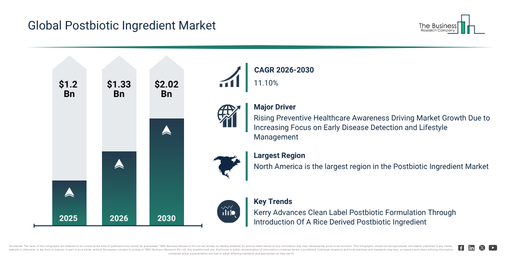
The postbiotic ingredient market size has experienced rapid expansion in recent years. This market is set to increase from $1.2 billion in 2025 to $1.33 billion in 2026, demonstrating a compound annual growth rate (CAGR) of 10.9%. Historically, this growth was driven by factors such as growing awareness of gut health benefits, increased adoption of probiotic products, a rise in functional food consumption, the expanding dietary supplement industry, and preliminary research into microbiome health advantages.
The postbiotic ingredient market is anticipated to experience substantial growth over the next few years, with its size projected to reach $2.02 billion by 2030, demonstrating a compound annual growth rate (CAGR) of 11.1%. This projected expansion can be attributed to several factors, including a rising demand for products that support immune health, an increasing prevalence of disorders linked to lifestyle, a heightened focus on preventive healthcare through nutrition, the broadening scope of personalized nutrition solutions, and greater investment in research and development centered on the microbiome. Major developments expected during this period include the wider adoption of clean-label and natural postbiotic formulations in functional foods, the deeper integration of postbiotics into customized nutrition and gut health strategies, an increased application of fermentation-derived bioactive compounds in dietary supplements, the expansion of microbiome-targeted product innovation within pharmaceutical contexts, and a growing need for stable, non-living probiotic alternatives in the development of new food and beverage products.
Download A Free Sample Report For Comprehensive Market Insights:
https://www.thebusinessresearchcompany.com/sample_request?id=71694042&type=smp
Postbiotic Ingredient Market Demand Drivers: What Is Fueling Industry Growth?
The rising need for preventive healthcare options is projected to drive the expansion of the postbiotic ingredient market in the future. Preventive healthcare encompasses measures and interventions aimed at reducing disease risk, enhancing overall wellness, and enabling early detection of health conditions before they become severe. The growing demand for preventive healthcare is fueled by increasing awareness regarding the benefits of early intervention, healthy lifestyles, and long-term disease prevention. Postbiotic ingredients support preventive healthcare by improving gut microbiome balance and strengthening immune and metabolic functions, thereby contributing to a reduced risk of chronic diseases. For example, in November 2025, according to the Organization for Economic Co-operation and Development report Health at a Glance 2025, a France-based government agency, spending on preventive care accounted for approximately 3% of total health expenditure across OECD countries, indicating that preventive care remains a relatively small share of overall health spending. Therefore, the increasing demand for preventive healthcare options is propelling the growth of the postbiotic ingredient market.
Postbiotic Ingredient Market Segment Breakdown: Which Categories Generate The Most Revenue?
The postbiotic ingredient market covered in this report is segmented –
1) By Product Type: Powder, Liquid, Capsules, Tablets, Other Product Types
2) By Source: Plant-Based, Animal-Based, Microbial-Based, Other Sources
3) By Distribution Channel: Online Stores, Supermarkets or Hypermarkets, Specialty Stores, Other Distribution Channels
4) By Application: Dietary Supplements, Functional Food And Beverages, Animal Feed, Pharmaceuticals, Personal Care, Other Applications
Subsegments:
1) By Powder: Spray Dried Postbiotic Powder, Freeze Dried Postbiotic Powder, Microencapsulated Postbiotic Powder, Heat Treated Postbiotic Powder, Fermented Postbiotic Powder
2) By Liquid: Concentrated Postbiotic Liquid, Fermented Postbiotic Liquid, Stabilized Postbiotic Liquid, Ready to Use Postbiotic Liquid, Water Soluble Postbiotic Liquid
3) By Capsules: Hard Shell Postbiotic Capsules, Soft Gel Postbiotic Capsules, Delayed Release Postbiotic Capsules, Vegetarian Postbiotic Capsules, Enteric Coated Postbiotic Capsules
4) By Tablets: Chewable Postbiotic Tablets, Effervescent Postbiotic Tablets, Sustained Release Postbiotic Tablets, Film Coated Postbiotic Tablets, Orally Disintegrating Postbiotic Tablets
5) By Other Product Types: Cell Free Supernatants, Inactivated Microbial Biomass, Peptidoglycan Derivatives, Lipoteichoic Acid Extracts, Exopolysaccharide Compounds, Enzyme Derived Metabolites, Fermentation Derived Organic Acids, Bacterial Lysate Fractions, Microbial Cell Wall Fragments, Post Fermentation Bioactive Compounds
Postbiotic Ingredient Market Innovation Trends: Which Developments Are Transforming The Industry?
Companies operating in the postbiotic ingredient market are increasingly emphasizing a shift towards clean-label formulations, such as heat-inactivated postbiotics derived from rice, to meet the rising consumer demand for functional ingredients that are safe, transparent, and naturally sourced. These ingredients consist of non-living microbial preparations specifically designed to offer gut and related wellness benefits, characterized by robust processing stability, clear label positioning, and extensive compatibility across supplement, food, and beverage formats. For example, in February 2024, Kerry Group PLC, an Ireland-based taste and nutrition company, unveiled Plenibiotic. This specific postbiotic ingredient, derived from rice, supports both gut and skin health, maintains stability across a range of temperature, moisture, and pH conditions, and is effective at low serving sizes, enabling broad formulation versatility in applications for humans and pets alike. These demonstrated attributes reinforce the significance of clean-label formulation trends within the postbiotic ingredient market.
Postbiotic Ingredient Market Key Players And Strategic Industry Positioning
Major companies operating in the postbiotic ingredient market are Nestlé S. A., Unilever PLC, BASF SE, Danone S. A., Archer Daniels Midland (ADM), Givaudan SA, dsm-firmenich, Associated British Foods (ABF), CJ CheilJedang, International Flavors & Fragrances (IFF), Asahi Group Holdings, Kerry Group, Novonesis (NZYM. VI), Kirin Holdings, Evonik Industries AG, Croda International, Symrise AG, Clariant AG, Ashland Inc., Morinaga Milk Industry
Access The Complete Postbiotic Ingredient Market Report:
https://www.thebusinessresearchcompany.com/report/postbiotic-ingredient-market-report
Postbiotic Ingredient Market Regional Distribution: Which Areas Drive Market Expansion?
North America was the largest region in the postbiotic ingredient market in 2025. Asia-Pacific is expected to be the fastest-growing region in the forecast period. The regions covered in the postbiotic ingredient market report are Asia-Pacific, South East Asia, Western Europe, Eastern Europe, North America, South America, Middle East and Africa.
Get in touch with us:
The Business Research Company: https://www.thebusinessresearchcompany.com/
Americas: +1 310-496-7795
Asia: +44 7882 955267 & +91 8897263534
Europe: +44 7882 955267
Email us at: marketing@tbrc.info
Follow us on:
LinkedIn: https://in.linkedin.com/company/the-business-research-company
YouTube: https://www.youtube.com/channel/UC24_fI0rV8cR5DxlCpgmyFQ
Global Market Model: https://www.thebusinessresearchcompany.com/global-market-model

Wasay has over a decade of experience in market research, data modelling, and analytics, with prior experience at GlobalData and Decision Tree Consulting Services. At The Business Research Company , he leads research operations across syndicated studies, customized consulting engagements, and the Global Market Model platform. His professional experience includes supporting organizations such as Boston Consulting Group, KPMG, and Ernst & Young. Wasay holds a degree in Electronics and Communications Engineering, postgraduate management qualifications from International Management Institute Belgium and Indian School of Business and Entrepreneurship, and completed the Integrated Program in Business Analytics from Indian Institute of Management Indore.