
Enhanced with market attractiveness analysis, total addressable market evaluation, company benchmarking matrices, interactive Excel dashboards, expanded supply chain intelligence, emerging startup coverage, and detailed product insights, The Business Research Company’s 2026 market reports deliver more actionable and strategically valuable research.
Gaming Merchandise Market Value Analysis: What Growth Is Expected Over The Forecast Period?
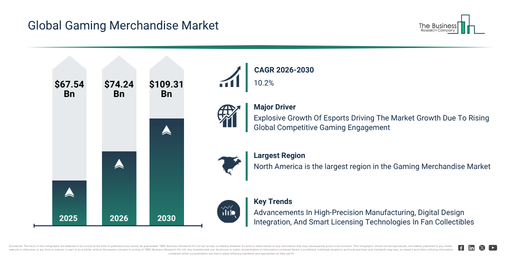
The market for gaming merchandise has seen substantial expansion in recent years. This industry is projected to grow from $67.54 billion in 2025 to $74.24 billion in 2026, demonstrating a compound annual growth rate (CAGR) of 9.9%. Historically, this increase can be attributed to the burgeoning global gaming community, the increasing popularity of video games based on franchises, the broadening reach of esports tournaments and fan culture, a heightened demand for character-based collectibles, and the proliferation of retail distribution channels for gaming merchandise.
The gaming merchandise market is anticipated to experience substantial growth in the coming years, reaching $109.31 billion by 2030, driven by a compound annual growth rate (CAGR) of 10.2%. This projected expansion can be attributed to factors such as the broadening of metaverse-linked gaming ecosystems, the increasing adoption of AI-driven personalized merchandise design, a rising consumer demand for sustainable gaming apparel and collectibles, the proliferation of direct-to-consumer gaming brand platforms, and the growing integration of digital and physical gaming experiences. Throughout this period, major trends are expected to include a surge in demand for character-driven collectible gaming merchandise, the expansion of esports-themed branded apparel ecosystems, the increasing popularity of limited edition and rare gaming collectibles, a rise in collaborations between streamers and gaming franchises for merchandise, and the personalization of gaming lifestyle accessories and décor products.
Download A Free Sample Report For Comprehensive Market Insights:
https://www.thebusinessresearchcompany.com/sample_request?id=15074715&type=smp
Gaming Merchandise Market Growth Momentum: Which Factors Are Influencing Demand?
The gaming merchandise market is projected to see significant expansion, primarily fueled by the rapid emergence of esports. Esports themselves encompass organized, competitive video gaming where individuals and teams contend in tournaments for both prizes and recognition. The increasing popularity of esports stems from rising global internet penetration, as improved access to high-speed internet allows more players and viewers to participate in online gaming and live-streamed competitive events. Gaming merchandise plays a crucial role in strengthening the esports ecosystem by boosting fan engagement and brand loyalty through themed apparel, collectibles, and accessories, which enable audiences to establish a tangible connection with their preferred teams, players, and tournaments. A case in point is a report published in June 2025 by Esports News UK, a UK-based online publication focused on daily UK esports updates, which indicated that revenues from UK games events and venues saw a remarkable increase of 140% year-on-year, reaching £10.3 ($11.05) million in 2023, in contrast to £4.35 ($4.66) million in 2022. Thus, the vigorous growth of esports is acting as a significant catalyst for the gaming merchandise market’s development.
Gaming Merchandise Market Segmentation Trends And Revenue Drivers
The gaming merchandise market covered in this report is segmented –
1) By Product Type: Apparel And Wearables, Collectibles And Figurines, Accessories And Lifestyle Products, Home Decor And Utility Merchandise, Stationery And Office Merchandise
2) By Licensing Type: Triple A Game Franchise Licensed Merchandise, Esports Team And League Licensed Merchandise, Streamer And Influencer Branded Merchandise, Retro And Classic Game Intellectual Property Merchandise, Other Licensing Types
3) By Age Group: Children, Teenagers And Young Adults, Adult Collectors, Other Age Groups
4) By Distribution Channel: Direct To Consumer Online Stores, Online Marketplaces, Offline Retail Stores, Other Distribution Channels
5) By End User: Casual Gamers, Core And Hardcore Gamers, Esports Fans, Collectors And Enthusiasts, Other End Users
Subsegments:
1) By Apparel And Wearables: T Shirts, Hooded Sweatshirts, Jackets And Outerwear, Caps And Headwear, Socks And Footwear
2) By Collectibles And Figurines: Action Figures, Character Statues, Limited Edition Models, Miniature Figurines, Replica Items
3) By Accessories And Lifestyle Products: Bags And Backpacks, Keychains And Charms, Phone Cases And Covers, Jewelry And Wristbands, Gaming Themed Watches
4) By Home Decor And Utility Merchandise: Wall Art And Posters, Bed Linen And Cushions, Lighting And Lamps, Kitchenware And Drinkware, Storage And Organizers
5) By Stationery And Office Merchandise: Notebooks And Diaries, Pens And Writing Tools, Desk Accessories, Calendars And Planners, Filing And Storage Supplies
Gaming Merchandise Market Trends Reshaping Industry Growth
Leading companies within the gaming merchandise sector are concentrating on creating novel approaches, such as a high-end, fan-centric design strategy, to enhance fan engagement, solidify brand loyalty, and deliver authentic, superior products that resonate with global gaming communities. This particular product development strategy prioritizes authentic, high-quality, and intricately detailed designs, specifically crafted to meet the tastes and demands of committed enthusiasts of a particular brand or franchise. As an illustration, in November 2025, Fanattik Ltd., a UK-based firm specializing in collectibles and merchandise, collaborated with Activision Blizzard, a US-based video game publisher, to introduce a fresh collection of officially licensed products inspired by franchises such as World of Warcraft, Diablo, Overwatch, and Hearthstone. This collection encompasses collectibles, home décor items, gifts, and accessories, all designed for gaming enthusiasts globally. The product line was distributed across Europe, North America, Japan, South Korea, Australasia, MENA, and China, thereby achieving extensive international reach and improving accessibility to high-quality gaming merchandise for fans in numerous regions.
#Gaming Merchandise Market Industry Leaders: Which Organizations Are Driving Competition?
Major companies operating in the gaming merchandise market are Microsoft Corporation, Sony Group Corporation, Nintendo Co. Ltd., Bandai Namco Entertainment Inc., Valve Corporation, Roblox Corporation, Sega Corporation, Square Enix Holdings Co. Ltd., Ubisoft Entertainment SA, Capcom Co. Ltd., Funko Inc, CD Projekt S.A., Riot Games Inc., Jinx Inc., First 4 Figures Limited, Displate, Good Smile Company, Dark Horse Comics LLC, Numskull Designs Ltd, Gaming Heads Ltd., Merchoid Ltd
Access The Complete Gaming Merchandise Market Report:
https://www.thebusinessresearchcompany.com/report/gaming-merchandise-market-report
Gaming Merchandise Market Geographic Landscape: Which Region Dominates Industry Growth?
North America was the largest region in the gaming merchandise market in 2025. Asia-Pacific is expected to be the fastest-growing region in the forecast period. The regions covered in the gaming merchandise market report are Asia-Pacific, South East Asia, Western Europe, Eastern Europe, North America, South America, Middle East, Africa.
Get in touch with us:
The Business Research Company: https://www.thebusinessresearchcompany.com/
Americas: +1 310-496-7795
Asia: +44 7882 955267 & +91 8897263534
Europe: +44 7882 955267
Email us at: marketing@tbrc.info
Follow us on:
LinkedIn: https://in.linkedin.com/company/the-business-research-company
YouTube: https://www.youtube.com/channel/UC24_fI0rV8cR5DxlCpgmyFQ
Global Market Model: https://www.thebusinessresearchcompany.com/global-market-model

Wasay has over a decade of experience in market research, data modelling, and analytics, with prior experience at GlobalData and Decision Tree Consulting Services. At The Business Research Company , he leads research operations across syndicated studies, customized consulting engagements, and the Global Market Model platform. His professional experience includes supporting organizations such as Boston Consulting Group, KPMG, and Ernst & Young. Wasay holds a degree in Electronics and Communications Engineering, postgraduate management qualifications from International Management Institute Belgium and Indian School of Business and Entrepreneurship, and completed the Integrated Program in Business Analytics from Indian Institute of Management Indore.