Enhanced with market attractiveness analysis, total addressable market evaluation, company benchmarking matrices, interactive Excel dashboards, expanded supply chain intelligence, emerging startup coverage, and detailed product insights, The Business Research Company’s 2026 market reports deliver more actionable and strategically valuable research.
Small Hydropower Market Growth Potential: How Will Market Size Change Through 2030?
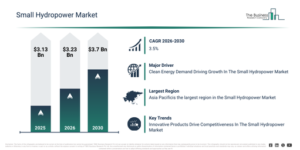
The small hydropower market size has consistently expanded in recent years. It is anticipated to increase from $3.13 billion in 2025 to $3.23 billion in 2026, achieving a compound annual growth rate (CAGR) of 3.2%. The historical growth of this market can be attributed to the early establishment of decentralized hydro systems, a surging demand for rural electrification, governmental support for small hydro initiatives, the escalating need for dependable local energy sources, and improvements in small turbine manufacturing.
The small hydropower market size is poised for consistent expansion over the upcoming years. It is projected to reach $3.7 billion by 2030, demonstrating a compound annual growth rate (CAGR) of 3.5%. This growth during the forecast period is largely due to the increasing deployment of microgrid installations, rising investments in environmentally friendly hydropower solutions, a growing need for energy reliability in distant locations, the expansion of hybrid renewable small hydro systems, and a burgeoning interest in community-based hydropower initiatives. Significant trends expected in this period include the wider adoption of compact renewable power solutions, an increasing demand for off-grid and remote area electrification, a stronger emphasis on low-impact and eco-conscious hydropower, the spread of rural electrification projects utilizing micro hydro systems, and ongoing advancements in turbine efficiency and mini hydro technologies.
Download A Free Sample Report For Comprehensive Market Insights:
#Small Hydropower Market Growth Factors: Which Forces Are Supporting Market Expansion?
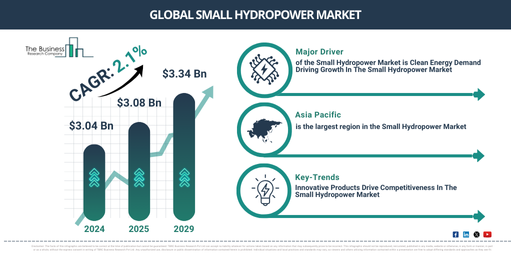
The growing demand for clean energy is anticipated to drive the small hydropower market moving ahead. “Clean energy” refers to energy sources and technologies that have minimal or no negative environmental impact, especially concerning greenhouse gas emissions and air pollution. Small hydropower systems produce electricity during operation without emitting greenhouse gases or air pollutants, thereby contributing to cleaner air and a reduced carbon footprint. For instance, in April 2025, the International Renewable Energy Agency (IRENA), a UAE-based intergovernmental organization, stated that global renewable power capacity increased by 585 GW in a single year, demonstrating a record annual growth rate of 15.1%, which surpassed the 14.3% growth rate from 2023. Therefore, the increasing demand for clean energy is propelling the small hydropower market.
Small Hydropower Market Segment Landscape: Which Areas Lead Market Development?
The small hydropower market covered in this report is segmented –
1) By Type: Micro Hydropower, Mini Hydropower
2) By Capacity: Up To 1 MW, 1–10 MW
3) By Application: Civil Construction, Power Infrastructure, Other Applications
4) By End-User: Commercial, Utility-Scale
Subsegments:
1) By Micro Hydropower: Up To 100 Kw Capacity, Off-Grid Systems
2) By Mini Hydropower: 101 Kw To 1 MW Capacity, Grid-Connected Systems
Small Hydropower Market Transformation Trends: Which Innovations Are Driving Change?
Major entities operating within the small hydropower market are concentrating on the development of innovative products, such as mini hydropower systems, to bolster their competitive edge. A mini hydropower system constitutes a compact hydropower installation that harnesses electricity from flowing water, generally possessing a capacity between 100 kW and 1 MW. Illustratively, in September 2025, Elis Co., Ltd., a Japan-based provider specializing in mini-hydropower systems and renewable energy solutions, unveiled its advanced WaterWeco mini hydropower generation system. This newly introduced system boasts an automatic load-following mechanism that modifies the turbine’s water inflow angle and the weir configuration in response to fluctuating water conditions. It is specifically engineered for installation in low-head, low-flow agricultural waterways and irrigation channels, rendering it highly appropriate for distributed renewable power generation.
Small Hydropower Market Industry Leaders And Market Competition
Major companies operating in the small hydropower market are General Electric, Siemens Energy, Toshiba Corporation, ANDRITZ, SNC Lavalin Group, Voith GmbH & Co. KGaA, Mavel, a.s., Flowserve Corporation, BHEL, Kolektor Turboinstitut, FLOVEL Energy Private Limited, Mannvit Engineering, VAPTECH, Canyon Hydro, Ganz EEM, ATB Riva Calzoni, Natel Energy, Inc., Canadian Hydro Components, Hitachi Mitsubishi Hydro, B Fouress, HydroCoil Power, Hydro Green Energy, Rentec Renewable Energy Technologies, Gilkes Hydro
Access The Complete Small Hydropower Market Report:
Small Hydropower Market Regional Analysis: Which Region Leads By Revenue?
Asia Pacific was the largest region in the small hydropower market in 2025. Asia Pacific is expected to be the fastest-growing region in the forecast period. The regions covered in the small hydropower market report are Asia-Pacific, South East Asia, Western Europe, Eastern Europe, North America, South America, Middle East, Africa.
Get in touch with us:
The Business Research Company: https://www.thebusinessresearchcompany.com/
Americas: +1 310-496-7795
Asia: +44 7882 955267 & +91 8897263534
Europe: +44 7882 955267
Email us at: marketing@tbrc.info
Follow us on:
LinkedIn: https://in.linkedin.com/company/the-business-research-company
YouTube: https://www.youtube.com/channel/UC24_fI0rV8cR5DxlCpgmyFQ
Global Market Model: https://www.thebusinessresearchcompany.com/global-market-model

Wasay has over a decade of experience in market research, data modelling, and analytics, with prior experience at GlobalData and Decision Tree Consulting Services. At The Business Research Company , he leads research operations across syndicated studies, customized consulting engagements, and the Global Market Model platform. His professional experience includes supporting organizations such as Boston Consulting Group, KPMG, and Ernst & Young. Wasay holds a degree in Electronics and Communications Engineering, postgraduate management qualifications from International Management Institute Belgium and Indian School of Business and Entrepreneurship, and completed the Integrated Program in Business Analytics from Indian Institute of Management Indore.