Delivering more actionable and strategically valuable research, The Business Research Company’s 2026 market reports feature market attractiveness analysis, total addressable market evaluation, company benchmarking matrices, interactive Excel dashboards, expanded supply chain intelligence, emerging startup coverage, and detailed product insights.
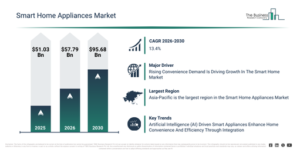
Smart Home Appliances Market Expected To Reach $95.68 Billion By 2030 At 13.4% CAGR
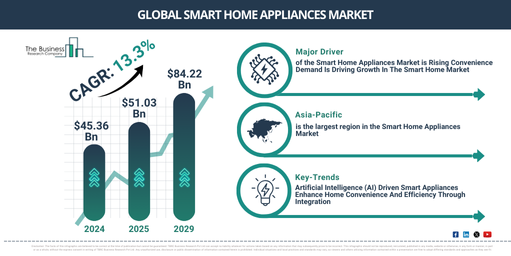
The market for smart home appliances has experienced rapid expansion in recent years. It is anticipated to grow from $51.03 billion in 2025 to $57.79 billion in 2026, achieving a compound annual growth rate (CAGR) of 13.3%. Historically, this growth can be attributed to a rise in household automation adoption, the early integration of wireless connectivity, a heightened consumer focus on convenience, the expansion of residential construction activities, and the increasing use of mobile app-controlled devices.
The smart home appliances market is set for significant expansion in the foreseeable future. Its valuation is predicted to climb to $95.68 billion by 2030, exhibiting a compound annual growth rate (CAGR) of 13.4%. This anticipated growth during the forecast period is largely driven by advances in AI-powered automation, an increasing desire for energy-saving solutions, modernization efforts in home security, wider adoption of high-speed internet, and enhanced interoperability across various devices in the ecosystem. Prominent trends for this period include a rising consumer demand for energy-efficient smart appliances, greater integration of voice control and virtual assistant technologies, an expansion of features for remote monitoring and predictive maintenance, increased implementation of smart security and safety-focused home devices, and a consumer preference for multi-functional and compact smart appliances.
Download A Free Sample Report For Comprehensive Market Insights:
Smart Home Appliances Market Growth Factors Supporting Long-Term Expansion
The advancement in connectivity infrastructure is anticipated to propel the smart home appliances market going forward. This infrastructure refers to the network systems and hardware that facilitate seamless communication and data transfer among devices, systems, and users. A crucial factor behind the growth in connectivity infrastructure is the rise of IoT (Internet of Things), as an increasing number of connected devices demand faster, reliable networks for smooth operation. Connectivity infrastructure allows smart home devices to interact, share data, and be remotely controlled, thereby improving convenience and energy efficiency for users. For instance, in 2023, according to a report published by Ericsson, a Sweden-based telecommunications company, total IoT connections reached 15.7 billion connections in 2023 and are expected to increase by 16% to 38.8 billion connections by 2029. Therefore, the improving connectivity infrastructure is a key driver for the smart home appliances market.
Smart Home Appliances Market Segmentation Trends And Revenue Drivers
The smart home appliances market covered in this report is segmented –
1) By Product: Washing Machine, Dishwasher, Refrigerator, Air Conditioner, Security Devices, Lighting Devices, Other Products
2) By Technology: Wi-Fi, Radio Frequency Identification, ZigBee, Cellular Technology, Bluetooth, Other Technologies
3) By Distribution Channel: Online, Offline
4) By Application: Personal, Commercial, Other Applications
Subsegments:
1) By Washing Machine: Front-Load Washing Machines, Top-Load Washing Machines, Washer-Dryer Combos
2) By Dishwasher: Built-In Dishwashers, Portable Dishwashers, Countertop Dishwashers
3) By Refrigerator: French Door Refrigerators, Side-by-Side Refrigerators, Top Freezer Refrigerators, Bottom Freezer Refrigerators
4) By Air Conditioner: Window Air Conditioners, Portable Air Conditioners, Split Air Conditioners, Central Air Conditioners
5) By Security Devices: Smart Locks, Surveillance Cameras, Motion Sensors, Alarm Systems
6) By Lighting Devices: Smart Bulbs, Smart Switches, Smart Light Strips, Smart Fixtures
7) By Other Products: Smart Thermostats, Smart Plugs, Smart Speakers, Smart Home Hubs
Smart Home Appliances Market Trends: What Is Shaping Future Industry Growth?
Leading companies in the smart home appliances market are concentrating on developing advanced solutions, such as artificial intelligence (AI)-driven smart connected appliances, with the goal of improving home convenience and efficiency through intelligent, connected devices that adapt to user behavior and requirements. Artificial intelligence (AI)-driven smart connected appliances are devices equipped with AI technology capable of analyzing data, learning from user interactions, and communicating with other smart devices to automate and enhance household functions. For instance, in April 2024, Samsung Electronics Co. Ltd., a South Korea-based company specializing in semiconductors and electronic products, introduced new connected Bespoke AI-Powered Home Appliances. This lineup includes the Bespoke French Door Refrigerator with AI Family Hub+, Bespoke Infinite Induction Line, Bespoke AI Laundry Combo, Bespoke Jet Bot Combo AI, Bespoke Jet AI, and Bespoke Cube Air Infinite Line. These products offer features like AI-driven cycle adjustments, food management using internal cameras, and smart connectivity through SmartThings, significantly boosting home convenience, efficiency, and integration into daily tasks.
#Smart Home Appliances Market Industry Leaders: Which Organizations Are Driving Competition?
Major companies operating in the smart home appliances market are Apple Inc., Google LLC (Alphabet Inc.), Samsung Electronics Co. Ltd., Robert Bosch GmbH, Hitachi Ltd., Sony Corporation, LG Electronics, Panasonic Corporation, Midea Group, Xiaomi Corporation, Haier Group, ABB Group, Whirlpool Corporation, Sharp Corp., Koninklijke Philips N.V., Emerson Electric Co., Electrolux Group, Hisense Electrical Co Ltd, Miele & Cie. KG, Ecovacs Robotics Co Ltd, iRobot Corporation, Neato Robotics Inc.
Access The Complete Smart Home Appliances Market Report:
Smart Home Appliances Market Geographic Distribution And Regional Opportunities
Asia-Pacific was the largest region in the smart home appliances market in 2025. Europe is expected to be the fastest-growing region in the forecast period. The regions covered in the smart home appliances market report are Asia-Pacific, South East Asia, Western Europe, Eastern Europe, North America, South America, Middle East, Africa.
Get in touch with us:
The Business Research Company: https://www.thebusinessresearchcompany.com/
Americas: +1 310-496-7795
Asia: +44 7882 955267 & +91 8897263534
Europe: +44 7882 955267
Email us at: marketing@tbrc.info
Follow us on:
LinkedIn: https://in.linkedin.com/company/the-business-research-company
YouTube: https://www.youtube.com/channel/UC24_fI0rV8cR5DxlCpgmyFQ
Global Market Model: https://www.thebusinessresearchcompany.com/global-market-model

Wasay has over a decade of experience in market research, data modelling, and analytics, with prior experience at GlobalData and Decision Tree Consulting Services. At The Business Research Company , he leads research operations across syndicated studies, customized consulting engagements, and the Global Market Model platform. His professional experience includes supporting organizations such as Boston Consulting Group, KPMG, and Ernst & Young. Wasay holds a degree in Electronics and Communications Engineering, postgraduate management qualifications from International Management Institute Belgium and Indian School of Business and Entrepreneurship, and completed the Integrated Program in Business Analytics from Indian Institute of Management Indore.