
Delivering more actionable and strategically valuable research, The Business Research Company’s 2026 market reports feature market attractiveness analysis, total addressable market evaluation, company benchmarking matrices, interactive Excel dashboards, expanded supply chain intelligence, emerging startup coverage, and detailed product insights.
Military Edge Computing Market Growth Potential: How Will Market Size Change Through 2030?
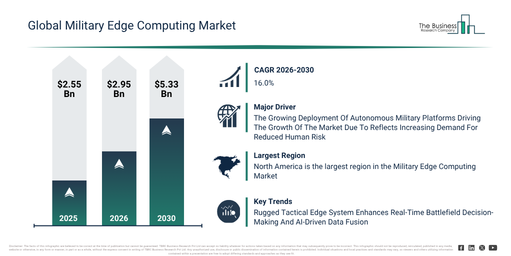
In recent years, the military edge computing market has experienced rapid growth in its size. Forecasts indicate it will expand from $2.55 billion in 2025 to $2.95 billion in 2026, achieving a compound annual growth rate (CAGR) of 15.7%. In the past, this growth was primarily driven by the increasing digitization of defense operations, a greater need for real-time battlefield decision-making, the expansion of sensor-based surveillance systems, the proliferation of network-centric warfare strategies, and the modernization of legacy military infrastructure.
The military edge computing market is projected to experience substantial expansion in the coming years. This market is predicted to reach $5.33 billion by 2030, demonstrating a compound annual growth rate (CAGR) of 16.0%. This anticipated growth throughout the forecast period stems from several factors, including the increased deployment of autonomous combat systems, a heightened need for disconnected and robust battlefield networks, greater investment in computing infrastructure deployed at the front lines, the expanding implementation of multi-domain operations strategies, and continuous progress in low-latency technologies crucial for mission-critical processing. Key trends expected during this period involve the optimization of ruggedized tactical edge hardware, the development of offline-first computing systems essential for critical missions, the creation of modular and plug-and-play battlefield edge architectures, enhanced integration of legacy defense systems at the edge for interoperability, and the introduction of energy-efficient portable computing solutions for defense applications.
Download A Free Sample Report For Comprehensive Market Insights:
https://www.thebusinessresearchcompany.com/sample_request?id=26135760&type=smp
Military Edge Computing Market Demand Drivers: What Is Fueling Industry Growth?
The expansion in the use of autonomous military platforms is anticipated to fuel the advancement of the military edge computing market in the future. These platforms are defined as self-governing systems, including drones, vehicles, or weaponry, capable of executing defense and combat operations with little to no human input, leveraging sensors, artificial intelligence, and integrated decision-making functions. Their increased adoption stems from a requirement to minimize human risk during combat, alongside enhancing mission effectiveness and accelerating battlefield decision-making processes. Military edge computing facilitates autonomous military platforms through the local processing of data directly at the battlefield’s edge, thereby enabling quicker real-time decisions, lower latency, and increased operational independence, free from dependence on central command structures. For example, in June 2025, the Ministry of Defense, a UK-based government body, reported that the UK plans to invest $0.44 billion (£350 million) to boost Ukraine’s drone provisions, scaling production from 10,000 units in 2024 to 100,000 units in 2025. Consequently, the expanding utilization of autonomous military platforms is propelling the expansion of the military edge computing market.
Military Edge Computing Market Segment Analysis Highlighting Growth Areas
The military edge computing market covered in this report is segmented –
1) By Component: Hardware, Software, Services
2) By Platform: Land, Airborne, Naval
3) By Deployment Type: On Premises, Cloud Based, Hybrid
4) By Application: Command And Control Systems, Surveillance And Reconnaissance, Data Processing And Analysis, Simulation And Training, Logistics And Transportation
5) By End User: Defense, Government, Aerospace, Commercial, Other End Users
Subsegments:
1) By Hardware: Processing Units, Data Storage Devices, Networking Equipment, Edge Servers And Gateways, Ruggedized Computing Devices
2) By Software: Edge Computing Platforms, Data Analytics And Processing Software, Artificial Intelligence And Machine Learning Software, Cybersecurity And Encryption Software, Network Management And Orchestration Software
3) By Services: System Integration Services, Deployment And Installation Services, Maintenance And Support Services, Consulting And Advisory Services, Training And Simulation Services
Military Edge Computing Market Innovation Trends: Which Developments Are Transforming The Industry?
Major companies operating in the military edge computing market are focusing on developing innovative platforms, such as ruggedized edge computing platforms, to enable real-time data processing and decision-making in harsh battlefield environments. These ruggedized edge computing platforms are durable computing systems designed to operate reliably in extreme military or industrial environments while processing data close to where it is generated for real-time decision-making. For instance, in March 2026, Leonardo DRS Inc., a US-based defense technology company, launched THOR (Tactical High-Performance Embedded Computing Open Architecture Rugged), a rugged edge computing system designed to deliver high-performance processing at the tactical edge for battlefield operations. The system supports artificial intelligence-enabled decision-making, multi-sensor data fusion, and real-time analytics, while operating reliably in extreme environments and enabling faster, more informed decisions in mission-critical scenarios.
Military Edge Computing Market Leading Companies: Who Holds Significant Market Presence?
Major companies operating in the military edge computing market are Microsoft Corporation, Amazon Web Services Inc., RTX Corporation, Lockheed Martin Corporation, Dell Technologies Inc., International Business Machines Corporation, NVIDIA Corporation, Cisco Systems Inc., General Dynamics Corporation, Northrop Grumman Corporation, Honeywell International Inc., BAE Systems plc, Hewlett Packard Enterprise Company, Thales S.A., L3Harris Technologies Inc., Leidos Holdings Inc., Leonardo S.p.A., Booz Allen Hamilton Holding Corp., CACI International Inc., Elbit Systems Ltd., Viasat Inc., Saab AB, Curtiss-Wright Corporation, Mercury Systems Inc.
Access The Complete Military Edge Computing Market Report:
https://www.thebusinessresearchcompany.com/report/military-edge-computing-market-report
Military Edge Computing Market Global Footprint: Which Region Holds Market Leadership?
North America was the largest region in the military edge computing market in 2025. Asia-Pacific is expected to be the fastest-growing region in the forecast period. The regions covered in the military edge computing report are Asia-Pacific, South East Asia, Western Europe, Eastern Europe, North America, South America, Middle East, Africa.
Get in touch with us:
The Business Research Company: https://www.thebusinessresearchcompany.com/
Americas: +1 310-496-7795
Asia: +44 7882 955267 & +91 8897263534
Europe: +44 7882 955267
Email us at: marketing@tbrc.info
Follow us on:
LinkedIn: https://in.linkedin.com/company/the-business-research-company
YouTube: https://www.youtube.com/channel/UC24_fI0rV8cR5DxlCpgmyFQ
Global Market Model: https://www.thebusinessresearchcompany.com/global-market-model

Wasay has over a decade of experience in market research, data modelling, and analytics, with prior experience at GlobalData and Decision Tree Consulting Services. At The Business Research Company , he leads research operations across syndicated studies, customized consulting engagements, and the Global Market Model platform. His professional experience includes supporting organizations such as Boston Consulting Group, KPMG, and Ernst & Young. Wasay holds a degree in Electronics and Communications Engineering, postgraduate management qualifications from International Management Institute Belgium and Indian School of Business and Entrepreneurship, and completed the Integrated Program in Business Analytics from Indian Institute of Management Indore.