
Delivering more actionable and strategically valuable research, The Business Research Company’s 2026 market reports feature market attractiveness analysis, total addressable market evaluation, company benchmarking matrices, interactive Excel dashboards, expanded supply chain intelligence, emerging startup coverage, and detailed product insights.
#Military Reconnaissance Market Size And Revenue Forecast Through 2030
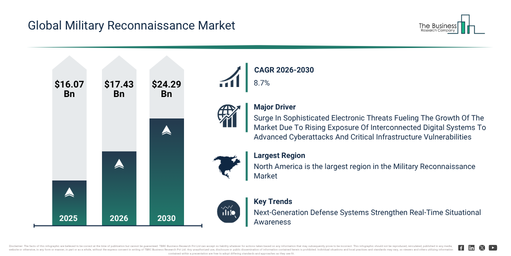
The military reconnaissance market size has shown significant growth in recent years. It is anticipated to increase from $16.07 billion in 2025 to $17.43 billion in 2026, exhibiting a compound annual growth rate (CAGR) of 8.4%. This historical expansion can be linked to heightened cross-border security tensions, the development of aerial surveillance programs, a growing requirement for battlefield situational awareness, improvements in defense intelligence infrastructure, and an increase in satellite-based reconnaissance capabilities.
The military reconnaissance market is projected to experience substantial expansion over the upcoming years. Its value is anticipated to reach $24.29 billion by 2030, exhibiting a compound annual growth rate (CAGR) of 8.7%. This projected growth during the forecast period is fueled by several factors, including the proliferation of autonomous reconnaissance operations, the rising integration of real-time intelligence analytics, the expansion of space-based surveillance platforms, the increasing need for distributed battlefield intelligence networks, and breakthroughs in hypersonic and stealth detection capabilities. Key trends expected within this period encompass reconnaissance systems utilizing multi-sensor fusion, methods for stealth-enabled surveillance data gathering, real-time geospatial intelligence mapping, low-signature intelligence surveillance platforms, and edge-enabled battlefield data processing units.
Download A Free Sample Report For Comprehensive Market Insights:
https://www.thebusinessresearchcompany.com/sample_request?id=13592755&type=smp
Military Reconnaissance Market Development Factors: Which Trends Are Supporting Demand?
The rising sophisticated electronic threats are projected to propel the expansion of the military reconnaissance market. These threats involve advanced, synchronized cyberattacks that employ developing digital methods to penetrate, disrupt, or compromise systems, networks, and vital infrastructure. The surge in such threats stems from increasing digital interconnectedness, given that greater dependence on integrated systems and networks generates additional vulnerabilities for advanced cyberattacks. Military reconnaissance plays a crucial role in countering sophisticated electronic threats by identifying, observing, and examining hostile electronic signals and cyber operations, thereby facilitating early alerts and well-informed defensive actions. For example, in December 2024, the techUK, a UK-based non-profit organization, reported that the National Cyber Security Centre (UK) informed 542 organisations about cyber incidents, which was over double the 258 reported in the preceding year, with 89 considered nationally significant and 12 categorized as severe. Consequently, the escalation of sophisticated electronic threats is fostering the growth of the military reconnaissance market.
Military Reconnaissance Market Segment Breakdown: Which Categories Generate The Most Revenue?
The military reconnaissance market covered in this report is segmented –
1) By Type: Signal Intelligence, Imagery Intelligence, Electronic Intelligence, Measurement And Signature Intelligence
2) By Platform: Unmanned Aerial Vehicles (UAV), Satellites, Manned Aircraft, Ground Vehicles, Naval Vessels
3) By Application: Surveillance And Monitoring, Target Acquisition, Battle Damage Assessment, Electronic Warfare Support, Early Warning Systems
4) By End User: Army, Navy, Air Force, Defense Intelligence Agencies
Subsegments:
1) By Signal Intelligence: Communications Intelligence, Foreign Communications Interception, Electronic Support Measures Intelligence
2) By Imagery Intelligence: Satellite Imagery Analysis, Aerial Reconnaissance Imagery Analysis, Geospatial Mapping Intelligence, Infrared Imaging Analysis, Synthetic Aperture Radar Imaging Analysis
3) By Electronic Intelligence: Radar Signal Interception, Electronic Emissions Monitoring, Air Defense Radar Tracking, Missile Guidance Signal Analysis, Electronic Signal Characterization
4) By Measurement And Signature Intelligence: Nuclear Signature Detection, Chemical Signature Analysis, Radar Cross Section Measurement, Infrared Signature Analysis, Acoustic Signature Detection, Seismic Signature Detection
Military Reconnaissance Market Transformation Trends: Which Innovations Are Driving Change?
Leading companies within the military reconnaissance sector are concentrating their efforts on advancing sophisticated intelligence, surveillance, and reconnaissance (ISR) functionalities, encompassing innovations like AI-powered situational awareness systems and integrated next-generation sensors. The objective is to bolster real-time threat identification, elevate battlefield understanding, and facilitate swifter decision-making within intricate operational settings. AI-powered situational awareness systems and next-generation sensor integration involve leveraging artificial intelligence to merge and analyze data from advanced sensors instantly, thereby improving detection, tracking, and strategic choices in challenging environments. A notable example occurred in November 2025 when SpaceX, an aerospace and artificial intelligence firm based in the US, deployed a reconnaissance satellite for South Korea as part of its military satellite initiative, aiming to boost space-based ISR capacities. Such endeavors are engineered to back enhanced national security and strategic observation, enabling rapid data acquisition, improved situational understanding, and more efficacious decision-making throughout defense operations, consequently reinforcing the overall efficacy of reconnaissance in contemporary warfare scenarios.
Military Reconnaissance Market Key Players And Strategic Industry Positioning
Major companies operating in the military reconnaissance market are The Boeing Company, RTX Corporation, Lockheed Martin Corporation, General Dynamics Corporation, Northrop Grumman Corporation, Airbus Defence and Space S.A., BAE Systems plc, L3Harris Technologies Inc., Thales Group, Leonardo S.p.A., Textron Systems Corporation, CACI International Inc., Rheinmetall AG, Elbit Systems Ltd., Teledyne Technologies Incorporated, General Atomics Aeronautical Systems Inc., HENSOLDT AG, Palantir Technologies Inc., AeroVironment Inc., Planet Labs PBC, BlackSky Technology Inc., QinetiQ Group plc, Elistair SAS
Access The Complete Military Reconnaissance Market Report:
https://www.thebusinessresearchcompany.com/report/military-reconnaissance-market-report
Military Reconnaissance Market Largest Region By Revenue And Market Share
North America was the largest region in the military reconnaissance market in 2025. Asia-Pacific is expected to be the fastest-growing region in the forecast period. The regions covered in the military reconnaissance report are Asia-Pacific, South East Asia, Western Europe, Eastern Europe, North America, South America, Middle East, Africa.
Get in touch with us:
The Business Research Company: https://www.thebusinessresearchcompany.com/
Americas: +1 310-496-7795
Asia: +44 7882 955267 & +91 8897263534
Europe: +44 7882 955267
Email us at: marketing@tbrc.info
Follow us on:
LinkedIn: https://in.linkedin.com/company/the-business-research-company
YouTube: https://www.youtube.com/channel/UC24_fI0rV8cR5DxlCpgmyFQ
Global Market Model: https://www.thebusinessresearchcompany.com/global-market-model

Wasay has over a decade of experience in market research, data modelling, and analytics, with prior experience at GlobalData and Decision Tree Consulting Services. At The Business Research Company , he leads research operations across syndicated studies, customized consulting engagements, and the Global Market Model platform. His professional experience includes supporting organizations such as Boston Consulting Group, KPMG, and Ernst & Young. Wasay holds a degree in Electronics and Communications Engineering, postgraduate management qualifications from International Management Institute Belgium and Indian School of Business and Entrepreneurship, and completed the Integrated Program in Business Analytics from Indian Institute of Management Indore.