
Enhanced with market attractiveness analysis, total addressable market evaluation, company benchmarking matrices, interactive Excel dashboards, expanded supply chain intelligence, emerging startup coverage, and detailed product insights, The Business Research Company’s 2026 market reports deliver more actionable and strategically valuable research.
Military Tactical Communications Market Expansion From $25.27 Billion In 2026 To $32.97 Billion In 2030
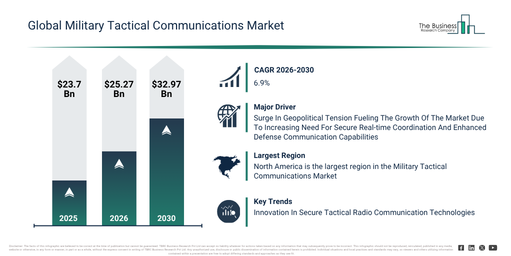
Recent years have witnessed strong expansion in the military tactical communications market size. It is projected to expand from $23.7 billion in 2025 to $25.27 billion in 2026, exhibiting a compound annual growth rate (CAGR) of 6.6%. This historical growth is largely due to the shift from analog to digital radio systems, the scaling up of satellite-based military communications, the advent of network-centric warfare strategies, escalating cross-border security threats, and the modernization of command and control infrastructure.
The military tactical communications market is poised for substantial growth over the coming years, with its size projected to reach $32.97 billion by 2030, advancing at a compound annual growth rate (CAGR) of 6.9%. This expansion during the forecast period is primarily driven by factors such as the embrace of AI-driven battlefield communication optimization, the proliferation of low earth orbit (leo) satellite communication networks, an escalating demand for quantum resistant encryption systems, heightened investment in multi-domain operational readiness, and the integration of autonomous defense communication systems. Key trends anticipated during this period encompass secure multi-domain tactical communication interoperability, anti-jamming and electronic warfare resistant communication systems, low latency battlefield data transmission networks, ruggedized and portable communication terminals designed for field operations, and encrypted real-time voice, data, and video communication systems.
Download A Free Sample Report For Comprehensive Market Insights:
https://www.thebusinessresearchcompany.com/sample_request?id=85546673&type=smp
Military Tactical Communications Market Expansion Supported By Key Demand Factors
The military tactical communications market is projected to experience growth in the future due to increasing geopolitical tension. Geopolitical tension refers to heightened political, economic, or military conflicts and uncertainties among countries or regions that can impact global stability and security. This escalation in geopolitical tension is driven by intensified regional power competition, as nations expand military capabilities and strategic alliances to bolster their security and influence. Military tactical communications help alleviate geopolitical tension by facilitating secure, real-time coordination and information sharing among defense forces, which improves situational awareness and reduces the risk of miscommunication or escalation during conflicts. For instance, in July 2024, the Armed Conflict Location and Event Data, a US-based non-profit organization, reported that over 165,273 incidents of political violence occurred worldwide between July 2023 and June 2024, marking a 15% increase from the previous year. During this period, it is estimated that approximately one in seven people globally were affected by conflict. Therefore, rising geopolitical tension is driving the growth of the military tactical communications market.
Military Tactical Communications Market Segmentation And Category Breakdown
The military tactical communications market covered in this report is segmented –
1) By Component: Hardware, Software
2) By Communication Type: Airborne Communication, Ground Communication, Naval Communication, Underwater Communication
3) By Technology: Satellite Communication (SATCOM), Very High Frequency Or Ultra High Frequency Or L Band, High Frequency Communication
4) By Application: Command And Control, Intelligence Surveillance And Reconnaissance, Situational Awareness, Routine Operations
5) By End User: Army, Navy, Air Force, Special Forces
Subsegments:
1) By Hardware: Communication Radios, Signal Processors, Antennas, Transceivers, Power Supply Units, Control Consoles, Encryption Devices, Network Interface Devices, Satellite Terminals, Routing Equipment
2) By Software: Network Management Software, Communication Security Software, Signal Processing Software, Data Encryption Software, Mission Planning Software, Spectrum Management Software, Interoperability Software, Command And Control Software, Communication Analytics Software
Military Tactical Communications Market Growth Trends Influencing Competitive Dynamics
Major companies operating in the military tactical communications market are prioritizing the creation of advanced communication solutions, including next-generation secure radio communication systems, to improve real-time data exchange, enhance interoperability, and guarantee reliable connectivity in complex and challenged operational environments. Next-generation secure radio communication systems refer to sophisticated, software-defined wireless platforms that enable encrypted, resilient, and interoperable voice and data transmission across multiple frequencies and operational settings. For example, in May 2024, Spectra Group, a UK-based defense communications firm, unveiled GENSS, its new tactical radio communications system, at SOF Week 2024. This system is a modular, software-defined tactical radio system designed to provide high interoperability through simple and rapid software reprogramming. It operates across HF, VHF, UHF, and satellite bands, enabling dependable beyond-line-of-sight communications and supporting mobile communications across land, sea, and air domains. The system integrates network-sensing capabilities with improved data transmission performance, supporting higher data rates over narrowband LTAC channels. Its flexible architecture allows it to adapt swiftly to evolving mission requirements while maintaining secure voice and high-bandwidth data connectivity.
Military Tactical Communications Market Competitive Analysis Of Major Industry Participants
Major companies operating in the military tactical communications market are Airbus Defence and Space GmbH, RTX Corporation, Lockheed Martin Corporation, General Dynamics Corporation, Northrop Grumman Corporation, Honeywell International Inc., BAE Systems plc, Collins Aerospace, Thales S.A., L3Harris Technologies Inc., Leonardo S.p.A., Elbit Systems Ltd., Israel Aerospace Industries Ltd., Saab AB, Rafael Advanced Defense Systems Ltd., ASELSAN A.S., Rohde & Schwarz GmbH & Co. KG, Curtiss-Wright Corporation, HENSOLDT AG, Bittium Corporation, Cisco Systems Inc., Viasat Inc., Kratos Defense & Security Solutions, Leonardo DRS Inc., Motorola Solutions Inc.
Access The Complete Military Tactical Communications Market Report:
https://www.thebusinessresearchcompany.com/report/military-tactical-communications-market-report
Military Tactical Communications Market Regional Outlook: Where Are The Largest Opportunities Located?
North America was the largest region in the military tactical communications market in 2025. Asia-Pacific is expected to be the fastest-growing region in the forecast period. The regions covered in the military tactical communications report are Asia-Pacific, South East Asia, Western Europe, Eastern Europe, North America, South America, Middle East, Africa.
Get in touch with us:
The Business Research Company: https://www.thebusinessresearchcompany.com/
Americas: +1 310-496-7795
Asia: +44 7882 955267 & +91 8897263534
Europe: +44 7882 955267
Email us at: marketing@tbrc.info
Follow us on:
LinkedIn: https://in.linkedin.com/company/the-business-research-company
YouTube: https://www.youtube.com/channel/UC24_fI0rV8cR5DxlCpgmyFQ
Global Market Model: https://www.thebusinessresearchcompany.com/global-market-model

Wasay has over a decade of experience in market research, data modelling, and analytics, with prior experience at GlobalData and Decision Tree Consulting Services. At The Business Research Company , he leads research operations across syndicated studies, customized consulting engagements, and the Global Market Model platform. His professional experience includes supporting organizations such as Boston Consulting Group, KPMG, and Ernst & Young. Wasay holds a degree in Electronics and Communications Engineering, postgraduate management qualifications from International Management Institute Belgium and Indian School of Business and Entrepreneurship, and completed the Integrated Program in Business Analytics from Indian Institute of Management Indore.