
Delivering more actionable and strategically valuable research, The Business Research Company’s 2026 market reports feature market attractiveness analysis, total addressable market evaluation, company benchmarking matrices, interactive Excel dashboards, expanded supply chain intelligence, emerging startup coverage, and detailed product insights.
Military Wireless Communication Market CAGR Analysis And Future Market Development
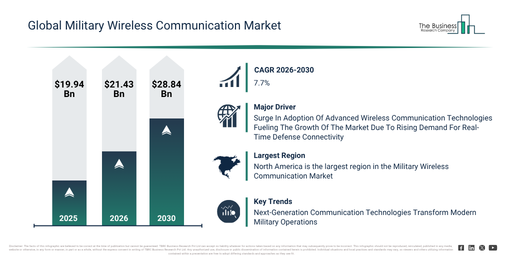
The military wireless communication market size has seen robust expansion in recent years. It is anticipated to increase from $19.94 billion in 2025 to $21.43 billion in 2026, demonstrating a compound annual growth rate (CAGR) of 7.5%. The growth observed in the past can be attributed to the transition from analog to digital wireless communication systems, the expansion of satellite based defense communication infrastructure, the rise of network centric warfare strategies, the increasing demand for real time battlefield connectivity, and the modernization of military radio frequency systems.
The military wireless communication market size is anticipated to experience substantial growth in the upcoming years. It is projected to expand to $28.84 billion by 2030, demonstrating a compound annual growth rate (CAGR) of 7.7%. This expansion during the forecast period is attributable to the integration of AI-driven adaptive wireless communication systems, the expansion of LEO satellite constellations for defense communication, the increasing adoption of quantum-resistant encryption protocols, a rising demand for autonomous battlefield communication networks, and heightened investment in resilient multi-domain wireless infrastructure. Significant trends in the forecast period include software-defined secure wireless communication systems, satellite-enabled military wireless networks, encrypted mesh networking for battlefield coordination, low-latency RF-based tactical communication systems, and multi-domain interoperable wireless communication platforms.
Download A Free Sample Report For Comprehensive Market Insights:
https://www.thebusinessresearchcompany.com/sample_request?id=85882806&type=smp
#Military Wireless Communication Market Demand Drivers Creating New Revenue Opportunities
The rising integration of advanced wireless communication technologies is projected to fuel the expansion of the military wireless communication market moving forward. These advanced technologies refer to contemporary communication systems such as 5G, satellite communication, and secure tactical networks, which enable high-speed, reliable, and real-time data transmission during military operations. Their increasing adoption stems from a heightened requirement for secure, resilient, and high-bandwidth communication infrastructure in defense and tactical environments. Military wireless communication systems address this need by ensuring seamless connectivity, improved situational awareness, and efficient command and control across various defense activities. For instance, in 2023, according to the International Telecommunication Union, a Switzerland-based specialized agency, there were 87 mobile-broadband subscriptions per 100 inhabitants globally in 2023, with mobile-broadband subscriptions growing by 27% over the past five years. Thus, the increasing uptake of advanced wireless communication technologies is a primary driver for the growth of the military wireless communication market.
Military Wireless Communication Market Segment Analysis And Revenue Opportunities
The military wireless communication market covered in this report is segmented –
1) By Component: Hardware, Software, Services
2) By Technology: Software Defined Radio, Satellite Communication, Secure Mobile Communication, Mesh Networking, Radio Frequency Communication
3) By Platform: Land Based, Airborne, Naval, Space Based
4) By Application: Voice Communication, Data Communication, Video Communication, Network Management, Situational Awareness
5) By End Use: Defense Forces, Government Agencies, Aerospace, Naval, Ground Forces
Subsegments:
1) By Hardware: Communication Devices, Network Equipment, Antenna Systems, Signal Transmitters, Signal Receivers
2) By Software: Network Management Software, Communication Control Software, Encryption Software, Signal Processing Software, Monitoring Software
3) By Services: Integration Services, Maintenance Services, Consulting Services, Training Services, Support Services
Military Wireless Communication Market Trends Driving Strategic Industry Expansion
Leading firms within the military wireless communication market are prioritizing the creation of advanced solutions, notably software-defined radios (SDRs), to facilitate secure, adaptable, and interoperable communication across varied frequencies and dynamic operational settings. These SDRs function as communication systems where essential radio tasks, including modulation, demodulation, and signal processing, are executed via software instead of dedicated hardware, thereby offering enhanced flexibility and reconfigurability. An example of this innovation is Pacific Defense, a US defense technology firm, which introduced the COM6300VP tactical radio card in December 2024. This card represents a cutting-edge wireless communication solution tailored for contemporary military platforms. The COM6300VP combines numerous radio functions and an integrated cryptographic module onto one compact card, thus minimizing its size, weight, and power consumption. It also ensures secure, multi-channel communication across a range of operational environments. Furthermore, its support for modular open systems architecture (MOSA) enables swift incorporation into various military vehicles and systems, boosting interoperability with current communication setups. The system also supports secure data transfer, adhering to sophisticated encryption standards and upcoming certification mandates, making it ideal for command-and-control, situational awareness, and vital mission operations.
Military Wireless Communication Market Leading Players Shaping Industry Direction
Major companies operating in the military wireless communication market are Lockheed Martin Corporation, General Dynamics Corporation, Northrop Grumman Corporation, Honeywell International Inc., BAE Systems plc, Thales S.A., L3Harris Technologies Inc., Motorola Solutions Inc., Elbit Systems Ltd., Rohde & Schwarz GmbH & Co KG, Iridium Communications Inc., Comtech Telecommunications Corp., Tait Communications Ltd., Cambium Networks Corporation, Telos Corporation, Hytera Communications Corporation Limited, KVH Industries Inc., Rajant Corporation, Airgain Inc., Airbus Defence and Space GmbH, FreeWave Technologies Inc., Microhard Systems Inc., Simoco Wireless Solutions Limited, Leonardo S.p.A., RTX Corporation, Saab AB, Leonardo DRS Inc., Kratos Defense & Security Solutions Inc.
Access The Complete Military Wireless Communication Market Report:
https://www.thebusinessresearchcompany.com/report/military-wireless-communication-market-report
Military Wireless Communication Market Leading Geography: Which Region Generates The Most Revenue?
North America was the largest region in the military wireless communication market in 2025. Asia-Pacific is expected to be the fastest-growing region in the forecast period. The regions covered in the military wireless communication report are Asia-Pacific, South East Asia, Western Europe, Eastern Europe, North America, South America, Middle East, Africa.
Get in touch with us:
The Business Research Company: https://www.thebusinessresearchcompany.com/
Americas: +1 310-496-7795
Asia: +44 7882 955267 & +91 8897263534
Europe: +44 7882 955267
Email us at: marketing@tbrc.info
Follow us on:
LinkedIn: https://in.linkedin.com/company/the-business-research-company
YouTube: https://www.youtube.com/channel/UC24_fI0rV8cR5DxlCpgmyFQ
Global Market Model: https://www.thebusinessresearchcompany.com/global-market-model

Wasay has over a decade of experience in market research, data modelling, and analytics, with prior experience at GlobalData and Decision Tree Consulting Services. At The Business Research Company , he leads research operations across syndicated studies, customized consulting engagements, and the Global Market Model platform. His professional experience includes supporting organizations such as Boston Consulting Group, KPMG, and Ernst & Young. Wasay holds a degree in Electronics and Communications Engineering, postgraduate management qualifications from International Management Institute Belgium and Indian School of Business and Entrepreneurship, and completed the Integrated Program in Business Analytics from Indian Institute of Management Indore.