Delivering more actionable and strategically valuable research, The Business Research Company’s 2026 market reports feature market attractiveness analysis, total addressable market evaluation, company benchmarking matrices, interactive Excel dashboards, expanded supply chain intelligence, emerging startup coverage, and detailed product insights.
Vehicle-To-Building (V2B) Power Electronics Market Size Forecast: How Large Could The Market Become By 2030?
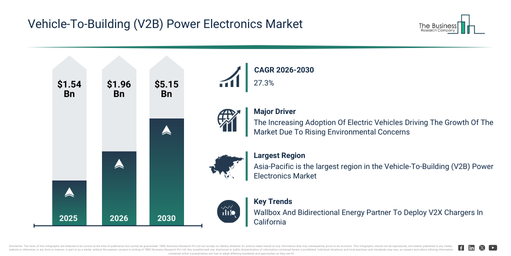
The market for vehicle-to-building (v2b) power electronics has experienced significant expansion in recent years. It is anticipated to grow from $1.54 billion in 2025 to $1.96 billion in 2026, demonstrating a compound annual growth rate (CAGR) of 27.5%. Historically, this growth can be attributed to factors like the early adoption of electric vehicles, increasing building electrification, a surge in renewable energy installations, initial smart grid deployments, and regulatory incentives promoting energy efficiency.
The vehicle-to-building (v2b) power electronics market is projected to experience rapid expansion over the upcoming years. This market is set to reach $5.15 billion by 2030, exhibiting a compound annual growth rate (CAGR) of 27.3%. Factors contributing to this growth during the projected period include the rising acceptance of v2b technology, the development of smart grid infrastructure, efforts to optimize energy costs, breakthroughs in bidirectional converters, and their incorporation into building energy management systems. Key developments anticipated within this timeframe encompass vehicle-to-building (v2b) integration, systems for bidirectional energy flow management, sophisticated energy storage options, electric vehicles that interact with the grid, and enhanced power electronics safety features.
Download A Free Sample Report For Comprehensive Market Insights:
Vehicle-To-Building (V2B) Power Electronics Market Growth Drivers: What Factors Are Accelerating Expansion?
The escalating acceptance of electric vehicles is projected to boost the expansion of the vehicle-to-building power electronics market in the future. EVs, or Electric Vehicles, operate either fully or partially on electricity held in rechargeable batteries, rather than depending exclusively on traditional internal combustion engines. This growing preference for electric vehicles stems from environmental worries, given their capacity to generate fewer greenhouse gas emissions and lessen air pollution relative to conventional automobiles. Vehicle-to-building power electronics allow EVs to return their stored energy to buildings, thereby improving grid stability, lowering energy expenses, and elevating the total worth of owning an EV. As an illustration, in January 2025, Cox Automotive, a US-based system software company, reported that electric vehicle (EV) sales for 2023 were adjusted upwards to 1,212,758 units, marking a 49% rise from 2022, and further expanded by 7.3% to reach 1,301,411 units in 2024. Consequently, the expanding adoption of electric vehicles is propelling the growth of the vehicle-to-building power electronics market.
Vehicle-To-Building (V2B) Power Electronics Market Segmentation Trends And Revenue Drivers
The vehicle-to-building (v2b) power electronics market covered in this report is segmented –
1) By Component: Converters, Inverters, Controllers, Power Management Systems, Other Components
2) By Vehicle Type: Electric Vehicles, Plug-in Hybrid Vehicles, Fuel Cell Vehicles
3) By Power Rating: Low Power, Medium Power, High Power
4) By Application: Commercial Buildings, Residential Buildings, Industrial Buildings, Other Applications
5) By End-User: Building Owners, Fleet Operators, Utilities, Other End-Users
Subsegments:
1) By Converters: Direct Current To Alternating Current Converter, Alternating Current To Direct Current Converter, Bidirectional Converter
2) By Inverters: String Inverter, Central Inverter, Modular Inverter, Hybrid Inverter
3) By Controllers: Voltage Controller, Current Controller, Temperature Controller, Power Factor Controller
4) By Power Management Systems: Energy Management System, Load Management System, Battery Management System, Demand Response System
5) By Other Components: Transformers, Relays, Switches, Sensors, Capacitors
Vehicle-To-Building (V2B) Power Electronics Market Trends: What Is Shaping Future Industry Growth?
Major companies operating in the vehicle-to-building power electronics market are adopting a strategic partnership approach to enhance technology integration and expand market reach. A strategic partnership typically refers to a collaborative relationship between two or more organizations where they combine their resources, expertise, and efforts to achieve common goals or objectives. In November 2023, Wallbox, a Spain-based company that provides electric vehicle (EV) charging and energy management solutions, partnered with Bidirectional Energy for the deployment of V2X chargers across California under the California Energy Commission (CEC) REDWDS grant. With this partnership, Wallbox and Bidirectional Energy aim to leverage their respective advanced technologies, combining Wallbox’s second-generation DC bidirectional charger, Quasar 2, with Bidirectional Energy’s EV charger management platform to provide EV owners and building operators with a comprehensive solution that enables bidirectional energy flow, cost savings, and enhanced grid resilience. Bidirectional Energy, a US-based company, specializes in software that manages vehicle-to-everything (V2X) energy flows, allowing EVs to supply power back to buildings or the grid.
#Vehicle-To-Building (V2B) Power Electronics Market Industry Leaders: Which Organizations Are Driving Competition?
Major companies operating in the vehicle-to-building (v2b) power electronics market are Volkswagen Aktiengesellschaft, Mercedes-Benz Aktiengesellschaft, Bayerische Motoren Werke Aktiengesellschaft, Honda Motor Company Limited, HyundAI Motor Company, Build Your Dreams Company Limited, Eaton Corporation plc, Delta Electronics Incorporated, Schneider Electric SE, Enphase Energy Inc., Shenzhen StarCharge Co. Ltd., JET Charge Proprietary Limited., Emporia Energy Inc., Transphorm Inc., Pulsetrain Gesellschaft mit beschränkter Haftung, Infypower Technologies Pvt. Ltd., Nuvve Holding Corp., Wallbox NV, Fuse Power Management Inc.
Access The Complete Vehicle-To-Building (V2B) Power Electronics Market Report:
Vehicle-To-Building (V2B) Power Electronics Market Leading Geography: Which Region Generates The Most Revenue?
Asia-Pacific was the largest region in the vehicle-to-building (V2B) power electronics market in 2025. The regions covered in the vehicle-to-building (v2b) power electronics market report are Asia-Pacific, South East Asia, Western Europe, Eastern Europe, North America, South America, Middle East, Africa.
Get in touch with us:
The Business Research Company: https://www.thebusinessresearchcompany.com/
Americas: +1 310-496-7795
Asia: +44 7882 955267 & +91 8897263534
Europe: +44 7882 955267
Email us at: marketing@tbrc.info
Follow us on:
LinkedIn: https://in.linkedin.com/company/the-business-research-company
YouTube: https://www.youtube.com/channel/UC24_fI0rV8cR5DxlCpgmyFQ
Global Market Model: https://www.thebusinessresearchcompany.com/global-market-model

Wasay has over a decade of experience in market research, data modelling, and analytics, with prior experience at GlobalData and Decision Tree Consulting Services. At The Business Research Company , he leads research operations across syndicated studies, customized consulting engagements, and the Global Market Model platform. His professional experience includes supporting organizations such as Boston Consulting Group, KPMG, and Ernst & Young. Wasay holds a degree in Electronics and Communications Engineering, postgraduate management qualifications from International Management Institute Belgium and Indian School of Business and Entrepreneurship, and completed the Integrated Program in Business Analytics from Indian Institute of Management Indore.