Through market attractiveness analysis, total addressable market evaluation, company benchmarking matrices, interactive Excel dashboards, expanded supply chain intelligence, emerging startup coverage, and detailed product insights, The Business Research Company’s 2026 market reports provide more actionable and strategically valuable research.
Spatial Light Modulator Market Growth From $2.45 Billion In 2026 To $3.46 Billion By 2030 At A CAGR Of 9%
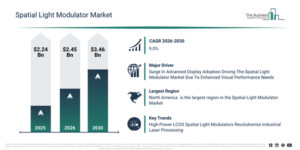
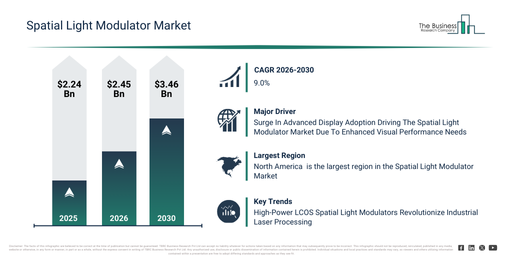
The spatial light modulator market has experienced robust growth over recent years. This market is anticipated to expand from $2.24 billion in 2025 to $2.45 billion in 2026, achieving a compound annual growth rate (CAGR) of 9.4%. The historical expansion of this market can be attributed to several factors, including the increased activity in optical research and academic laboratories, the growing adoption of holography and beam shaping systems, the broader integration of SLMs into projection and display systems, advancements in liquid crystal materials, and the consistent demand for precision optical instrumentation.
The spatial light modulator market is projected to experience substantial expansion over the coming years. This market is anticipated to reach $3.46 billion by 2030, demonstrating a compound annual growth rate (CAGR) of 9.0%. This expansion during the projection period stems from several factors, including the proliferation of laser-based manufacturing systems, the growing integration into AR and VR optical engines, a heightened need for adaptive optics in medical imaging, increased usage in autonomous sensing and lidar applications, and ongoing advancements in MEMS and LCoS technologies. Key trends foreseen for this period encompass improvements in resolution and pixel density, capabilities for multi-wavelength and broadband light modulation, the development of smaller and more compact SLM modules, enhanced precision in phase-only modulation, and efforts toward cost reduction and efficiency gains in SLM production.
Download A Free Sample Report For Comprehensive Market Insights:
Spatial Light Modulator Market Industry Drivers: What Is Driving Revenue Growth?
The future expansion of the spatial light modulator market is anticipated to be driven by the increasing need for advanced display technology. This advanced display technology encompasses innovative visual systems and components designed to improve image quality, color precision, brightness, contrast, and viewing angles beyond what traditional displays offer, providing superior visual performance in various sectors including consumer electronics, automotive dashboards, medical diagnostics, and virtual environments. A key factor fueling this demand is the growing focus on immersive and interactive user experiences, as businesses in different industries aim to distinguish their offerings through more realistic visuals and smooth digital interactions, which in turn boosts customer engagement and contentment. Spatial light modulators play a crucial role in meeting this escalating demand for advanced display technology by allowing precise manipulation of light’s phase and amplitude, leading to superior resolution, better image quality, and more sophisticated visual effects in future displays. For example, data from June 2025 provided by GOSTUDENT LTD, an Austria-based online tutoring platform, indicated significant impacts in UK classrooms: VR lesson plans increased engagement by 30% in 2023, 44% of SEN parents considered VR vital for personalized learning, and 59% of teachers observed that merging human instruction with AI and VR produced optimal results. Furthermore, VR adoption in schools saw a 35% rise in 2024, attributed to more accessible headset prices, and 93% of educators felt VR improved teaching quality and student participation. Consequently, the increased need for advanced display technology is propelling the expansion of the spatial light modulator market.
Spatial Light Modulator Market Segmentation Trends And Revenue Drivers
The spatial light modulator market covered in this report is segmented –
1) By Product Type: Optically Addressed, Electrically Addressed
2) By Component Type: Hardware, Software, Services
3) By Technology: Liquid Crystal Spatial Light Modulators, Digital Micromirror Devices, Liquid Crystal On Silicon, Microelectromechanical Systems
4) By Application: Laser Beam Steering, Beam Shaping, Holographic Data Storage, Display Application, Optical Applications, Other Applications
5) By End Use: Education, Healthcare, Telecommunications
Subsegments:
1) By Optically Addressed: Liquid Crystal Light Valves, Photorefractive Crystal Light Modulators
2) By Electrically Addressed: Ferroelectric Liquid Crystal Light Modulators, Twisted Nematic Liquid Crystal Light Modulators’ Silicon-Based Light Modulators
Spatial Light Modulator Market Trends: What Is Shaping Future Industry Growth?
Major companies within the spatial light modulator market are prioritizing the creation of technological advancements, including high-power liquid crystal on silicon designs, to enable precise beam control, improve performance, and expand capabilities. High-power liquid crystal on silicon designs denote advanced SLM architectures specifically engineered to handle intense laser power while sustaining precise phase modulation, thermal stability, and optical efficiency for rigorous industrial, scientific, and defense applications. For instance, in 2025, Santec AOC Corporation, a Japan-based optical technology company, unveiled the SLM-310, an LCOS-based spatial light modulator designed to withstand 1kW-class laser power in the near-infrared spectrum. Intended for advanced industrial applications like metal 3D printing and precision laser processing, the SLM-310 incorporates newly developed liquid crystal materials with a water-cooling system, enabling exceptional light resistance, precise phase control, beam shaping, and multi-point laser irradiation, surpassing the capabilities of traditional galvanometer scanner technology.
#Spatial Light Modulator Market Industry Leaders: Which Organizations Are Driving Competition?
Major companies operating in the spatial light modulator market are Hamamatsu Photonics K.K., HOLOEYE Photonics AG, Meadowlark Optics, Inc., Texas Instruments Incorporated, Jenoptik AG, Santec Corporation, Thorlabs, Inc., Forth Dimension Displays, Jasper Display Corporation, Silicon Light Machines, Boston Micromachines Corporation, ViALUX GmbH, PerkinElmer, CAS-Microstar, Changchun New Industries (CNI), Beijing Rofea Optoelectronics Co., Ltd., Laser 2000, Kopin Corporation, Holographix, UPOLabs, CamOptics, Sintec Optronics, Elliot Scientific
Access The Complete Spatial Light Modulator Market Report:
Spatial Light Modulator Market Regional Analysis And Leading Geography
North America was the largest region in the spatial light modulator market in 2025. Asia-Pacific is expected to be the fastest-growing region in the forecast period. The regions covered in the spatial light modulator market report are Asia-Pacific, South East Asia, Western Europe, Eastern Europe, North America, South America, Middle East, Africa.
Get in touch with us:
The Business Research Company: https://www.thebusinessresearchcompany.com/
Americas: +1 310-496-7795
Asia: +44 7882 955267 & +91 8897263534
Europe: +44 7882 955267
Email us at: marketing@tbrc.info
Follow us on:
LinkedIn: https://in.linkedin.com/company/the-business-research-company
YouTube: https://www.youtube.com/channel/UC24_fI0rV8cR5DxlCpgmyFQ
Global Market Model: https://www.thebusinessresearchcompany.com/global-market-model

Wasay has over a decade of experience in market research, data modelling, and analytics, with prior experience at GlobalData and Decision Tree Consulting Services. At The Business Research Company , he leads research operations across syndicated studies, customized consulting engagements, and the Global Market Model platform. His professional experience includes supporting organizations such as Boston Consulting Group, KPMG, and Ernst & Young. Wasay holds a degree in Electronics and Communications Engineering, postgraduate management qualifications from International Management Institute Belgium and Indian School of Business and Entrepreneurship, and completed the Integrated Program in Business Analytics from Indian Institute of Management Indore.