Through market attractiveness analysis, total addressable market evaluation, company benchmarking matrices, interactive Excel dashboards, expanded supply chain intelligence, emerging startup coverage, and detailed product insights, The Business Research Company’s 2026 market reports provide more actionable and strategically valuable research.
Food Hydrocolloids Market CAGR Analysis And Future Market Development
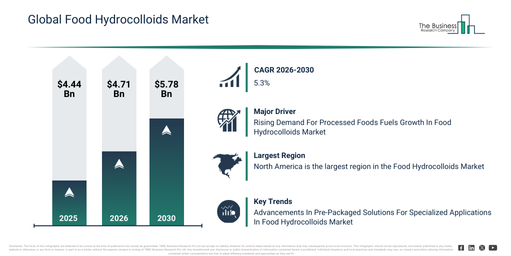
The food hydrocolloids market size has shown robust growth over recent years. It is anticipated to expand from $4.44 billion in 2025 to $4.71 billion in 2026, achieving a compound annual growth rate (CAGR) of 5.9%. The market’s growth in the past can be attributed to the rising consumption of processed and convenience foods, an increased application of thickeners and stabilizers, the development of dairy and bakery applications, innovations in food texture engineering, and the accessibility of varied hydrocolloid sources.
The food hydrocolloids market size is anticipated to experience substantial expansion over the upcoming years. It is projected to reach $5.78 billion by 2030, exhibiting a compound annual growth rate (CAGR) of 5.3%. This growth during the forecast period can be primarily attributed to several factors, including the escalating demand for plant-based and vegan food options, a heightened emphasis on clean-label ingredients, the broadening scope of functional food formulations, advancements in hydrocolloid blending innovation, and their increasing utilization in products with reduced fat and sugar content. Key trends anticipated during this period encompass the growing acceptance of plant-based hydrocolloids, a surge in the need for texture and stability-enhancing agents, their expanding application in clean-label food preparations, the development of diverse multi-functional hydrocolloid blends, and a stronger emphasis on extending product shelf life.
Download A Free Sample Report For Comprehensive Market Insights:
Food Hydrocolloids Market Demand Drivers: What Is Fueling Industry Growth?
The increasing consumer need for processed foods is anticipated to drive expansion within the food hydrocolloids market moving ahead. Processed foods refer to edible items modified from their natural form via techniques like canning, cooking, freezing, or the incorporation of ingredients to boost flavor, prolong shelf life, or offer greater convenience. This demand stems from contemporary living, which necessitates ease of use, extended shelf longevity, and rapid meal solutions, alongside the extensive availability and promotional efforts for these items. Food hydrocolloids find application in refining the texture, stability, and shelf life of processed foods, facilitating reductions in fat and calories and augmenting nutritional content. This aids in creating convenient and attractive ready-to-eat products that cater to the needs of today’s consumers. For example, in 2023, the United States Department of Agriculture, a federal agency based in the U.S., reported that the total export value of American processed food products rose to $36.59 billion, marking a 1.7% increase from prior years. Consequently, the rising requirement for processed foods acts as a key impetus for the food hydrocolloids market.
Food Hydrocolloids Market Segment Breakdown: Which Categories Generate The Most Revenue?
The food hydrocolloids market covered in this report is segmented –
1) By Type: Gelatin, Carrageenan, Xanthan Gum, Alginates, Agar, Pectin, Gum Arabic, Locust Bean Gum, Other Types
2) By Source: Plant, Animal, Microbial, Seaweed, Synthetic
3) By Application: Bakery And Confectionery, Meat And Poultry Products, Beverages, Dairy Products, Sauces And Dressing, Other Applications
Subsegments:
1) By Gelatin: Animal-based Gelatin, Plant-based Gelatin
2) By Carrageenan: Kappa Carrageenan, Iota Carrageenan, Lambda Carrageenan
3) By Xanthan Gum: Food-grade Xanthan Gum, Industrial-grade Xanthan Gum
4) By Alginates: Sodium Alginate, Calcium Alginate, Potassium Alginate
5) By Agar: Standard Agar, Agarose
6) By Pectin: High Methoxyl Pectin, Low Methoxyl Pectin
7) By Gum Arabic: Dehydrated Gum Arabic, Spray-dried Gum Arabic
8) By Locust Bean Gum: Locust Bean Gum (Carob Bean Gum), Hydrolyzed Locust Bean Gum
9) By Other Types: Guar Gum, Tara Gum, Konjac Gum, Gellan Gum
Food Hydrocolloids Market Innovation Trends: Which Developments Are Transforming The Industry?
Leading companies within the food hydrocolloids market are concentrating on developing innovative pre-packaged formulations to gain a competitive advantage. These pre-packaged solutions refer to ready-to-use mixtures or products that are prepared and packaged beforehand, intended for specific applications. For example, in March 2023, Meron Group, an India-based company specializing in the production and distribution of hydrocolloids, introduced new dessert premixes targeted at the HoReCa (Hotel, Restaurant, and Catering) sector. These hydrocolloids are crucial for enhancing the mouthfeel, texture, and stability across a range of desserts, such as crème brulee, panna cotta, mousses, and puddings. They act as vital stabilizing, thickening, and binding agents, ensuring a consistent level of quality and improved sensory appeal in the finished goods.
Food Hydrocolloids Market Key Players And Strategic Industry Positioning
Major companies operating in the food hydrocolloids market are Cargill Incorporated, Archer Daniels Midland Company, BASF SE, DuPont de Nemours Inc., International Flavors & Fragrances Inc., Kerry Group plc, Ingredion Incorporated, Ashland Inc., CP Kelco ApS, Tate & Lyle PLC, Darling Ingredients Inc., Jungbunzlauer Suisse AG, Nexira, Palsgaard A/S, Meihua Holdings Group Co. Ltd., Ceamsa, Koninklijke DSM N.V., W Hydrocolloids Inc., Tic Gums Inc., Polygal AG, Lucid Colloids Ltd., JM Huber Corporation, Deosen Biochemical (Ordos) Ltd., Hindustan Gum & Chemicals Ltd., UNIPEKTIN Ingredients AG, BASF SE
Access The Complete Food Hydrocolloids Market Report:
#Food Hydrocolloids Market Largest Region: Which Geography Holds The Highest Market Share?
North America was the largest region in the food hydrocolloids market in 2025. Asia-Pacific is expected to be the fastest-growing region in the forecast period. The regions covered in the food hydrocolloids market report are Asia-Pacific, South East Asia, Western Europe, Eastern Europe, North America, South America, Middle East and Africa.
Get in touch with us:
The Business Research Company: https://www.thebusinessresearchcompany.com/
Americas: +1 310-496-7795
Asia: +44 7882 955267 & +91 8897263534
Europe: +44 7882 955267
Email us at: marketing@tbrc.info
Follow us on:
LinkedIn: https://in.linkedin.com/company/the-business-research-company
YouTube: https://www.youtube.com/channel/UC24_fI0rV8cR5DxlCpgmyFQ
Global Market Model: https://www.thebusinessresearchcompany.com/global-market-model

Wasay has over a decade of experience in market research, data modelling, and analytics, with prior experience at GlobalData and Decision Tree Consulting Services. At The Business Research Company , he leads research operations across syndicated studies, customized consulting engagements, and the Global Market Model platform. His professional experience includes supporting organizations such as Boston Consulting Group, KPMG, and Ernst & Young. Wasay holds a degree in Electronics and Communications Engineering, postgraduate management qualifications from International Management Institute Belgium and Indian School of Business and Entrepreneurship, and completed the Integrated Program in Business Analytics from Indian Institute of Management Indore.