Enhanced with market attractiveness analysis, total addressable market evaluation, company benchmarking matrices, interactive Excel dashboards, expanded supply chain intelligence, emerging startup coverage, and detailed product insights, The Business Research Company’s 2026 market reports deliver more actionable and strategically valuable research.
Food Inclusions Market Size, Value And Growth Trends Through 2030
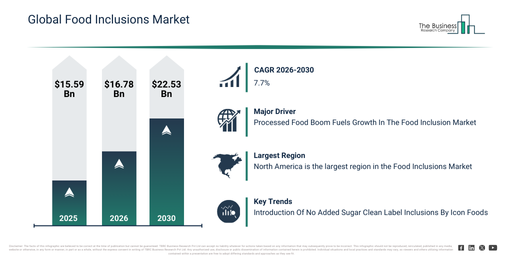
The food inclusions market has experienced significant growth over recent years. This market is projected to expand from $15.59 billion in 2025 to $16.78 billion in 2026, demonstrating a compound annual growth rate (CAGR) of 7.6%. The expansion observed in the historical period can be primarily attributed to factors such as the increasing consumption of bakery and confectionery items, a heightened demand for value-added food products, the broadening scope of processed and packaged foods, enhanced innovation in ingredient formulation, and the availability of various inclusion formats.
The food inclusions market is projected to experience substantial expansion in the coming years. This market is anticipated to reach $22.53 billion by 2030, exhibiting a compound annual growth rate (CAGR) of 7.7%. Factors contributing to this growth during the forecast period include the rising demand for indulgent and experiential foods, an increased emphasis on clean-label ingredient solutions, the proliferation of functional snacking products, evolving customization in food formulations, and enhanced innovation in inclusion processing. Key trends expected over the forecast period encompass a greater utilization of texture-enhancing inclusions, an escalating demand for premium and artisanal food products, the wider acceptance of clean-label inclusions, the broader availability of functional and nutrient-rich inclusions, and a heightened emphasis on sensory experience.
Download A Free Sample Report For Comprehensive Market Insights:
#Food Inclusions Market Growth Factors: Which Forces Are Supporting Market Expansion?
The increasing need for processed food is anticipated to fuel the expansion of the food inclusion market in the future. Processed food refers to any raw agricultural product that has undergone treatments such as washing, cleaning, milling, chopping, heating, pasteurization, blanching, cooking, canning, freezing, drying, dehydration, blending, or packaging. This category also involves incorporating preservatives, flavors, nutrients, and various food additives, alongside permitted food ingredients like salt, sugars, and fats. Food inclusions enhance the flavor, texture, aroma, color, and nutritional profile of processed foods, making the products distinctive, appealing to consumers, and setting them apart from alternatives. For example, data released in April 2024 by the National Association of Convenience Stores (NACS), a US-based trade organization, indicated that total industry foodservice sales constituted 26.9% of in-store sales in 2023, an increase from 25.6% in 2022, with prepared food sales growing by 12.2% per store per month, establishing it as the top in-store category. Consequently, the growing consumer preference for processed food will boost the demand within the food inclusion market.
Food Inclusions Market Segment Analysis: What Are The Major Market Categories?
The food inclusions market covered in this report is segmented –
1) By Type: Chocolate, Fruit And Nut, Cereal, Flavored Sugar And Caramel, Confectionery, Other Types
2) By Form: Pieces, Nuts, Chips, Flakes And Crunches, Powder, Liquid
3) By Application: Cereal Products, Snacks And Bars, Bakery Products, Dairy And Frozen Desserts, Chocolate And Confectionery Products, Other Applications Products
Subsegments:
1) By Chocolate: Chocolate Chips, Chocolate Chunks, Cocoa Nibs
2) By Fruit And Nut: Dried Fruits, Nuts
3) By Cereal: Granola Clusters, Cereal Bits
4) By Flavored Sugar And Caramel: Flavored Sugar Crystals, Caramel Bits
5) By Confectionery: Gummies, Marshmallows
6) By Other Types: Spices And Seasonings, Savory Inclusions
Food Inclusions Market Industry Trends: What Changes Are Reshaping Demand?
Leading companies in the food inclusions market are concentrating on developing advanced solutions, such as no-added-sugar clean-label inclusions, as alternatives to conventional high-sugar and artificial-ingredient toppings. A no-added-sugar solution signifies a healthier formulation that boosts nutritional value by lowering sugar content, removing artificial additives, and promoting the creation of better-for-you products. For example, in September 2025, Icon Foods Inc, a US-based clean-label ingredient manufacturer, launched its SweetBitz Inclusions to offer guilt-free indulgence across various applications including cookies, bars, ice creams, and baked goods. This innovation replaces typical sugar-rich inclusions by providing flavorful, shelf-stable options created with natural sweeteners and clean-label ingredients that align with modern dietary preferences. It delivers enhanced texture, a balanced level of sweetness, and adaptable application possibilities, allowing manufacturers to increase product appeal without relying on added sugars. Integrated within Icon Foods’ wider selection of reduced-sugar solutions, SweetBitz supports the development of healthier product formulations, enhances consumer satisfaction, and assists brands in addressing the increasing demand for nutritious, clean-label treats.
Food Inclusions Market Leading Companies Driving Competitive Growth
Major companies operating in the food inclusions market are Archer Daniels Midland Company, Agarna Beteiligungs AG, Barry Callebaut AG, Cargill Inc., Georgia Nut Company Inc., Kerry Group PLC, Puratos N.V., Sensient Technologies Corporation, Tate And Lyle Plc., Taura Natural Ingredients Ltd., Nimbus Foods Ltd, Trufoodmfg LLC., Inclusion Technologies LLC, Diana Food SAS, Doehler, Olam International, GEA Group, Pecan Deluxe Candy Company, Sensapure, Kanegrade, PreGel, Skjodt-Barrett, Tree Top, DMH Ingredients, The Scoular Company, Chaucer Foods, Paradiesfrucht, Dawn Foods, Candico
Access The Complete Food Inclusions Market Report:
Food Inclusions Market Geographic Landscape: Which Region Dominates Industry Growth?
North America was the largest region in the food inclusion market in 2025. The regions covered in the food inclusions market report are Asia-Pacific, South East Asia, Western Europe, Eastern Europe, North America, South America, Middle East and Africa.
Get in touch with us:
The Business Research Company: https://www.thebusinessresearchcompany.com/
Americas: +1 310-496-7795
Asia: +44 7882 955267 & +91 8897263534
Europe: +44 7882 955267
Email us at: marketing@tbrc.info
Follow us on:
LinkedIn: https://in.linkedin.com/company/the-business-research-company
YouTube: https://www.youtube.com/channel/UC24_fI0rV8cR5DxlCpgmyFQ
Global Market Model: https://www.thebusinessresearchcompany.com/global-market-model

Wasay has over a decade of experience in market research, data modelling, and analytics, with prior experience at GlobalData and Decision Tree Consulting Services. At The Business Research Company , he leads research operations across syndicated studies, customized consulting engagements, and the Global Market Model platform. His professional experience includes supporting organizations such as Boston Consulting Group, KPMG, and Ernst & Young. Wasay holds a degree in Electronics and Communications Engineering, postgraduate management qualifications from International Management Institute Belgium and Indian School of Business and Entrepreneurship, and completed the Integrated Program in Business Analytics from Indian Institute of Management Indore.