Enhanced with market attractiveness analysis, total addressable market evaluation, company benchmarking matrices, interactive Excel dashboards, expanded supply chain intelligence, emerging startup coverage, and detailed product insights, The Business Research Company’s 2026 market reports deliver more actionable and strategically valuable research.
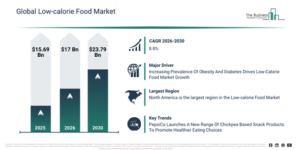
Low-calorie Food Market Growth From $17 Billion In 2026 To $23.79 Billion By 2030 At A CAGR Of 8.8%
The low-calorie food market has seen substantial growth in recent years. Its size is projected to expand from $15.69 billion in 2025 to $17 billion in 2026, exhibiting a compound annual growth rate (CAGR) of 8.4%. The historical growth is attributable to several key factors: increased consumer understanding of obesity and lifestyle diseases, wider adoption of diet-focused food products, the emergence of health-conscious consumer demographics, the expansion of functional food categories, and broader access to sugar substitute ingredients.
The low-calorie food market is projected to experience substantial expansion over the coming years. Its valuation is anticipated to reach $23.79 billion by 2030, exhibiting a compound annual growth rate (CAGR) of 8.8%. This projected growth throughout the forecast period stems from several factors, including the rising demand for personalized nutrition, a growing inclination towards plant-based low-calorie food options, the broadening of diabetic-friendly product ranges, increased investments in food formulation technologies, and enhanced regulatory backing for healthier food labeling. Key trends anticipated during this period encompass a surge in demand for clean-label low-calorie products, the increasing embrace of natural sugar alternatives, the diversification of nutrient-dense meal replacement foods, heightened product innovation within reduced-calorie snacks, and a stronger emphasis on functional low-calorie formulations.
Download A Free Sample Report For Comprehensive Market Insights:
#Low-calorie Food Market Growth Drivers And Industry Catalysts
The global rise in obesity and diabetes cases is projected to propel the low-calorie food market in the future. Obesity is a medical condition characterized by an excessive amount of body fat. Diabetes is a disorder resulting from persistently elevated blood sugar concentrations. These two conditions, obesity and diabetes, are interconnected and frequently co-exist. Adopting a low-calorie diet can prove highly advantageous in managing obesity and diabetes, as it accelerates fat metabolism and induces a catabolic state within the body. As an illustration, in June 2024, the National Health Service (NHS), a UK-based publicly funded healthcare system, reported that over half a million (549,000) additional individuals in England were identified as being at risk of developing type 2 diabetes during the previous year. For individuals under 40, this increase was even more significant, climbing by nearly a quarter, from 173,166 in 2022 to 216,440 in 2023. Consequently, the growing incidence of diabetes and obesity is a key driver for the low-calorie food market.
Low-calorie Food Market Categorization By Product Type And Application
The low-calorie food market covered in this report is segmented –
1) By Sweetener Category: Sugar Substitutes, Sugar Alcohol Substitutes
2) By Product: Aspartame, Sucralose, Stevia, Saccharin, Cyclamate
3) By Application: Dairy Products, Dietary Beverages, Bakery Products, Snacks, Other Applications
Subsegments:
1) By Sugar Substitutes: Stevia, Aspartame, Sucralose, Monk Fruit Extract, Acesulfame Potassium
2) By Sugar Alcohol Substitutes: Erythritol, Xylitol, Maltitol, Sorbitol, Isomalt
#Low-calorie Food Market Trends Influencing Long-Term Demand
Leading businesses within the low-calorie food market are concentrating on creating innovative solutions, including chickpea-based snacks, to offer healthier options instead of conventional crisps and snacks. Such healthier snack options denote products that minimize calorie, fat, salt, and sugar levels while delivering nutritional advantages like fiber, thereby fostering consumer well-being and more mindful snacking decisions. An example is PepsiCo Inc, a US-based food and beverage corporation, which introduced a new line of Walkers snacks featuring chickpea in July 2024. This novel product range encompasses Wotsits Cheese Toastie, Wotsits Crispy Bacon, and Monster Munch BBQ Sauce, with each pack containing under 100 calories and 25% less salt compared to typical extruded products. The collection ensures genuine taste and pleasure, enabling consumers to select healthier snack alternatives without sacrificing flavor. Backed by a £58 million investment directed towards the Walkers factory in Leicester, this product rollout utilizes enhanced manufacturing capabilities to boost output. Aligned with PepsiCo’s wider health programs, these new chickpea-based snacks help advance the company’s objective of achieving 50 percent of snack sales from products that are not high in fat, sugar, and salt, or from 100-calorie servings by 2025. This introduction enhances consumer satisfaction, broadens product options, and reinforces PepsiCo’s dedication to advocating for beneficial dietary habits.
Low-calorie Food Market Company Landscape And Strategic Competition
Major companies operating in the low-calorie food market are Ajinomoto Co. Inc., Beneo Group, Ingredion Incorporated, Abbott Laboratories, Galam Ltd., PepsiCo Inc., Zydus Wellness Limited, Bernard Food Industries Inc., Danisco A/S, Archer Daniels Midland Company, The Coca-Cola Company, Cargill Incorporated, Groupe Danone SA, Nestlé S.A., McNeil Nutritionals LLC, Dr Pepper Snapple Group Inc., Heartland Food Products Group, Kellogg Company, General Mills Inc., The Hershey Company, Mars Incorporated, Mondelez International Inc., Unilever PLC, Kraft Heinz Company, Campbell Soup Company, Conagra Brands Inc., The J.M. Smucker Company
Access The Complete Low-calorie Food Market Report:
Low-calorie Food Market Geographic Distribution And Regional Opportunities
North America was the largest region in the low-calorie food market in 2025. Asia-Pacific is expected to be the fastest-growing region in the forecast period. The regions covered in the low-calorie food market report are Asia-Pacific, South East Asia, Western Europe, Eastern Europe, North America, South America, Middle East and Africa.
Get in touch with us:
The Business Research Company: https://www.thebusinessresearchcompany.com/
Americas: +1 310-496-7795
Asia: +44 7882 955267 & +91 8897263534
Europe: +44 7882 955267
Email us at: marketing@tbrc.info
Follow us on:
LinkedIn: https://in.linkedin.com/company/the-business-research-company
YouTube: https://www.youtube.com/channel/UC24_fI0rV8cR5DxlCpgmyFQ
Global Market Model: https://www.thebusinessresearchcompany.com/global-market-model

Wasay has over a decade of experience in market research, data modelling, and analytics, with prior experience at GlobalData and Decision Tree Consulting Services. At The Business Research Company , he leads research operations across syndicated studies, customized consulting engagements, and the Global Market Model platform. His professional experience includes supporting organizations such as Boston Consulting Group, KPMG, and Ernst & Young. Wasay holds a degree in Electronics and Communications Engineering, postgraduate management qualifications from International Management Institute Belgium and Indian School of Business and Entrepreneurship, and completed the Integrated Program in Business Analytics from Indian Institute of Management Indore.