Delivering more actionable and strategically valuable research, The Business Research Company’s 2026 market reports feature market attractiveness analysis, total addressable market evaluation, company benchmarking matrices, interactive Excel dashboards, expanded supply chain intelligence, emerging startup coverage, and detailed product insights.
Malt Ingredients Market CAGR Analysis And Future Market Development
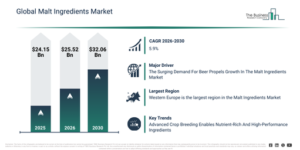
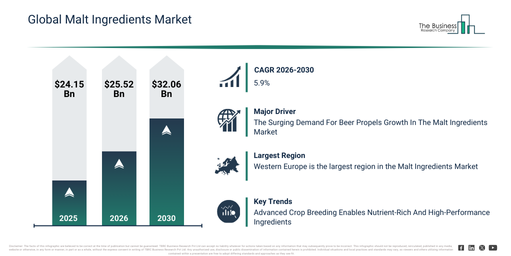
The malt ingredients market size has seen significant expansion in recent years. It is anticipated to increase from $24.15 billion in 2025 to $25.52 billion in 2026, growing at a compound annual growth rate (CAGR) of 5.6%. The historical surge in this market can be attributed to the rising global beer production, the expansion of distilling industries, an uptick in the consumption of malt-based foods, the availability of a diverse range of grain raw materials, and continuous improvements in malting technologies.
The malt ingredients market size is anticipated to undergo significant expansion in the coming years. It is forecast to reach $32.06 billion by 2030, demonstrating a compound annual growth rate (CAGR) of 5.9%. This growth over the forecast period is propelled by factors such as an escalating demand for craft and premium alcoholic drinks, an increased application of malt in functional food products, the expansion of non-alcoholic malt beverages, rising investments in sustainable malting techniques, and continuous innovation in specialty malt varieties. Noteworthy trends during this period include a surging demand for specialty and craft malts, the increasing utilization of malt ingredients in non-alcoholic drinks, the broadening reach of microbrewery applications, an intensified focus on flavor customization, and enhanced investment in improving malt processing efficiency.
Download A Free Sample Report For Comprehensive Market Insights:
#Malt Ingredients Market Growth Factors: Which Forces Are Supporting Market Expansion?
The rising demand for beer is fueling the malt ingredients market. Beer, an alcoholic beverage typically containing under 5% alcohol, is a carbonated, fermented drink commonly brewed from malted cereal grains (primarily barley) and flavored with hops. Globally, increased disposable income and evolving consumer preferences are leading to higher beer consumption. Malt ingredients are vital as they impart color, flavor, and foam to beer, provide the necessary sugars for fermentation, and contribute to the beverage’s health aspects. For instance, in April 2024, BeverageDaily.com, a UK-based online website, reported that in 2023, small and independent brewers collectively produced 23.4 million barrels of beer. Furthermore, craft beer’s share of the total market, by volume, rose to 13.3% in 2023, an increase from 13.1% in 2022. Therefore, the growing demand for beer is anticipated to boost the demand for malt ingredients during the forecast period.
Malt Ingredients Market Segment Analysis: What Are The Major Market Categories?
The malt ingredients market covered in this report is segmented –
1) By Type: Dry Malt, Liquid Malt, Malt Flour, Other Types
2) By Raw Material: Barley, Wheat, Rye
3) By Application: Brewing (Beer & Craft Beer), Distilling (Whisky & Spirits), Non-Alcoholic Malt Beverages
Subsegments:
1) By Dry Malt: Malted Barley, Malted Wheat
2) By Liquid Malt: Liquid Malt Extract (LME), Malt Syrup
3) By Malt Flour: Diastatic Malt Flour, Non-Diastatic Malt Flour
4) By Other Types: Malt Extracts, Specialty Malts
Malt Ingredients Market Industry Trends: What Changes Are Reshaping Demand?
Leading companies within the malt ingredients market are increasingly focusing on diversifying their product offerings through specialty malts derived from unconventional grains, such as various hybrid cereals. This strategic shift aims to lessen dependence on traditional barley, improve the resilience of raw material sourcing against climate challenges, and provide novel taste and functional attributes to both beverage and food manufacturers. Hybrid cereals themselves are crops created by interbreeding two distinct cereal species to integrate advantageous characteristics like increased yield, enhanced nutritional content, and better climate adaptability. Within the malt ingredients industry, hybrid cereals contribute significantly by boosting raw-material sustainability, optimizing enzymatic efficiency, and facilitating the creation of malts that possess distinct flavor and functional profiles, surpassing those of conventional barley-based malts. A notable illustration occurred in 2023 when Boortmalt, a malting company situated in Belgium, introduced the Atlantis Malt Series. This innovative range of malts is wholly derived from Tritordeum, which is a naturally bred, non-GMO hybrid resulting from the cross of durum wheat and wild barley. Tritordeum-based malt is distinguished by its considerable enzymatic power and high extract yield, along with a minimal beta-glucan content and an exceptionally high lutein level, approximately 10× greater than that found in wheat. These characteristics culminate in a distinctive nutty, biscuity, and honey-like flavor profile, accompanied by an amber-to-golden color. Such qualities establish it as a adaptable component, suitable for not only brewing but also for distilling and a range of other food applications, thereby attracting manufacturers and consumers searching for malt solutions that are functional, unique, and environmentally conscious.
Malt Ingredients Market Leading Companies Driving Competitive Growth
Major companies operating in the malt ingredients market are Deltamalt, Cargill Malt, GrainCorp Limited, Duerr Malzfabrik GmbH & Co KG, Dobele Malz GmbH & Co KG, Honeywell Specialty Grains LLC, IREKS GmbH, Grupo Huerga y CIA S.L., Haas Malz GmbH & Co KG, Gerkens Malt BV, Muntons PLC, Gambrinus Malterie NV, Malteurop Group S.A., Barmalt S.A., Briess Malt & Ingredients Company, Imperial Malt Ltd., Dingemans BV, Crisp Malt Limited, Frey Malz GmbH & Co KG, Farmos Oyj, Eiselt Malz GmbH & Co KG, Ernest Grain Ltd., Minnaar International BV, Neville Maltings Ltd., Permalz GmbH & Co KG, Provital Malt France, Rehorst GmbH & Co KG, Soufflet Malt Europe SAS, Viking Malt Inc., Weyermann Malz GmbH & Co KG
Access The Complete Malt Ingredients Market Report:
Malt Ingredients Market Global Footprint: Which Region Holds Market Leadership?
Western Europe was the largest region in the malt ingredients market share in 2025. The regions covered in the malt ingredients market report are Asia-Pacific, South East Asia, Western Europe, Eastern Europe, North America, South America, Middle East and Africa.
Get in touch with us:
The Business Research Company: https://www.thebusinessresearchcompany.com/
Americas: +1 310-496-7795
Asia: +44 7882 955267 & +91 8897263534
Europe: +44 7882 955267
Email us at: marketing@tbrc.info
Follow us on:
LinkedIn: https://in.linkedin.com/company/the-business-research-company
YouTube: https://www.youtube.com/channel/UC24_fI0rV8cR5DxlCpgmyFQ
Global Market Model: https://www.thebusinessresearchcompany.com/global-market-model

Wasay has over a decade of experience in market research, data modelling, and analytics, with prior experience at GlobalData and Decision Tree Consulting Services. At The Business Research Company , he leads research operations across syndicated studies, customized consulting engagements, and the Global Market Model platform. His professional experience includes supporting organizations such as Boston Consulting Group, KPMG, and Ernst & Young. Wasay holds a degree in Electronics and Communications Engineering, postgraduate management qualifications from International Management Institute Belgium and Indian School of Business and Entrepreneurship, and completed the Integrated Program in Business Analytics from Indian Institute of Management Indore.