Through market attractiveness analysis, total addressable market evaluation, company benchmarking matrices, interactive Excel dashboards, expanded supply chain intelligence, emerging startup coverage, and detailed product insights, The Business Research Company’s 2026 market reports provide more actionable and strategically valuable research.
Specialty Malt Market Expected To Reach $5.1 Billion By 2030 At 5.9% CAGR
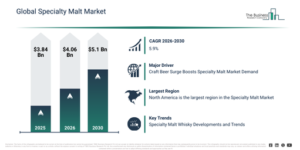
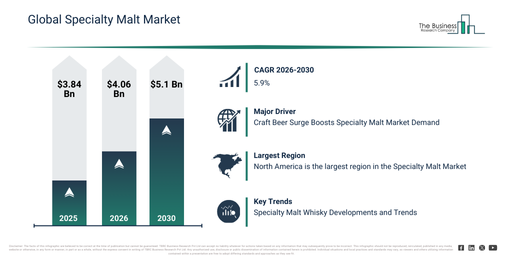
The specialty malt market size has seen strong expansion in recent years. It is anticipated to increase from $3.84 billion in 2025 to $4.06 billion in 2026, demonstrating a compound annual growth rate (CAGR) of 5.7%. The historical period’s growth can be ascribed to several factors, including the expansion of brewing and distilling industries, increasing consumption of malt-based beverages, the growth of artisanal food production, rising demand for flavor differentiation, and the availability of diverse malt varieties.
The specialty malt market is anticipated to experience substantial expansion in the coming years. By 2030, its valuation is projected to reach $5.1 billion, demonstrating a compound annual growth rate (CAGR) of 5.9%. This anticipated growth during the forecast period can be ascribed to several factors, including heightened innovation in specialty malt processing, escalating demand from craft beverage manufacturers, the broadening scope of non-alcoholic malt applications, an intensified focus on procuring premium ingredients, and the increasing uptake of tailored malt solutions. Key trends expected within this period encompass an escalating demand for craft and specialized beverages, a greater incorporation of flavor-improving malt ingredients, the widening application of specialty malts within the food sector, enhanced personalization of malt profiles, and an elevated emphasis on both quality and consistency.
Download A Free Sample Report For Comprehensive Market Insights:
Specialty Malt Market Growth Factors Supporting Long-Term Expansion
The anticipated growth of the specialty malt market is largely driven by the increasing demand for craft beer. Craft beer is produced by specialty breweries, which often operate independently and have significantly lower production volumes compared to large brewers. In brewing, malt serves as a source of carbohydrates essential for fermentation and enhances the beer’s mouthfeel with its lingering sweetness. Moreover, malt provides a variety of nutrients, such as silica and vitamin B, which are considerably more abundant in beer than in wine or other spirits and are preserved throughout the brewing process. Consequently, the rising demand for craft beer is expected to boost the demand for specialty malt. For instance, in August 2024, William Reed Ltd., a UK-based media company, reported an expansion in the craft beer sector, with active craft breweries increasing from 9,339 in June 2023 to 9,358 in June 2024. Thus, the escalating demand for craft beer is a key factor driving the specialty malt market.
Specialty Malt Market Segment Outlook: Which Categories Are Expanding The Fastest?
The specialty malt market covered in this report is segmented –
1) By Product: Caramelized Malt, Roasted Malt
2) By Source: Barley, Rye, Wheat
3) By Form: Dry Specialty Malts, Liquid Specialty Malts
4) By Application: Bakery And Confectionery, Alcoholic Beverages, Non-Alcoholic Beverages
Subsegments:
1) By Caramelized Malt: Caramel Malt, Crystal Malt, Amber Malt
2) By Roasted Malt: Black Malt, Chocolate Malt
Specialty Malt Market Industry Trends Shaping Future Revenue Growth
Leading companies in the specialty malt market are concentrating on creating and introducing new products, such as their third single malt whisky, with an emphasis on unique flavor profiles and sustainable methods. Malt whisky is characterized as a whisky primarily produced from malted barley at a single distillery, celebrated for its profound flavors and intricate character, typically matured in oak barrels for at least three years. For example, in July 2024, Holyrood Distillery, a UK-based whisky producer, unveiled Ambir. This product delivers a sophisticated flavor profile, blending heritage malts with innovative techniques for a distinctive whisky experience. Moderate intake could offer health advantages, such as enhanced heart health and improved cognitive function. It functions as both a cultural tie to Edinburgh’s whisky legacy and a pleasant selection for social occasions.
Specialty Malt Market Key Companies And Competitive Benchmarking
Major companies operating in the specialty malt market are Muntons Malt plc, Malteurop, Weyermann Malting, Castle Malting, Briess Malt & Ingredients Co, Simpson’s Malt, Crisp Malting Group, Boortmalt, Soufflet Group, Great Western Malting, Thomas Fawcett & Sons, Rahr Corporation, IREKS GmbH, Viking Malt, Dingemans Malt, Franco-Belges Malting, Mouterij Dingemans, BestMalz, Avangard Malz, Holland Malt
Access The Complete Specialty Malt Market Report:
Specialty Malt Market Regional Outlook: Where Are The Largest Opportunities Located?
North America was the largest region in the specialty malt market in 2025. The regions covered in the specialty malt market report are Asia-Pacific, South East Asia, Western Europe, Eastern Europe, North America, South America, Middle East and Africa.
Get in touch with us:
The Business Research Company: https://www.thebusinessresearchcompany.com/
Americas: +1 310-496-7795
Asia: +44 7882 955267 & +91 8897263534
Europe: +44 7882 955267
Email us at: marketing@tbrc.info
Follow us on:
LinkedIn: https://in.linkedin.com/company/the-business-research-company
YouTube: https://www.youtube.com/channel/UC24_fI0rV8cR5DxlCpgmyFQ
Global Market Model: https://www.thebusinessresearchcompany.com/global-market-model

Wasay has over a decade of experience in market research, data modelling, and analytics, with prior experience at GlobalData and Decision Tree Consulting Services. At The Business Research Company , he leads research operations across syndicated studies, customized consulting engagements, and the Global Market Model platform. His professional experience includes supporting organizations such as Boston Consulting Group, KPMG, and Ernst & Young. Wasay holds a degree in Electronics and Communications Engineering, postgraduate management qualifications from International Management Institute Belgium and Indian School of Business and Entrepreneurship, and completed the Integrated Program in Business Analytics from Indian Institute of Management Indore.