Through market attractiveness analysis, total addressable market evaluation, company benchmarking matrices, interactive Excel dashboards, expanded supply chain intelligence, emerging startup coverage, and detailed product insights, The Business Research Company’s 2026 market reports provide more actionable and strategically valuable research.
Marine Propulsion Engines Market Size Outlook: How Fast Will Revenue Grow Through 2030?
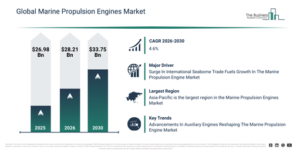
The marine propulsion engines market has demonstrated consistent growth in recent years. It is projected to expand from $26.98 billion in 2025 to $28.21 billion in 2026, achieving a compound annual growth rate (CAGR) of 4.5%. The historical growth of this market can be attributed to factors such as global maritime trade growth, the dominance of diesel propulsion, the demand for high-power engines, the expansion of shipbuilding activities, and efforts toward fuel cost optimization.
The marine propulsion engines market is anticipated to show consistent expansion over the coming years. It is projected to increase to $33.75 billion by 2030, achieving a compound annual growth rate (CAGR) of 4.6%. This projected growth throughout the forecast period stems from factors such as decarbonization mandates, the increasing adoption of alternative fuels, advanced digital engine control systems, efficiency-focused vessel upgrades, and various green shipping initiatives. Key trends during this period are expected to encompass the uptake of low-emission propulsion systems, a transition towards LNG and dual-fuel engines, an expansion of fleet modernization programs, a heightened demand for high-efficiency engines, and the widespread deployment of smart engine monitoring technologies.
Download A Free Sample Report For Comprehensive Market Insights:
#Marine Propulsion Engines Market Growth Factors: Which Forces Are Supporting Market Expansion?
The anticipated expansion of international seaborne trade is projected to fuel the growth of the marine propulsion engine market. Seaborne trade involves transporting goods via ships across oceanic routes. Marine propulsion systems move vessels through water, concurrently enhancing marine ecosystem safety, offering cost-effectiveness, and reducing emissions for the maritime industry. Consequently, an increase in international seaborne trade boosts the demand for the marine propulsion engine market. For example, in October 2024, the United Nations Conference on Trade and Development (UNCTAD), a permanent intergovernmental UN body located in Switzerland, reported that seaborne trade growth, measured in ton-miles, advanced from 4.2% in 2023 to 5.1% in 2024, marking a 21.4% acceleration in its growth rate. Furthermore, the overall seaborne trade volume expanded from 5,047 nautical miles in 2023 to 5,186 nautical miles in 2024, signifying an approximate 2.8% rise. Thus, the growing international seaborne trade is a key impetus for the marine propulsion engine market.
Marine Propulsion Engines Market Segmentation And Category Breakdown
The marine propulsion engines market covered in this report is segmented –
1) By Engine Type: 2-Stroke Engine, 4- Stroke Engine
2) By Ship Type: Cargo Or Container Ships, Tanker, Bulk Carrier, Offshore Vessel, Passenger Ship
3) By Power Range: 1,001-5,000 HP, 5,001-10,000 HP, 10,001-20,000 HP, Above 20,000 HP
4) By Fuel Type: Diesel, Heavy Fuel Oil, Natural Gas
5) By Application: Commercial, Defense, Passenger
Subsegments:
1) By 2-Stroke Engine: Low-Speed Crosshead 2-Stroke Engines, Medium-Speed Trunk Piston 2-Stroke Engines, Diesel-Fueled 2-Stroke Engines, Dual-Fuel 2-Stroke Engines (Diesel And Gas), Liquefied Natural Gas (LNG) 2-Stroke Engines, Heavy Fuel Oil 2-Stroke Engines, Electronically Controlled 2-Stroke Engines, Mechanically Controlled 2-Stroke Engines
2) By 4-Stroke Engine: Medium-Speed 4-Stroke Engines, High-Speed 4-Stroke Engines, Diesel-Fueled 4-Stroke Engines, Gas-Fueled 4-Stroke Engines, Dual-Fuel 4-Stroke Engines (Diesel And Gas), Liquefied Natural Gas (LNG) 4-Stroke Engines, Lean-Burn 4-Stroke Engines, Spark-Ignited 4-Stroke Engines, Turbocharged 4-Stroke Engines
#Marine Propulsion Engines Market Trends Influencing Long-Term Demand
Prominent companies within the marine propulsion engine market are actively developing new auxiliary engines to secure a competitive advantage. An auxiliary engine serves as a secondary power source in a vehicle or vessel, supplying additional energy for specific functions separate from the primary propulsion. For instance, in September 2023, Perkins Engines Company Limited, a UK-based marine engines company, introduced the Perkins E44 and E70B auxiliary engines. These were engineered for diverse marine applications, including inland waterways, tugs, governmental vessels, fishing boats, and ferry services. The E44, an electronic 4.4-liter, 4-cylinder engine, and the E70B both offer a wide spectrum of power ratings, providing flexible and configurable power solutions to address the auxiliary power requirements of boat operators. Designed for durability and high uptime, these electronic engines boast a 500-hour service interval and include low maintenance attributes such as a self-priming fuel system and automatic valve lash adjustment. With an emphasis on compact design and simple installation, these engines are targeted at end-users in various sectors, offering multiple cooling options and ease of integration.
Marine Propulsion Engines Market Competitive Analysis Of Major Industry Participants
Major companies operating in the marine propulsion engines market are Caterpillar lnc., Daihatsu Diesel Mfg Co. Ltd, Hyundai Heavy Industries Co. Ltd., Mitsubishi Heavy Industries Ltd., Rolls-Royce Holdings Plc, Wärtsilä Corporation, Yanmar Holdings Co. Ltd., Scania AB, MAN Energy Solutions, Cummins Inc., AB Volvo Penta, Kawasaki Heavy Industries Ltd., Fairbanks Morse Defense, Anglo Belgian Corporation, Nigata Power Systems Co. Ltd., Deutz AG, WinGD, Yamaha Motor Co. Ltd., China Shipbuilding Corporation, Mitsubishi Turbocharger and Engine Europe B.V.
Access The Complete Marine Propulsion Engines Market Report:
Marine Propulsion Engines Market Global Footprint: Which Region Holds Market Leadership?
Asia-Pacific was the largest region in the marine propulsion engines market in 2025. The regions covered in the marine propulsion engines market report are Asia-Pacific, South East Asia, Western Europe, Eastern Europe, North America, South America, Middle East, Africa
Get in touch with us:
The Business Research Company: https://www.thebusinessresearchcompany.com/
Americas: +1 310-496-7795
Asia: +44 7882 955267 & +91 8897263534
Europe: +44 7882 955267
Email us at: marketing@tbrc.info
Follow us on:
LinkedIn: https://in.linkedin.com/company/the-business-research-company
YouTube: https://www.youtube.com/channel/UC24_fI0rV8cR5DxlCpgmyFQ
Global Market Model: https://www.thebusinessresearchcompany.com/global-market-model

Wasay has over a decade of experience in market research, data modelling, and analytics, with prior experience at GlobalData and Decision Tree Consulting Services. At The Business Research Company , he leads research operations across syndicated studies, customized consulting engagements, and the Global Market Model platform. His professional experience includes supporting organizations such as Boston Consulting Group, KPMG, and Ernst & Young. Wasay holds a degree in Electronics and Communications Engineering, postgraduate management qualifications from International Management Institute Belgium and Indian School of Business and Entrepreneurship, and completed the Integrated Program in Business Analytics from Indian Institute of Management Indore.