Delivering more actionable and strategically valuable research, The Business Research Company’s 2026 market reports feature market attractiveness analysis, total addressable market evaluation, company benchmarking matrices, interactive Excel dashboards, expanded supply chain intelligence, emerging startup coverage, and detailed product insights.
Vibration Control Systems Market Size, Value And Growth Trends Through 2030
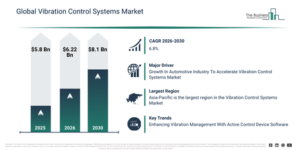
The vibration control systems market has experienced robust growth in its size over recent years. It is forecast to expand from $5.8 billion in 2025 to $6.22 billion in 2026, exhibiting a compound annual growth rate (CAGR) of 7.2%. The expansion witnessed during the historic period stems from factors such as the growth of industrial automation, machinery reliability requirements, aerospace engineering needs, automotive comfort standards, and the demand for manufacturing precision.
The vibration control systems market size is projected to experience significant expansion in the coming years. This market is expected to reach $8.1 billion by 2030, with a compound annual growth rate (CAGR) of 6.8%. The expansion during the forecast period is largely driven by the adoption of smart manufacturing, the increase in electric vehicles, the integration of predictive maintenance, infrastructure modernization, and the need for noise and vibration reduction. Important trends anticipated in the forecast period include the rising application of active vibration control, the incorporation of smart sensors and analytics, the requirement for high precision motion control, the growth of hybrid control systems, and a heightened focus on equipment longevity and safety.
Download A Free Sample Report For Comprehensive Market Insights:
#Vibration Control Systems Market Demand Drivers Creating New Revenue Opportunities
The anticipated expansion of the automotive industry is expected to stimulate the growth of the vibration control systems market moving forward. This industry focuses on developing, manufacturing, and selling motor vehicles like cars, trucks, and motorcycles, along with their components and supporting infrastructure. The automotive industry is experiencing growth due to rising global vehicle consumption, technological advancements in electric and self-driving vehicles, and the increasing demand for efficient transportation options. Vibration control systems are utilized within the automotive industry to minimize noise and enhance ride comfort by dampening engine, road, and structural vibrations. For instance, in March 2024, data from the European Automobile Manufacturers Association, a Belgium-based automotive industry body, indicated that the European Union car industry saw a growth of 13.9% in 2023 compared to 2022, reaching a production volume of 0.0105 billion units. Therefore, the significant expansion of the automotive sector will serve as a key driver for the vibration control systems market’s growth.
Vibration Control Systems Market Segment Analysis Highlighting Growth Areas
The vibration control systems market covered in this report is segmented –
1) By Component: Hardware, Software
2) By System Type: Passive Vibration Control Systems, Active Vibration Control Systems, Semi-Active Vibration Control Systems, Hybrid Vibration Control Systems
3) By Application: Automotive, Manufacturing, Aerospace And Defense, Electrical And Electronics, Oil And Gas, Healthcare, Other Applications
Subsegments:
1) By Hardware: Vibration Isolators, Dampers and Shock Absorbers, Mounts and Bushings, Actuators and Sensors, Tuned Mass Dampers
2) By Software: Vibration Monitoring Software, Control and Feedback Algorithms, Predictive Maintenance and Analytics Software
Vibration Control Systems Market Transformation Trends: Which Innovations Are Driving Change?
Leading companies within the vibration control systems market are concentrating on creating sophisticated technologies, such as wireless sensors, to enhance real-time oversight, boost system efficiency, and facilitate remote control and diagnostics for superior performance and reliability in vibration management. A wireless sensor is an instrument that senses and quantifies physical properties like temperature, pressure, motion, or vibration, subsequently transmitting the collected data wirelessly to a central system or network without needing physical cabling. Such sensors commonly utilize technologies including Wi-Fi, Bluetooth, or Zigbee for communication. Within vibration control systems, wireless sensors are employed to continuously observe and measure vibrations. For example, in November 2023, Worldsensing, a software company headquartered in Spain, unveiled a new wireless sensor named the Vibration Meter, specifically designed to optimize vibration monitoring in civil engineering. This innovative apparatus is engineered for prolonged, uninterrupted monitoring and incorporates a tri-axial MEMS accelerometer to elevate its performance. Noteworthy features include its battery longevity combined with a robotic design.
Vibration Control Systems Market Leading Companies: Who Holds Significant Market Presence?
Major companies operating in the vibration control systems market are Continental AG, Hutchinson S.A., Parker Hannifin Corporation, Trelleborg Aktiebolag, Cooper Standard Holdings Inc., LORD Corporation, Mason Industries Inc., Kinetics Noise Control Inc., ACE Controls Inc., Kurashiki Kako Co. Ltd, GERB Vibration Control Systems Inc., Sentek Dynamics Incorporated, Crystal Instruments Corporation, LISEGA SE, Isolation Technology Inc., Fabreeka International Inc., VICODA GmbH, Enidine Inc., Getzner Werkstoffe GmbH, ITT Inc., Bridgestone Corporation, Sumitomo Rubber Industries Ltd
Access The Complete Vibration Control Systems Market Report:
Vibration Control Systems Market Geographic Distribution And Regional Opportunities
Asia-Pacific was the largest region in the vibration control systems market in 2025. Europe is expected to be the fastest-growing region in the forecast period. The regions covered in the vibration control systems market report are Asia-Pacific, South East Asia, Western Europe, Eastern Europe, North America, South America, Middle East, Africa
Get in touch with us:
The Business Research Company: https://www.thebusinessresearchcompany.com/
Americas: +1 310-496-7795
Asia: +44 7882 955267 & +91 8897263534
Europe: +44 7882 955267
Email us at: marketing@tbrc.info
Follow us on:
LinkedIn: https://in.linkedin.com/company/the-business-research-company
YouTube: https://www.youtube.com/channel/UC24_fI0rV8cR5DxlCpgmyFQ
Global Market Model: https://www.thebusinessresearchcompany.com/global-market-model

Wasay has over a decade of experience in market research, data modelling, and analytics, with prior experience at GlobalData and Decision Tree Consulting Services. At The Business Research Company , he leads research operations across syndicated studies, customized consulting engagements, and the Global Market Model platform. His professional experience includes supporting organizations such as Boston Consulting Group, KPMG, and Ernst & Young. Wasay holds a degree in Electronics and Communications Engineering, postgraduate management qualifications from International Management Institute Belgium and Indian School of Business and Entrepreneurship, and completed the Integrated Program in Business Analytics from Indian Institute of Management Indore.