Delivering more actionable and strategically valuable research, The Business Research Company’s 2026 market reports feature market attractiveness analysis, total addressable market evaluation, company benchmarking matrices, interactive Excel dashboards, expanded supply chain intelligence, emerging startup coverage, and detailed product insights.
#Wind Turbine Market Size And Revenue Forecast Through 2030
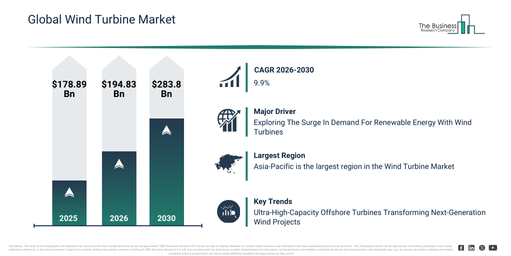
The wind turbine market size has experienced substantial expansion in recent years. This market is projected to increase from $178.89 billion in 2025 to $194.83 billion in 2026, exhibiting a compound annual growth rate (CAGR) of 8.9%. The growth observed in the preceding period was influenced by factors such as renewable energy policies, falling wind power costs, climate change commitments, the need for grid diversification, and the volatility of fossil fuel prices.
The wind turbine market size is anticipated to experience substantial expansion over the upcoming years. Its valuation is projected to reach $283.8 billion by 2030, demonstrating a compound annual growth rate (CAGR) of 9.9%. This projected increase during the forecast period is primarily driven by factors such as the pursuit of net zero targets, significant investments in offshore wind, the integration of renewables into grid systems, improvements in turbine efficiency, and various energy security initiatives. Key developments expected in this period encompass the rapid scaling up of utility-scale wind projects, a rise in the deployment of offshore wind farms, innovations in turbine blade materials, the incorporation of digital monitoring systems, and the increasing adoption of high-capacity wind turbines.
Download A Free Sample Report For Comprehensive Market Insights:
Wind Turbine Market Demand Drivers: What Is Fueling Industry Growth?
The escalating need for renewable power sources is fueling the expansion of the wind turbine market. Such energy sources are characterized by their ability to repeatedly replenish without depletion. Historically, a substantial portion of energy has been sourced from fossil fuels like coal, oil, and natural gas. Wind itself is a prime example of a renewable energy source. Generally, producing energy from wind has fewer adverse effects on the environment compared to other energy generation methods. Wind turbines do not release pollutants into the air or water and operate without requiring water for cooling. Furthermore, their use reduces the electricity generated from fossil fuels, leading to decreased total air pollution and carbon dioxide emissions. For example, in February 2025, the World Resources Institute, a US-based non-profit organization, reported that 2024 saw solar energy set a new record by adding an estimated 39.6 gigawatts (GW) of capacity, which surpassed the 27.4 GW installed in 2023. Consequently, the rising demand for renewable energy sources is a significant driver for the growth of the wind turbine market.
Wind Turbine Market Segmentation Trends And Revenue Drivers
The wind turbine market covered in this report is segmented –
1) By Component: Rotator Blade, Gearbox, Generator, Nacelle, Other Components
2) By Axis Type: Horizontal, Vertical
3) By Location Of Deployment: Onshore, Offshore
4) By Connectivity Type: Grid Connected, Stand Alone
5) By Application: Industrial, Commercial, Residential, Utility
Subsegments:
1) By Rotator Blade: Composite Blades, Steel Blades, Carbon Fiber Blades
2) By Gearbox: Planetary Gearbox, Helical Gearbox, Spur Gearbox
3) By Generator: Synchronous Generators, Asynchronous Generators, Permanent Magnet Generators
4) By Nacelle: Housing Components, Cooling Systems, Control Systems
5) By Other Components: Tower, Yaw System, Pitch Control System
Wind Turbine Market Innovation Trends: Which Developments Are Transforming The Industry?
Leading companies in the wind turbine market are concentrating on developing next-generation, extremely high-capacity offshore turbines, often referred to as multi-megawatt “super WTG” platforms, to enhance energy capture and improve the financial viability of projects. These ultra-high-capacity offshore turbines are characterized by considerably larger rotor diameters and greater nominal power ratings, allowing for increased electricity generation per unit while simultaneously decreasing the overall levelized cost of energy (LCoE) for utility-scale wind farms. For instance, in December 2024, Siemens Gamesa, an energy automation firm based in Germany, commenced the installation of a 21 MW offshore wind turbine prototype at the Østerild Test Centre in Denmark. This 21 MW prototype boasts a rotor height surpassing 300 meters from its base to the blade tip and is designed to deliver exceptional power output per turbine. This evolving trend enables developers to reduce the quantity of turbines required per farm and optimize operational and maintenance (O&M) expenses. Conversely, the intricate technical demands, higher capital investment, and complex logistical challenges associated with deploying such massive offshore units could impede their widespread adoption in areas lacking sufficient installation infrastructure or financial support.
#Wind Turbine Market Industry Leaders: Which Organizations Are Driving Competition?
Major companies operating in the wind turbine market are Clipper Windpower A/S, Siemens AG, General Electric Company, Suzlon Energy Limited, CRRC Group Corporation, Shanghai Electric Group Co. Ltd., Vestas Wind Systems A/S, Sany Heavy Industry Co. Ltd., Gamesa Electric, Dongfang Electric Corporation, Nordex SE, Goldwind Science and Technology Co. Ltd., Ming Yang Smart Energy Group Co. Ltd., Guodian United Power Technology Co. Ltd., Zhejiang Windey Co. Ltd., Envision Energy, LM Windpower A/S, Impsa S.A., Sinovel Wind Group Co. Ltd., Leitwind GmbH, Vergnet S.A., Northern Power Systems Ltd., Enercon GmbH Windenergieanlagen, Senvion SE, Bergey Windpower Inc., United Power Inc.
Access The Complete Wind Turbine Market Report:
Wind Turbine Market Leading Geography: Which Region Generates The Most Revenue?
Asia-Pacific was the largest region in the wind turbine market in 2025. Asia-Pacific is expected to be the fastest-growing region in the forecast period. The regions covered in the wind turbine market report are Asia-Pacific, South East Asia, Western Europe, Eastern Europe, North America, South America, Middle East, Africa
Get in touch with us:
The Business Research Company: https://www.thebusinessresearchcompany.com/
Americas: +1 310-496-7795
Asia: +44 7882 955267 & +91 8897263534
Europe: +44 7882 955267
Email us at: marketing@tbrc.info
Follow us on:
LinkedIn: https://in.linkedin.com/company/the-business-research-company
YouTube: https://www.youtube.com/channel/UC24_fI0rV8cR5DxlCpgmyFQ
Global Market Model: https://www.thebusinessresearchcompany.com/global-market-model

Wasay has over a decade of experience in market research, data modelling, and analytics, with prior experience at GlobalData and Decision Tree Consulting Services. At The Business Research Company , he leads research operations across syndicated studies, customized consulting engagements, and the Global Market Model platform. His professional experience includes supporting organizations such as Boston Consulting Group, KPMG, and Ernst & Young. Wasay holds a degree in Electronics and Communications Engineering, postgraduate management qualifications from International Management Institute Belgium and Indian School of Business and Entrepreneurship, and completed the Integrated Program in Business Analytics from Indian Institute of Management Indore.