Through market attractiveness analysis, total addressable market evaluation, company benchmarking matrices, interactive Excel dashboards, expanded supply chain intelligence, emerging startup coverage, and detailed product insights, The Business Research Company’s 2026 market reports provide more actionable and strategically valuable research.
Smart Machines Market Revenue Outlook: What CAGR Is Expected Through 2030?
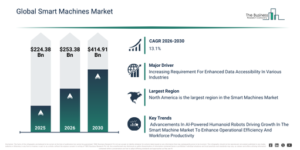
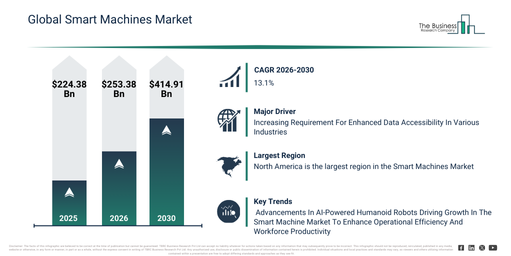
The smart machines market has experienced rapid growth in recent years. It is forecast to expand from $224.38 billion in 2025 to $253.38 billion in 2026, achieving a compound annual growth rate (CAGR) of 12.9%. This historical expansion can be attributed to factors such as advancements in computing power, increased data availability, the early adoption of industrial automation, the expansion of cloud infrastructure, and a rising demand for operational efficiency.
The smart machines market is projected for significant expansion in the upcoming years, reaching $414.91 billion by 2030, exhibiting a compound annual growth rate (CAGR) of 13.1%. This anticipated growth stems from advancements in AI model performance, the wider uptake of autonomous systems, greater funding for smart infrastructure, an increasing need for predictive insights, and burgeoning enterprise digital transformation efforts. Key developments expected during this period involve a surge in self-learning machine deployments, increased incorporation of cognitive decision systems, greater utilization of machine-to-machine communication, an elevated requirement for autonomous operational functions, and the proliferation of real-time data-driven automation.
Download A Free Sample Report For Comprehensive Market Insights:
#Smart Machines Market Growth Drivers And Industry Catalysts
The rising demand for improved data accessibility across different sectors is anticipated to fuel the expansion of the smart machine market. Data accessibility can be defined as the capability of an organization’s personnel to retrieve and effectively utilize information from databases. Smart machines are highly dependent on data accessibility to acquire diverse and pertinent data, which is essential for achieving superior performance and adaptability. For example, in December 2024, Hitachi Vantara, a US-based data foundation for innovation, reported that 37% of U.S. companies considered data quality or data infrastructure readiness a significant issue during AI implementation, suggesting that as companies pursue AI, they increasingly perceive data accessibility as an obstacle. Consequently, the escalating need for better data accessibility across diverse industries will propel the growth of the smart machine market.
Smart Machines Market Segment Landscape: Which Areas Lead Market Development?
The smart machines market covered in this report is segmented –
1) By Component: Hardware, Software, Services,
2) By Technology: Cloud Computing Technology, Big Data Technology, Internet of Everything, Robotics, Cognitive Technology, Affective Technology
3) By Machine: Robots, Autonomous Cars, Drones, Wearable Devices, Other Machines
4) By Verticals: Manufacturing, Transportation And Logistics, Healthcare, Consumer Goods And Retail, Aerospace And Defense, Other Verticals
Subsegments:
1) By Hardware: Sensors, Actuators, Processors, Communication Devices, Connectivity Modules
2) By Software: Operating Systems, Application Software, Data Analytics Software, Artificial Intelligence (AI) Software, Security Software
3) By Services: Consulting Services, Integration Services, Maintenance And Support Services, Training Services, Managed Services
Smart Machines Market Industry Trends Shaping Future Revenue Growth
Leading companies within the smart machine market are prioritizing technological innovations, including AI-driven humanoid robots featuring unified vision, language, and action capabilities. This focus addresses the escalating need for automation, driven by workforce deficits, the requirement for versatile production methods, and the increasing call for adaptable, multi-purpose machines across the manufacturing, logistics, and service industries. These intelligent humanoid robots integrate sophisticated robotic hardware, such as articulated limbs, sensors, and cameras, with embedded artificial intelligence. This integration allows them to perceive their surroundings, interpret natural language commands, and perform diverse tasks, offering significantly greater flexibility compared to conventional fixed automation, like conveyors or pre-programmed robotic arms, or even human workers. An illustrative example is the launch of Figure 02 by US-based robotics firm Figure AI in August 2024; this advanced humanoid robot is engineered for industrial and commercial applications. Figure 02 is equipped with six RGB cameras, an integrated visual-language model, speakers and microphones for intuitive speech interaction, and enhanced, highly dexterous hands. Its advancements also encompass significantly boosted computing power for real-time visual processing, decision-making, and operational control. These capabilities empower the robot to comprehend verbal instructions, visually evaluate its environment, and execute actions like moving containers or manipulating items, enabling its deployment alongside or in place of human staff in factory, warehouse, or service environments. Such progress highlights the market’s evolution from rigid, specialized machinery to intelligent, adaptable “smart machines” that can adjust to diverse tasks as needed.
Smart Machines Market Industry Leaders And Market Competition
Major companies operating in the smart machines market are Alphabet Inc., Microsoft Corporation, Amazon.com Inc., IBM Corporation, Siemens AG, General Electric Company, ABB Ltd., Robert Bosch GmbH, Honeywell International Inc., Schneider Electric SE, Rockwell Automation Inc., Emerson Electric Co., KUKA AG, FANUC Corporation, Yaskawa Electric Corporation, Boston Dynamics Inc., Tesla Inc., NVIDIA Corporation, Intel Corporation, Qualcomm Technologies Inc., Baidu Inc., Toyota Motor Corporation, Hyundai Motor Company, BAE Systems plc, Lockheed Martin Corporation
Access The Complete Smart Machines Market Report:
Smart Machines Market Regional Analysis: Which Region Leads By Revenue?
North America was the largest region in the smart machines market in 2025. Asia-Pacific is expected to be the fastest-growing region in the forecast period. The regions covered in the smart machines market report are Asia-Pacific, South East Asia, Western Europe, Eastern Europe, North America, South America, Middle East, Africa
Get in touch with us:
The Business Research Company: https://www.thebusinessresearchcompany.com/
Americas: +1 310-496-7795
Asia: +44 7882 955267 & +91 8897263534
Europe: +44 7882 955267
Email us at: marketing@tbrc.info
Follow us on:
LinkedIn: https://in.linkedin.com/company/the-business-research-company
YouTube: https://www.youtube.com/channel/UC24_fI0rV8cR5DxlCpgmyFQ
Global Market Model: https://www.thebusinessresearchcompany.com/global-market-model

Wasay has over a decade of experience in market research, data modelling, and analytics, with prior experience at GlobalData and Decision Tree Consulting Services. At The Business Research Company , he leads research operations across syndicated studies, customized consulting engagements, and the Global Market Model platform. His professional experience includes supporting organizations such as Boston Consulting Group, KPMG, and Ernst & Young. Wasay holds a degree in Electronics and Communications Engineering, postgraduate management qualifications from International Management Institute Belgium and Indian School of Business and Entrepreneurship, and completed the Integrated Program in Business Analytics from Indian Institute of Management Indore.