Enhanced with market attractiveness analysis, total addressable market evaluation, company benchmarking matrices, interactive Excel dashboards, expanded supply chain intelligence, emerging startup coverage, and detailed product insights, The Business Research Company’s 2026 market reports deliver more actionable and strategically valuable research.
Digital Twin Urban Rail Signal Market Value Analysis: What Growth Is Expected Over The Forecast Period?
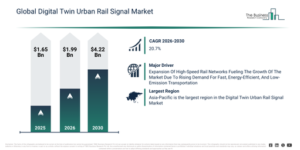
The market size for digital twin urban rail signals has seen significant growth recently. Projections show it will expand from $1.65 billion in 2025 to reach $1.99 billion by 2026, registering a compound annual growth rate (CAGR) of 20.6%. The historical growth in this market can be attributed to several factors, including the expansion of urban rail networks, the modernization of signaling infrastructure, the adoption of centralized rail control systems, an increase in metro and light rail projects, and a heightened focus on rail safety standards.
The digital twin urban rail signal market is projected to experience substantial expansion over the upcoming years. It is foreseen to reach $4.22 billion by 2030, demonstrating a compound annual growth rate (CAGR) of 20.7%. This growth during the forecast period is fueled by escalating investments in intelligent rail infrastructure, the expanding acceptance of digital twin platforms, the proliferation of autonomous train operations, the increasing incorporation of AI-powered traffic optimization, and a heightened requirement for predictive asset management. Prominent trends for the forecast period encompass the greater implementation of virtual signal simulation platforms, the surging integration of predictive maintenance analytics, the wider utilization of real-time train data modeling, the broadening deployment of cloud-based rail control systems, and an intensified focus on optimizing network reliability.
Download A Free Sample Report For Comprehensive Market Insights:
Digital Twin Urban Rail Signal Market Expansion Drivers: What Is Shaping Future Growth?
The expansion of high-speed rail networks is anticipated to stimulate the growth of the digital twin urban rail signal market. High-speed rail networks are characterized by rail systems where trains operate at speeds exceeding 250 km/h (155 mph), providing fast, efficient, and environmentally friendly transportation across long distances between major cities. These networks are expanding due to an increasing demand for rapid, energy-efficient, and low-emission travel alternatives to air and road transportation. Digital twin urban rail signals enhance high-speed rail networks by offering real-time simulation and monitoring capabilities, rendering them ideal for optimizing traffic flow and ensuring safety. They also mitigate operational risks by enabling predictive maintenance and facilitating rapid decision-making, thereby improving overall network efficiency. For instance, in January 2024, the State Council Information Office (SICO), a China-based government administration, reported that China’s high-speed rail network had reached a total length of 45,000 km by 2023 and is projected to expand to 70,000 km by 2035. Consequently, the ongoing expansion of high-speed rail networks is a key driver for the growth of the digital twin urban rail signal market.
Digital Twin Urban Rail Signal Market Segment Analysis: What Are The Major Market Categories?
The digital twin urban rail signal market covered in this report is segmented –
1) By Component: Software, Hardware, Services
2) By Rail Type: Metro, Light Rail, High-Speed Rail, Other Rail Types
3) By Deployment Mode: On-Premises, Cloud
4) By Application: Train Control, Signaling, Maintenance, Asset Management, Operations Optimization, Other Applications
5) By End User: Rail Operators, Infrastructure Providers, Government Agencies, Other End-Users
Subsegments:
1) By Software: Simulation Software, Analytics Software, Visualization Software
2) By Hardware: Sensors, Communication Devices, Control Units
3) By Services: Consulting, Implementation, Maintenance
Digital Twin Urban Rail Signal Market Strategic Trends: What Is Defining The Next Phase Of Growth?
Major companies within the digital twin urban rail signal market are concentrating on creating sophisticated solutions, such as AI-powered predictive maintenance platforms, to improve operational efficiency, safety, and decision-making capabilities. These Artificial intelligence (AI)-powered predictive maintenance platforms are software systems that leverage AI to foresee equipment malfunctions, streamline maintenance, and minimize downtime. For instance, in July 2024, Casco Signal Ltd., a China-based rail transit system manufacturing company, unveiled its Xihe digital urban rail transit solution. This advanced AI-powered predictive maintenance platform is designed to revolutionize rail operations through intelligent digital technologies. Xihe integrates the intelligent operation control platform and the intelligent operation and maintenance platform, serving as the railway’s ‘smart brain’ and ‘health manager’ to optimize operations and ensure system reliability. This platform incorporates AI-driven anomaly detection, real-time simulation, and 3D visualization to refine train control systems, decrease downtime, and enhance asset lifecycle management. It also provides automated signal health monitoring and adaptive traffic management functionalities, enabling rail operators to dynamically modify signaling patterns based on live network conditions without requiring human input.
Digital Twin Urban Rail Signal Market Leading Companies Driving Competitive Growth
Major companies operating in the digital twin urban rail signal market are Schneider Electric SE, Mitsubishi Electric Corporation, CRRC Corporation Limited, ABB Group, Thales Group, Alstom SA, Wabtec Corporation, Rockwell Automation Inc., Siemens Mobility GmbH, Hitachi Rail Limited, Toshiba Corporation, PTC Inc., Esri, Bentley Systems Incorporated, CASCO Signal Inc, Nippon Signal Co. Ltd., Huawei Technologies Co. Ltd., Indra Sistemas S.A., Dassault Systèmes SE, AVES Reality
Access The Complete Digital Twin Urban Rail Signal Market Report:
Digital Twin Urban Rail Signal Market Geographic Analysis: Where Is Demand Growing The Fastest?
Asia-Pacific was the largest region in the digital twin urban rail signal market in 2025. The regions covered in the digital twin urban rail signal market report are Asia-Pacific, South East Asia, Western Europe, Eastern Europe, North America, South America, Middle East, Africa.
Get in touch with us:
The Business Research Company: https://www.thebusinessresearchcompany.com/
Americas: +1 310-496-7795
Asia: +44 7882 955267 & +91 8897263534
Europe: +44 7882 955267
Email us at: marketing@tbrc.info
Follow us on:
LinkedIn: https://in.linkedin.com/company/the-business-research-company
YouTube: https://www.youtube.com/channel/UC24_fI0rV8cR5DxlCpgmyFQ
Global Market Model: https://www.thebusinessresearchcompany.com/global-market-model

Wasay has over a decade of experience in market research, data modelling, and analytics, with prior experience at GlobalData and Decision Tree Consulting Services. At The Business Research Company , he leads research operations across syndicated studies, customized consulting engagements, and the Global Market Model platform. His professional experience includes supporting organizations such as Boston Consulting Group, KPMG, and Ernst & Young. Wasay holds a degree in Electronics and Communications Engineering, postgraduate management qualifications from International Management Institute Belgium and Indian School of Business and Entrepreneurship, and completed the Integrated Program in Business Analytics from Indian Institute of Management Indore.