Delivering more actionable and strategically valuable research, The Business Research Company’s 2026 market reports feature market attractiveness analysis, total addressable market evaluation, company benchmarking matrices, interactive Excel dashboards, expanded supply chain intelligence, emerging startup coverage, and detailed product insights.
Holographic TV Market Value Analysis: What Growth Is Expected Over The Forecast Period?
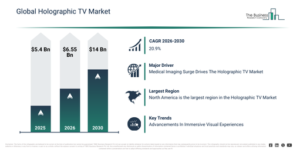
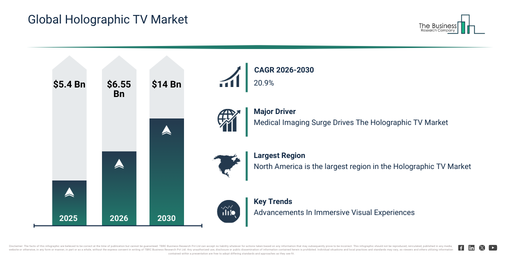
The holographic tv market has experienced substantial expansion in recent times. Its value is projected to increase from $5.4 billion in 2025 to $6.55 billion in 2026, achieving a compound annual growth rate (CAGR) of 21.2%. This historical growth can be linked to various factors such as breakthroughs in display technologies, the rising consumer desire for immersive entertainment, initial implementation in defense visualization, the proliferation of digital content creation, and financial commitments in visual communication systems.
The holographic tv market is poised for substantial growth in the next few years, with projections indicating it will expand to $14 billion by 2030, demonstrating a compound annual growth rate (CAGR) of 20.9%. This anticipated growth during the forecast period is attributed to several factors, including the expansion of metaverse applications, increased adoption in education and training sectors, a rising demand for interactive advertising, the integration of AI-driven graphics, and the decreasing cost of holographic components. Major trends expected in the forecast period encompass glasses-free 3D visualization, multi-angle viewing capability, real-time holographic rendering, high-resolution spatial imaging, and interactive holographic displays.
Download A Free Sample Report For Comprehensive Market Insights:
#Holographic TV Market Growth Drivers And Industry Catalysts
The increasing adoption of medical imaging is projected to fuel the expansion of the holographic TV market over the forthcoming years. Medical imaging, also known as radiography, constitutes a medical field where professionals capture various images of bodily components for purposes such as clinical assessment, medical procedures, and visual representation of organ or tissue functionality. Within medical imaging, holographic TV enables surgeons to visualize and engage with 3D human anatomy, thereby enhancing both preoperative planning and guidance during operations, leading to more precise and effective surgical outcomes. As an illustration, in November 2023, the National Health Service, a UK-based government body, reported that for the year concluding in March 2023, England conducted 45.0 million imaging tests, which represented a 2.2% increase from the 44.0 million tests performed in the preceding year. This figure encompassed 10.3 million diagnostic ultrasound tests, showing a 1.8% rise; 7.1 million CT scans, increasing by 5.5%; and 4.1 million MRI scans, growing by 6.2%. Consequently, the expanding application of medical imaging is a key impetus for the holographic TV market.
Holographic TV Market Segment Outlook: Which Categories Are Expanding The Fastest?
The holographic tv market covered in this report is segmented –
1) By Type: Laser Plasma, Micromagnetic Piston Display, Holographic Television Display, Touchable Holograms
2) By Distribution Channel: Online, Offline
3) By End User: Education, Consumer Applications, Aerospace And Defense, Industrial Applications, Healthcare, Other End Users
Subsegments:
1) By Laser Plasma: Solid-State Laser Plasma Displays, Gas Laser Plasma Displays
2) By Micromagnetic Piston Display: Electromagnetic Actuated Displays, Piezoelectric Actuated Displays
3) By Holographic Television Display: Static Holographic Displays, Dynamic Holographic Displays
4) By Touchable Holograms: Tactile Feedback Holograms, Interactive Holographic Interfaces
Holographic TV Market Trends: What Is Shaping Future Industry Growth?
Leading companies within the holographic TV market are concentrating on developing innovative solutions, such as AI-driven holographic avatar displays, to satisfy the growing demand for immersive, interactive, and lifelike visual experiences across entertainment, communication, retail, and education sectors. These AI-powered holographic displays utilize advanced light-field projection, computer vision, and real-time rendering algorithms to generate three-dimensional virtual avatars or objects viewable from all angles, providing a richer, more interactive experience compared to the two-dimensional visuals and fixed perspectives offered by traditional flat-screen TVs. For example, in November 2025, Akool Inc., a US-based immersive technology company, introduced its Holographic Avatar Display Series, integrating AI-powered avatars into real-world environments for personal, commercial, and public applications. This series combines high-definition light-field projection with AI-driven avatar generation, enabling real-time animation, interactive gestures, and dynamic expression adaptation from multiple viewing angles without requiring special glasses. The technology also incorporates voice and gesture control, is customizable for events, retail, entertainment, or remote communication, and features lifelike 3D rendering with adaptive AI behaviors. This solution seamlessly connects with digital content platforms to enhance engagement, create immersive experiences, and redefine interactions in both professional and consumer settings.
Holographic TV Market Key Companies And Competitive Benchmarking
Major companies operating in the holographic tv market are Apple Inc.; Google LLC; Samsung Electronics Co. Ltd; Microsoft Corporation; Sony Corporation; Panasonic Corporation; LG Electronics Inc.; Qualcomm Inc.; Mitsubishi Electric Corporation; Nvidia Corporation; Toshiba Corporation; Epson Corporation; Konica Minolta Inc.; EON Reality; Ostendo Technologies Inc.; Leia Inc.; Hypervsn (Kino-mo Ltd.); AV Concepts Inc; Vuzix Corporation; Light Field Lab Inc.; Avegant Corporation; RealView Imaging Ltd; Voxon Photonics Pty Ltd.; SeeReal Technologies; Realfiction Holding AB; Holoxica Ltd; Musion Das Hologram Ltd (MDH Hologram); Looking Glass Factory Inc.; Shenzhen SMX Display Technology Co. Ltd.; Provision Holding Inc
Access The Complete Holographic TV Market Report:
Holographic TV Market Regional Analysis: Which Region Leads By Revenue?
North America was the largest region in the holographic TV market in 2025. Asia-Pacific is expected to be the fastest-growing region in the forecast period. The regions covered in the holographic tv market report are Asia-Pacific, South East Asia, Western Europe, Eastern Europe, North America, South America, Middle East, Africa.
Get in touch with us:
The Business Research Company: https://www.thebusinessresearchcompany.com/
Americas: +1 310-496-7795
Asia: +44 7882 955267 & +91 8897263534
Europe: +44 7882 955267
Email us at: marketing@tbrc.info
Follow us on:
LinkedIn: https://in.linkedin.com/company/the-business-research-company
YouTube: https://www.youtube.com/channel/UC24_fI0rV8cR5DxlCpgmyFQ
Global Market Model: https://www.thebusinessresearchcompany.com/global-market-model

Wasay has over a decade of experience in market research, data modelling, and analytics, with prior experience at GlobalData and Decision Tree Consulting Services. At The Business Research Company , he leads research operations across syndicated studies, customized consulting engagements, and the Global Market Model platform. His professional experience includes supporting organizations such as Boston Consulting Group, KPMG, and Ernst & Young. Wasay holds a degree in Electronics and Communications Engineering, postgraduate management qualifications from International Management Institute Belgium and Indian School of Business and Entrepreneurship, and completed the Integrated Program in Business Analytics from Indian Institute of Management Indore.