Through market attractiveness analysis, total addressable market evaluation, company benchmarking matrices, interactive Excel dashboards, expanded supply chain intelligence, emerging startup coverage, and detailed product insights, The Business Research Company’s 2026 market reports provide more actionable and strategically valuable research.
eSIM Market Value Analysis: What Growth Is Expected Over The Forecast Period?
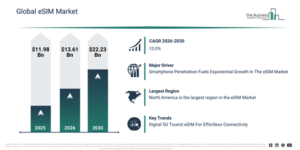
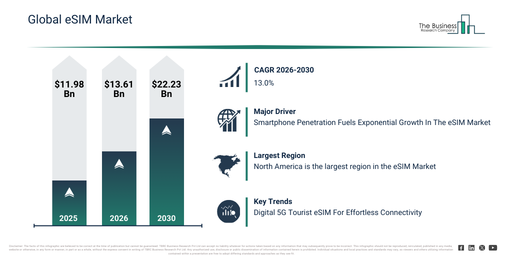
The esim market has experienced rapid expansion in recent years. It is anticipated to grow from $11.98 billion in 2025 to $13.61 billion in 2026, demonstrating a compound annual growth rate (CAGR) of 13.7%. The market’s past growth is attributable to the proliferation of connected device ecosystems, increasing smartphone penetration, the adoption of M2M communication technologies, the rise in global mobile subscriptions, and the availability of embedded IC technologies.
The esim market is projected to experience substantial expansion over the coming years, reaching $22.23 billion by 2030, exhibiting a compound annual growth rate (CAGR) of 13.0%. This anticipated growth during the forecast period is driven by several factors, including the increasing adoption of connected vehicles, the expanding deployment of industrial IoT devices, the proliferation of wearables and smart devices, a growing need for flexible network provisioning, and a heightened emphasis on secure digital identity management. Key trends observed during this period encompass the growing uptake of embedded connectivity solutions, an increasing demand for remote SIM provisioning capabilities, the expanding integration of eSIM technology into IoT devices, broader adoption of eSIM in automotive applications, and a strengthened focus on secure digital connectivity.
Download A Free Sample Report For Comprehensive Market Insights:
eSIM Market Growth Factors Supporting Long-Term Expansion
The expanding presence of smartphones is playing a crucial role in propelling the eSIM market forward. A smartphone is an advanced mobile phone with highly sophisticated functions. eSIMs are integrated into consumer devices such as smartphones, allowing users to modify SIM content like the international mobile subscriber identifier (IMSI) and network carrier profiles via software, thus removing the need for physical SIM card replacement. For instance, according to Demand Sage, a US-based Google Sheets-based revenue operations platform, in July 2023, the global count of smartphone users was 6.8 billion in 2023, showing an increase from around 6.6 billion users in 2022. Consequently, the rising adoption of smartphones will drive the eSIM market.
eSIM Market Segment Analysis And Revenue Opportunities
The esim market covered in this report is segmented –
1) By Solution: Hardware, Connectivity Services
2) By Application: Connected Cars, Laptops, M2M, Smartphones, Tablets, Wearables, Other Applications
3) By Vertical: Automotive, Consumer Electronics, Energy And Utilities, Manufacturing, Retail, Transportation And Logistics
Subsegments:
1) By Hardware: eSIM Chips, eSIM Modules, Integrated Circuits (ICs)
2) By Connectivity Services: Remote SIM Provisioning, Mobile Network Operator (MNO) Services, Data Plans And Subscription Services
eSIM Market Trends Driving Strategic Industry Expansion
Major companies in the eSIM market are primarily focused on creating digital 5G tourist eSIMs featuring unique attributes like a straightforward digital activation process, aiming to satisfy the increasing demand from international travelers. This digital and convenient activation process refers to a method of initiating and enabling services or functionalities using electronic means, typically via online platforms or applications. For instance, in September 2023, Singtel, a Singapore-based telecommunications company, introduced a 5G Tourist eSIM to cater to the growing demand from international travelers. Its objective was to deliver enhanced convenience and value, allowing tourists to manage their connectivity needs online before arriving in Singapore. With a specific focus on the Grand Prix event, the digital 5G Tourist eSIM offers hassle-free activation, thereby saving time that would typically be spent on traditional SIM card purchases. Singtel aims to enhance the travel experience, providing continuous connectivity and additional digital experiences with 5G technology.
eSIM Market Leading Players Shaping Industry Direction
Major companies operating in the esim market are Infineon Technologies AG; NXP Semiconductors N.V; Samsung Group; STMicroelectronics; CEC Huada Electronic Design Co Ltd; Eastcompeace Technology Co Ltd; Valid S.A.; Microchip Technology Incorporated; Sony Group Corporation; EM Microelectronic; Watchdata Technologies Ptd Ltd; CardLogix Corporation; Gemalto (now Thales Digital Identity and Security); IDEMIA; Giesecke+Devrient; Sierra Wireless; Deutsche Telekom AG; Telit; Arm Holdings; Vodafone Group; Telefónica; Cubic Telecom; Truphone; Workz Group; KORE Wireless; Kigen
Access The Complete eSIM Market Report:
eSIM Market Leading Geography: Which Region Generates The Most Revenue?
North America was the largest region in the eSIM market in 2025. The regions covered in the esim market report are Asia-Pacific, South East Asia, Western Europe, Eastern Europe, North America, South America, Middle East, Africa.
Get in touch with us:
The Business Research Company: https://www.thebusinessresearchcompany.com/
Americas: +1 310-496-7795
Asia: +44 7882 955267 & +91 8897263534
Europe: +44 7882 955267
Email us at: marketing@tbrc.info
Follow us on:
LinkedIn: https://in.linkedin.com/company/the-business-research-company
YouTube: https://www.youtube.com/channel/UC24_fI0rV8cR5DxlCpgmyFQ
Global Market Model: https://www.thebusinessresearchcompany.com/global-market-model

Wasay has over a decade of experience in market research, data modelling, and analytics, with prior experience at GlobalData and Decision Tree Consulting Services. At The Business Research Company , he leads research operations across syndicated studies, customized consulting engagements, and the Global Market Model platform. His professional experience includes supporting organizations such as Boston Consulting Group, KPMG, and Ernst & Young. Wasay holds a degree in Electronics and Communications Engineering, postgraduate management qualifications from International Management Institute Belgium and Indian School of Business and Entrepreneurship, and completed the Integrated Program in Business Analytics from Indian Institute of Management Indore.