
Enhanced with market attractiveness analysis, total addressable market evaluation, company benchmarking matrices, interactive Excel dashboards, expanded supply chain intelligence, emerging startup coverage, and detailed product insights, The Business Research Company’s 2026 market reports deliver more actionable and strategically valuable research.
Connected Lighting Market Growth Potential: How Will Market Size Change Through 2030?
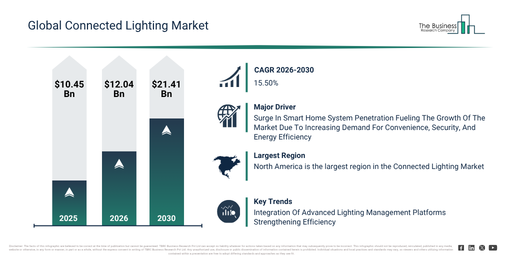
The connected lighting market has experienced significant expansion in recent years. Projections indicate an increase from $10.45 billion in 2025 to $12.04 billion in 2026, reflecting a compound annual growth rate (CAGR) of 15.2%. This historical growth has been driven by factors such as the growing uptake of energy-efficient lighting solutions, accelerating urbanization and smart city initiatives, heightened commercial construction activity, reduced costs associated with LED lighting systems, and the early implementation of building automation technologies in developed areas.
The connected lighting market is projected to experience substantial expansion in the coming years. By 2030, its value is anticipated to reach $21.41 billion, progressing at a compound annual growth rate (CAGR) of 15.5%. This upward trajectory in the forecast period is fueled by several factors: a rising demand for net-zero and green buildings, the advancement of smart city infrastructure initiatives, greater incorporation of IoT-enabled building systems, a heightened emphasis on energy efficiency and carbon reduction goals, and the growing implementation of AI-powered facility management systems. Key developments shaping this period include a stronger focus on human-centric lighting systems to boost occupant well-being and productivity, wider adoption of energy-saving smart lighting in commercial spaces to lower operational expenses, deeper integration of lighting with building automation platforms for streamlined central control, the proliferation of wireless connected lighting solutions for easier retrofitting in existing structures, and more frequent use of occupancy and daylight sensors to enable adaptive lighting adjustments.
Download A Free Sample Report For Comprehensive Market Insights:
Connected Lighting Market Expansion Supported By Key Demand Factors
The anticipated expansion of the connected lighting market is being driven by the increasing adoption of smart home systems. A smart home system consists of interconnected devices and appliances that can be controlled and automated remotely, enhancing convenience, security, and energy efficiency. The rise in smart home usage is primarily due to the convenience it offers, enabling users to remotely manage and automate household tasks, thereby saving time and simplifying daily life. Connected lighting contributes to these systems by working with sensors and voice assistants to automatically adjust illumination based on occupancy, time of day, or user instructions, boosting both comfort and energy conservation. For example, in August 2024, GreenMatch, a UK-based online services company, reported that as of 2023, approximately 5.3 million households in the UK—about 19.7% of all homes—use smart home products, with projections indicating a sharp increase to nearly 98.8% of households adopting smart devices by 2027. As a result, the growing prevalence of smart home systems is fueling the growth of the connected lighting market.
Connected Lighting Market Segment Outlook: Which Categories Are Expanding The Fastest?
The connected lighting market covered in this report is segmented –
1) By Component: Hardware, Software, Services
2) By Sales Channel: Direct Sales, Distributors Or Wholesalers, Online Retail, Electrical Contractors Or Integrators, Original Equipment Manufacturer Channels
3) By Deployment Type: Wired Connected Lighting, Wireless Connected Lighting
4) By Application: Indoor Lighting, Outdoor Lighting
5) By End User Industry: Commercial And Enterprise, Industrial And Manufacturing, Residential, Municipal And Public Infrastructure, Healthcare, Education, Transportation And Logistics, Utilities And Energy
Subsegments:
1) By Hardware: Smart Bulbs And Lamps, Control Modules And Switches, Gateways And Hubs
2) By Software: Lighting Control Platforms, Energy Management Software, Building Management Integration Software
3) By Services: Installation And Commissioning Services, Maintenance And Support Services, Consulting And System Design Services
Connected Lighting Market Growth Trends Influencing Competitive Dynamics
Major players in the connected lighting market are dedicating efforts toward the creation of advanced solutions, including cloud-based lighting management systems. These systems leverage cloud computing to facilitate remote oversight, control, and optimization of lighting networks via internet-enabled devices and software platforms. Their purpose is to boost operational efficiency, strengthen safety measures, and maintain regulatory compliance through centralized control, monitoring, and automation. A notable example occurred in June 2025 when Signify N. V., a lighting firm based in the Netherlands, introduced the Interact emergency lighting system. This wireless solution allows building managers to oversee, control, and test emergency lighting using a secure cloud-based dashboard. Seamlessly integrated with the Interact building manager platform, the system automates function and duration tests, issues real-time health status alerts, and produces detailed compliance reports, all while accommodating various testing schedules. As a result, building operators can cut down on manual tasks, lower operational expenses, improve system reliability, and guarantee adherence to safety standards. At the same time, this approach enables smooth management of both general and emergency lighting within a unified, connected framework.
Connected Lighting Market Key Companies And Competitive Benchmarking
Major companies operating in the connected lighting market are Signify N. V., Schneider Electric SE, Acuity Inc., Legrand SA, Eaton Corporation plc, Lutron Electronics Co. Inc., Honeywell International Inc., Samsung Electronics Co. Ltd., Panasonic Holdings Corporation, Hubbell Incorporated, Delta Electronics Inc., Zumtobel Group AG, Fagerhult Group AB, Helvar Oy Ab, Trilliant Networks Inc., Bajaj Electricals Limited, Leviton Manufacturing Co. Inc., Havells India Limited, Wipro Lighting Limited, Syska LED Lights Pvt. Ltd., Ubicquia Inc., Enlighted Inc., Schréder S. A., Dimonoff Inc., Flashnet S. A., CIMCON Lighting Inc.
Access The Complete Connected Lighting Market Report:
https://www.thebusinessresearchcompany.com/report/connected-lighting-market-report
Connected Lighting Market Geographic Landscape: Which Region Dominates Industry Growth?
North America was the largest region in the connected lighting market in 2025. Asia-Pacific is expected to be the fastest-growing region in the forecast period. The regions covered in the connected lighting market report are Asia-Pacific, South East Asia, Western Europe, Eastern Europe, North America, South America, Middle East and Africa.
Access a Customized Connected Lighting Market Report for Deeper Competitive Insights
Get in touch with us:
The Business Research Company: https://www.thebusinessresearchcompany.com/
Americas: +1 310-496-7795
Asia: +44 7882 955267 & +91 8897263534
Europe: +44 7882 955267
Email us at: marketing@tbrc.info
Follow us on:
LinkedIn: https://in.linkedin.com/company/the-business-research-company
YouTube: https://www.youtube.com/channel/UC24_fI0rV8cR5DxlCpgmyFQ
Global Market Model: https://www.thebusinessresearchcompany.com/global-market-model

Wasay has over a decade of experience in market research, data modelling, and analytics, with prior experience at GlobalData and Decision Tree Consulting Services. At The Business Research Company , he leads research operations across syndicated studies, customized consulting engagements, and the Global Market Model platform. His professional experience includes supporting organizations such as Boston Consulting Group, KPMG, and Ernst & Young. Wasay holds a degree in Electronics and Communications Engineering, postgraduate management qualifications from International Management Institute Belgium and Indian School of Business and Entrepreneurship, and completed the Integrated Program in Business Analytics from Indian Institute of Management Indore.