Delivering more actionable and strategically valuable research, The Business Research Company’s 2026 market reports feature market attractiveness analysis, total addressable market evaluation, company benchmarking matrices, interactive Excel dashboards, expanded supply chain intelligence, emerging startup coverage, and detailed product insights.
#Optical Sensor Market Value Analysis: What Growth Is Expected Over The Forecast Period?#_x000D_
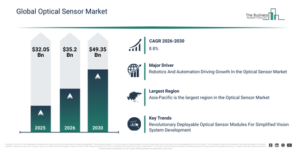
The optical sensor market has demonstrated substantial expansion in recent years. Its valuation is anticipated to climb from $32.05 billion in 2025 to $35.2 billion in 2026, achieving a compound annual growth rate (CAGR) of 9.8%. The market’s historical development is attributable to factors including manual monitoring of manufacturing lines, limited sensing accuracy, the need for process automation, the implementation of early light-based sensors, and the rise of consumer electronics._x000D_
_x000D_
The optical sensor market is projected for significant expansion in the coming years. Its valuation is anticipated to reach $49.35 billion by 2030, exhibiting a compound annual growth rate (CAGR) of 8.8%. This projected growth is primarily driven by factors such as the incorporation of smart industrial automation, the advancement of image sensors, the uptake of IoT-enabled optical sensors, increasing miniaturization alongside improved precision, and their application across automotive and healthcare sectors. Key developments expected during this period encompass the integration of fiber optic sensors, the prevalence of time-of-flight (ToF) sensors, the evolution of CMOS and CCD image sensors, progress in ambient light sensor technology, and enhancements in both proximity and infrared sensors._x000D_
_x000D_
#Download A Free Sample Report For Comprehensive Market Insights:#_x000D_
_x000D_
#Optical Sensor Market Expansion Drivers: What Is Shaping Future Growth?#_x000D_
The expanding field of robotics and automation is anticipated to fuel the future expansion of the optical sensor market. Robotics and automation involve the deployment of robotic instruments and AI-powered systems to execute tasks autonomously in both manufacturing and service sectors, eliminating the need for direct human involvement. The escalating need for robotics and automation stems from demands for enhanced productivity, stricter efficiency goals, insufficient labor availability, and the drive towards adaptable and personalized production setups. The optical sensor market plays a crucial role in facilitating this trend by supplying essential functions such as detection, precise positioning, quality assurance, and safety, thereby improving the functionalities of automated systems and robotic units. An example illustrating this is data from September 2024, where the International Federation of Robotics, a non-profit entity based in Germany, reported that the global inventory of industrial robots in factories reached 4,281,585 units in 2023, marking a 10% rise. Additionally, the yearly installation count of 541,302 units in 2023 stands as the second highest ever recorded. Consequently, the expansion of robotics and automation is a primary impetus behind the growth of the optical sensor market._x000D_
_x000D_
#Optical Sensor Market Segment Landscape: Which Areas Lead Market Development?#_x000D_
The optical sensor market covered in this report is segmented – _x000D_
_x000D_
1) By Type: Fiber Optics, Position Sensors, Image Sensors, Ambient Light Sensors, Proximity Sensors, Infrared Sensors_x000D_
2) By Application: Pressure And Strain Sensing, Temperature Sensing, Geological Survey, Biometric_x000D_
3) By Vertical: Consumer Electronics, Industrial, Aerospace And Defense, Oil And Gas, Automotive, Healthcare_x000D_
_x000D_
Subsegments:_x000D_
1) By Fiber Optics: Optical Fiber Sensors, Distributed Fiber Optic Sensors, Fiber Bragg Grating Sensors _x000D_
2) By Position Sensors: Linear Position Sensors, Rotary Position Sensors, Angular Position Sensors _x000D_
3) By Image Sensors: CMOS (Complementary Metal-Oxide-Semiconductor) Sensors, CCD (Charge-Coupled Device) Sensors, Time-Of-Flight (ToF) Sensors _x000D_
4) By Ambient Light Sensors: Photoresistor-Based Sensors, Photodiode-Based Sensors, Phototransistor-Based Sensors _x000D_
5) By Proximity Sensors: Capacitive Proximity Sensors, Inductive Proximity Sensors, Optical Proximity Sensors _x000D_
6) By Infrared Sensors: Active Infrared Sensors, Passive Infrared Sensors, Infrared Thermopile Sensors_x000D_
_x000D_
#Optical Sensor Market Strategic Trends: What Is Defining The Next Phase Of Growth?#_x000D_
Leading companies in the optical sensor market are advancing technologies, such as FSM: GO, to simplify vision system development and enhance the integration of optical sensing capabilities into contemporary devices. FSM: GO refers to compact, modular image sensor systems designed to embed specialized vision technologies into machines, enabling them to perceive and interpret their surroundings. For instance, in January 2024, FRAMOS GmbH, a Germany-based technology provider, launched FSM: GO, presenting it as a complete system of deployable optical sensor modules engineered to help machines “see and think.” This solution offers a curated set of pre-selected sensors paired with optimally focused lenses to deliver exceptional off-the-shelf image quality. Designed as a versatile, production-ready prototyping tool, FSM: GO streamlines embedded vision development by enabling immediate testing, rapid configuration, and seamless transition to mass manufacturing, ultimately accelerating the time-to-market for vision-enabled products._x000D_
_x000D_
#Optical Sensor Market Industry Leaders And Market Competition#_x000D_
Major companies operating in the optical sensor market are Sony Corporation; Panasonic Holdings Corporation; Honeywell International Inc; Broadcom Inc; ABB Ltd; Texas Instruments; T.E. Connectivity Ltd; STMicroelectronics; Infineon Technologies AG; NXP Semiconductor Inc; Analog Devices Inc; ON Semiconductor Corporation; Keyence Corporation; OMRON Corporation; Teledyne Technologies Inc; ams AG; ROHM Semiconductor; Sick AG; Hamamatsu Photonics; ifm electronic gmbh; Vishay Intertechnology; Balluff Webshop UK; First Sensor AG; AlphaSense; Oxsensis Ltd; Rockwell Automation _x000D_
_x000D_
#Access The Complete Optical Sensor Market Report:#_x000D_
_x000D_
#Optical Sensor Market Global Footprint: Which Region Holds Market Leadership?#_x000D_
Asia-Pacific was the largest region in the optical sensor market in 2025. Asia-Pacific is expected to be the fastest-growing region in the forecast period. The regions covered in the optical sensor market report are Asia-Pacific, South East Asia, Western Europe, Eastern Europe, North America, South America, Middle East, Africa._x000D_
_x000D_
#Get in touch with us:#_x000D_
_x000D_
The Business Research Company: https://www.thebusinessresearchcompany.com/_x000D_
Americas: +1 310-496-7795_x000D_
Asia: +44 7882 955267 & +91 8897263534_x000D_
Europe: +44 7882 955267_x000D_
Email us at: marketing@tbrc.info_x000D_
_x000D_
#Follow us on:#_x000D_
_x000D_
LinkedIn: https://in.linkedin.com/company/the-business-research-company_x000D_
YouTube: https://www.youtube.com/channel/UC24_fI0rV8cR5DxlCpgmyFQ_x000D_
Global Market Model: https://www.thebusinessresearchcompany.com/global-market-model

Wasay has over a decade of experience in market research, data modelling, and analytics, with prior experience at GlobalData and Decision Tree Consulting Services. At The Business Research Company , he leads research operations across syndicated studies, customized consulting engagements, and the Global Market Model platform. His professional experience includes supporting organizations such as Boston Consulting Group, KPMG, and Ernst & Young. Wasay holds a degree in Electronics and Communications Engineering, postgraduate management qualifications from International Management Institute Belgium and Indian School of Business and Entrepreneurship, and completed the Integrated Program in Business Analytics from Indian Institute of Management Indore.