Delivering more actionable and strategically valuable research, The Business Research Company’s 2026 market reports feature market attractiveness analysis, total addressable market evaluation, company benchmarking matrices, interactive Excel dashboards, expanded supply chain intelligence, emerging startup coverage, and detailed product insights.
Augmented Reality (AR) Shopping Market Value Analysis: What Growth Is Expected Over The Forecast Period?
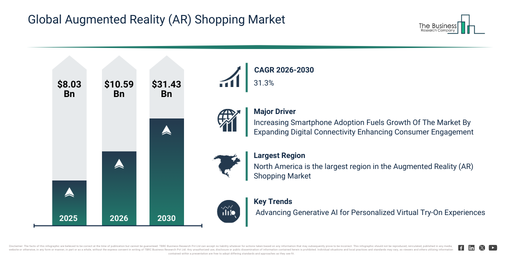
The augmented reality (AR) shopping market size has seen rapid expansion in recent years. It is anticipated to increase from $8.03 billion in 2025 to $10.59 billion in 2026, exhibiting a compound annual growth rate (CAGR) of 31.9%. This historical growth can be linked to the expansion of online retail platforms, a rise in smartphone usage, the demand for interactive shopping experiences, the limitations inherent in traditional e-commerce visuals, and the initial widespread use of virtual try-on tools.
The augmented reality (ar) shopping market is anticipated to expand significantly over the coming years. It is projected to reach $31.43 billion by 2030, driven by a compound annual growth rate (CAGR) of 31.3%. This expansion is primarily attributed to the growth of metaverse commerce, increasing adoption of AR smart devices, a rising consumer preference for immersive shopping, the integration of AR with payment platforms, and the development of omnichannel retail strategies. Notable trends within the forecast period include mobile-based AR shopping experiences, AI-powered virtual try-on solutions, web-based AR commerce platforms, personalized AR shopping interfaces, and the integration of social commerce with AR.
Download A Free Sample Report For Comprehensive Market Insights:
Augmented Reality (AR) Shopping Market Expansion Drivers: What Is Shaping Future Growth?
Growing smartphone access is anticipated to fuel the expansion of the augmented reality (AR) shopping market in the future. High rates of smartphone uptake are attributed to their cost-effectiveness, versatile functions, and uninterrupted connectivity, fulfilling various consumer requirements within a single, portable device. These devices facilitate augmented reality (AR) shopping, enabling consumers to preview items virtually in real-time, thus enriching the online retail journey through engaging and interactive elements. As an illustration, in February 2024, data from Uswitch Limited, a UK-based comparison and switching service provider, indicated 71.8 million mobile connections in the UK as of early 2022. Projections suggest that by 2025, the UK’s population will reach 68.3 million, with an estimated 95% (around 65 million people) utilizing smartphones. Consequently, the greater proliferation of smartphones is set to propel the expansion of the augmented reality (AR) shopping market.
Augmented Reality (AR) Shopping Market Segmentation: How Is The Market Structured Across Key Categories?
The augmented reality (ar) shopping market covered in this report is segmented –
1) By Offering: Hardware, Software, Services
2) By AR Technology: Marker-Based AR, Markerless AR
3) By Application: Automotive, Home Goods And Furniture, Beauty And Cosmetics, Apparel Fittings, Grocery Shopping, Footwear, Other Applications
4) By End Use: Retail And In-Store, E-Commerce And Out Of Store
Subsegments:
1) By Hardware: Augmented Reality Smart Glasses, Augmented Reality Head-Mounted Displays, Augmented Reality-Enabled Smartphones And Tablets, Augmented Reality Mirrors And Kiosks, Augmented Reality Sensors And Cameras
2) By Software: Augmented Reality Shopping Applications, Artificial Intelligence-Powered Virtual Try-On Solutions, Augmented Reality-Powered Product Visualization Tools, Web-Based Augmented Reality Shopping Platforms, Augmented Reality Content Creation And Management Software
3) By Services: Augmented Reality Integration And Deployment Services, Augmented Reality Shopping Experience Consulting, Custom Augmented Reality Application Development, Maintenance And Support Services For AR Solutions, Augmented Reality Marketing And Advertising Solutions
#Augmented Reality (AR) Shopping Market Growth Trends: What Is Influencing The Future Outlook?
Leading companies in the augmented reality (AR) shopping market are concentrating on technological advancements, such as generative AI-powered AR try-on APIs. This focus aims to satisfy the increasing consumer demand for highly personalized and immersive online shopping experiences, which helps boost buyer confidence and lower return rates. Generative AI AR try-on APIs provide developers with pre-trained models capable of rendering realistic virtual garments, makeup, or accessories on users’ photos or live video in real time. Unlike traditional rule-based AR overlays, these APIs utilize deep learning to comprehend body shape, lighting, and pose, resulting in more accurate and lifelike previews. For instance, in December 2024, Perfect Corp., a Taiwan-based SaaS company specializing in AI and AR beauty and fashion tech, launched its Generative AI APIs, which include virtual hairstyle and wig try-on, AI makeup transfer, and age-progression simulation. These APIs combine generative deep learning models and image processing tools, allowing developers to integrate hyper-realistic virtual try-on experiences into e-commerce applications or websites without constructing complex AI pipelines from scratch. The solution supports real-time interactivity, scales with traffic, and offers a highly personalized user journey by tailoring looks to individual facial structure, lighting, and style, thus enhancing engagement, reducing returns, and enriching online retail.
Augmented Reality (AR) Shopping Market Competitive Landscape And Leading Companies
Major companies operating in the augmented reality (ar) shopping market are Amazon.com Inc., Apple Inc., Google LLC, Microsoft Corporation, Meta Platforms Inc., Inter Ikea Systems BV, Qualcomm Technologies, Inc., Wayfair Inc., Seiko Epson Corporation, Burberry Group Plc, PTC Inc., Converse Inc., Warby Parker Inc., Houzz Inc., Magic Leap Inc., Rebecca Minkoff LLC, StayinFront Inc., 3D Cloud by Marxent (Marxent Labs LLC), Blippar Ltd., Vuzix Corporation, Wikitude GmbH, Holition Ltd., ViewAR GmbH, Zugara Inc., Imaginate Technologies
Access The Complete Augmented Reality (AR) Shopping Market Report:
Augmented Reality (AR) Shopping Market Geographic Distribution And Regional Opportunities
North America was the largest region in the augmented reality (AR) shopping market in 2025. The regions covered in the augmented reality (ar) shopping market report are Asia-Pacific, South East Asia, Western Europe, Eastern Europe, North America, South America, Middle East, Africa.
Get in touch with us:
The Business Research Company: https://www.thebusinessresearchcompany.com/
Americas: +1 310-496-7795
Asia: +44 7882 955267 & +91 8897263534
Europe: +44 7882 955267
Email us at: marketing@tbrc.info
Follow us on:
LinkedIn: https://in.linkedin.com/company/the-business-research-company
YouTube: https://www.youtube.com/channel/UC24_fI0rV8cR5DxlCpgmyFQ
Global Market Model: https://www.thebusinessresearchcompany.com/global-market-model

Wasay has over a decade of experience in market research, data modelling, and analytics, with prior experience at GlobalData and Decision Tree Consulting Services. At The Business Research Company , he leads research operations across syndicated studies, customized consulting engagements, and the Global Market Model platform. His professional experience includes supporting organizations such as Boston Consulting Group, KPMG, and Ernst & Young. Wasay holds a degree in Electronics and Communications Engineering, postgraduate management qualifications from International Management Institute Belgium and Indian School of Business and Entrepreneurship, and completed the Integrated Program in Business Analytics from Indian Institute of Management Indore.