Delivering more actionable and strategically valuable research, The Business Research Company’s 2026 market reports feature market attractiveness analysis, total addressable market evaluation, company benchmarking matrices, interactive Excel dashboards, expanded supply chain intelligence, emerging startup coverage, and detailed product insights.
Business Productivity Software Market Value Analysis: What Growth Is Expected Over The Forecast Period?
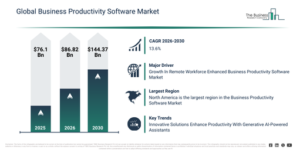
The market for business productivity software has experienced significant expansion recently. This market is projected to expand from $76.1 billion in 2025 to $86.82 billion by 2026, demonstrating a compound annual growth rate (CAGR) of 14.1%. Historically, this growth has been driven by factors such as the increasing embrace of digital workplaces, the growing demand for enterprise collaboration tools, the greater utilization of cloud-based applications, the rise of remote and hybrid work arrangements, and the accessibility of subscription-based productivity software.
The business productivity software market is expected to demonstrate significant expansion in the coming years. It is projected to achieve a valuation of $144.37 billion by 2030, growing at a compound annual growth rate (CAGR) of 13.6%. This anticipated growth is primarily driven by factors such as the increasing integration of AI assistants into productivity tools, a rising demand for immersive collaboration experiences, the expansion of cross-platform productivity ecosystems, a growing focus on workflow automation, and increased adoption among small and medium enterprises. Key trends for the forecast period include the increasing uptake of AI-powered productivity tools, a rising demand for cloud-based collaboration platforms, the growing integration of task automation features, the expansion of remote work enablement software, and an enhanced emphasis on user experience and engagement.
Download A Free Sample Report For Comprehensive Market Insights:
Business Productivity Software Market Expansion Drivers: What Is Shaping Future Growth?
The global expansion of remote and distributed workforces is anticipated to fuel the expansion of the business productivity software market in the future. These work arrangements involve employees operating outside conventional office environments, frequently from their residences or other distant locations. The growth in such workforces stems from technological progress, evolving perspectives on work-life balance, and the COVID-19 pandemic’s role in accelerating the embrace of flexible work models. Business productivity software assists these workforces by supplying essential tools and platforms for effective communication, collaboration, project management, and task coordination. A relevant example shows that in March 2025, the U.S. Bureau of Labor Statistics reported that during the first quarter of 2024, 35.5 million individuals were working from home or teleworking for compensation, marking an increase of 5.1 million from the preceding year. This cohort constituted 22.9% of all employed individuals in that timeframe, a rise from 19.6% in the comparable quarter of the previous year. Consequently, the increasing prevalence of remote and distributed workforces worldwide is a key factor propelling the growth of the business productivity software market.
Business Productivity Software Market Segmentation: How Is The Market Structured Across Key Categories?
The business productivity software market covered in this report is segmented –
1) By Solutions: Content Management And Collaboration, Asset Creation, Artificial Intelligence (AI) And Predictive Analytics, Structured Work Management
2) By Deployment: On-Premise, Cloud
3) By Organization Size: Small And Medium Enterprises, Large Enterprises
4) By Industry: Banking, Financial Services, and Insurance, Information Technology And Telecom, Healthcare, Travel And Hospitality, Retail And E-Commerce, Manufacturing, Other Industries
Subsegments:
1) By Content Management and Collaboration: Document Management Systems, File Storage and Sharing, Team Collaboration Platforms, Knowledge Management Systems, Real-Time Co-Authoring Tools, Communication and Messaging Tools
2) By Asset Creation: Document and Spreadsheet Creation Tools, Presentation Software, Graphic Design and Multimedia Creation Tools, Content Editing and Formatting Tools, Template-Based Content Creation Tools
3) By Artificial Intelligence (AI) and Predictive Analytics: Workflow Automation and AI Assistants, Predictive Analytics and Forecasting Tools, Intelligent Data Analysis and Reporting, Natural Language Processing (NLP) Tools, Recommendation and Decision-Support Systems
4) By Structured Work Management: Task and To-Do Management Tools, Project and Portfolio Management Software, Workflow and Process Management Tools, Resource and Capacity Planning Tools, Time Tracking and Performance Monitoring Tools
Business Productivity Software Market Trends: What Is Shaping Future Industry Growth?
Leading companies within the business productivity software market are concentrating on developing generative AI-powered assistant solutions aimed at enhancing both developer and business productivity. A generative AI-powered assistant solution in business productivity software functions as an artificial intelligence (AI)-driven instrument crafted to elevate efficiency through automating tasks, offering valuable insights, and supporting decision-making processes. For example, in April 2024, Amazon Web Services Inc., a US-based cloud computing platform, unveiled Amazon Q, an advanced generative artificial intelligence (AI) assistant designed to accelerate software development and improve business data utilization. Amazon Q represents a comprehensive business productivity software solution that harnesses generative AI to boost efficiency, decision-making, and collaboration for developers, offering deep enterprise integration, robust security, potent generative AI capabilities, numerous productivity-enhancing features, and has shown proven adoption by large organizations and business users throughout enterprises.
Business Productivity Software Market Competitive Landscape And Leading Companies
Major companies operating in the business productivity software market are Google LLC, Microsoft Corporation, Salesforce.com Inc., Adobe Inc., Zoom Video Communications Inc., Atlassian Corporation plc, Dropbox Inc., HubSpot Inc., Zendesk Inc., Slack Technologies Inc., Zoho Corporation Pvt. Ltd., Smartsheet Inc., TeamViewer GmbH, Miro, Monday.com Ltd., Freshworks Inc., Asana Inc., Basecamp LLC, Intercom Inc., Box Inc., Wrike Inc., ClickUp Inc., Airtable Inc., Notion Labs Inc., Evernote Corporation, Trello Inc.
Access The Complete Business Productivity Software Market Report:
Business Productivity Software Market Geographic Distribution And Regional Opportunities
North America was the largest region in the business productivity software market in 2025. Asia-Pacific is expected to be the fastest-growing region in the forecast period. The regions covered in the business productivity software market report are Asia-Pacific, South East Asia, Western Europe, Eastern Europe, North America, South America, Middle East, Africa.
Get in touch with us:
The Business Research Company: https://www.thebusinessresearchcompany.com/
Americas: +1 310-496-7795
Asia: +44 7882 955267 & +91 8897263534
Europe: +44 7882 955267
Email us at: marketing@tbrc.info
Follow us on:
LinkedIn: https://in.linkedin.com/company/the-business-research-company
YouTube: https://www.youtube.com/channel/UC24_fI0rV8cR5DxlCpgmyFQ
Global Market Model: https://www.thebusinessresearchcompany.com/global-market-model

Wasay has over a decade of experience in market research, data modelling, and analytics, with prior experience at GlobalData and Decision Tree Consulting Services. At The Business Research Company , he leads research operations across syndicated studies, customized consulting engagements, and the Global Market Model platform. His professional experience includes supporting organizations such as Boston Consulting Group, KPMG, and Ernst & Young. Wasay holds a degree in Electronics and Communications Engineering, postgraduate management qualifications from International Management Institute Belgium and Indian School of Business and Entrepreneurship, and completed the Integrated Program in Business Analytics from Indian Institute of Management Indore.