
Through market attractiveness analysis, total addressable market evaluation, company benchmarking matrices, interactive Excel dashboards, expanded supply chain intelligence, emerging startup coverage, and detailed product insights, The Business Research Company’s 2026 market reports provide more actionable and strategically valuable research.
Airborne Telemetry Market Value Analysis: What Growth Is Expected Over The Forecast Period?
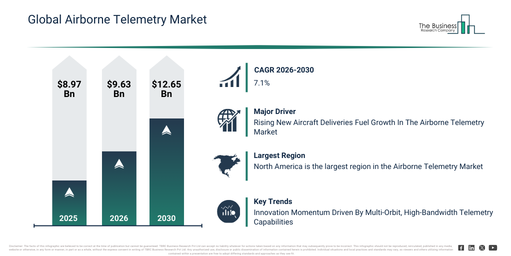
The airborne telemetry market has experienced robust expansion over the past few years. This market is projected to expand from $8.97 billion in 2025 to reach $9.63 billion by 2026, exhibiting a compound annual growth rate (CAGR) of 7.4%. Historically, this expansion has been driven by several factors, including the increase in aerospace testing programs, the wider adoption of unmanned aerial vehicles, the need for real-time flight monitoring, the implementation of satellite communication systems, and a rise in defense modernization initiatives.
The airborne telemetry market is anticipated to experience robust expansion over the coming years. This market is projected to reach $12.65 billion by 2030, exhibiting a compound annual growth rate (CAGR) of 7.1%. Key factors contributing to this anticipated growth include the expansion of drone-based operations, an increasing need for space telemetry systems, the implementation of AI-powered signal processing, advancements in commercial aviation monitoring, and integration with satellite broadband networks. Significant trends observed during the forecast period encompass real-time flight data transmission, the development of high-bandwidth wireless telemetry systems, the emergence of miniaturized telemetry sensors, the integration of long-range communication capabilities, and the adoption of advanced signal processing technologies.
Download A Free Sample Report For Comprehensive Market Insights:
Airborne Telemetry Market Opportunity Drivers: What Is Creating New Revenue Potential?
The airborne telemetry market is expected to experience growth primarily due to the increasing volume of new aircraft deliveries. These deliveries refer to the process where newly produced aircraft are handed over from manufacturers to customers, signifying their operational commencement. The rise in new aircraft deliveries stems from airlines upgrading their fleets with more fuel-efficient models and responding to the expanding demand for air travel, which is influenced by economic recovery and a boost in tourism. Airborne telemetry offers significant utility for aircraft by enabling the real-time transmission of critical flight data to ground stations, thereby enhancing safety, operational effectiveness, and remote issue identification. For example, in January 2024, Airbus SE, a commercial aircraft manufacturing company based in the Netherlands, reported delivering 735 commercial aircraft in 2023, marking an 11% increase from 2022. They also secured 2,319 gross orders (2,094 net), which included 1,835 A320 Family and 300 A350 Family aircraft. Consequently, the escalating new aircraft deliveries are a key driver for the expansion of the airborne telemetry market.
Airborne Telemetry Market Segmentation And Category Breakdown
The airborne telemetry market covered in this report is segmented –
1) By Component: Receiver, Transmitter, Antenna, Sensors
2) By Sensor: Global Positioning System (GPS), Load Cell, Torque, Weather Prediction, Other Sensors
3) By Platform: Manned Aircraft, Unmanned Aerial Vehicles, Missiles, Rockets, Satellites
4) By Technology: Wired Telemetry, Wireless Telemetry, Data Loggers, Acoustic Telemetry, Digital Telemetry
Subsegments:
1) By Receiver: Ground-Based Receivers, Airborne Receivers, Handheld Receivers, Multi-Channel Receivers, Digital Receivers
2) By Transmitter: High-Power Transmitters, Low-Power Transmitters, Digital Transmitters, Frequency-Modulated (FM) Transmitters, Frequency-Hopping Transmitters
3) By Antenna: Omnidirectional Antennas, Directional Antennas, High-Gain Antennas, Folded Dipole Antennas, Patch Antennas
4) By Sensors: Temperature Sensors, Pressure Sensors, Humidity Sensors, Altitude Sensors, Accelerometers, Gyroscopes, GPS Sensors
Airborne Telemetry Market Trends: What Is Shaping Future Industry Growth?
Leading companies in the Airborne Telemetry market are concentrating on developing innovative advancements, such as Multi-Orbit Connectivity Portfolios, with the goal of enhancing real-time data transmission reliability, improving platform-to-ground interoperability, and supporting high-bandwidth mission operations across diverse flight environments. A Multi-Orbit Connectivity Portfolio is defined as an integrated collection of communication capabilities that utilize multiple satellite orbits, including Low Earth Orbit (LEO), Medium Earth Orbit (MEO), and Geostationary Earth Orbit (GEO), to provide resilient, high-bandwidth, and uninterrupted data links for airborne platforms. As an illustration, in August 2025, Viasat, Inc., a U.S.-based commercial internet service provider, introduced its HaloNet Capability Portfolio. This portfolio aims to bolster resilient near-Earth communications, improve multi-orbit interoperability, and facilitate high-bandwidth, mission-critical data transfer for government and aerospace applications. Viasat’s HaloNet Capability Portfolio implements a modular, multi-orbit communications architecture that connects space and terrestrial networks to support missions from LEO through MEO. It enables high-capacity data transfer through multi-band (L-, Ka-, and optical) connectivity, offering rates up to 10 Gbps and dynamic switching between relay and direct-to-Earth paths. Furthermore, the portfolio incorporates field-deployable command-and-control gateways to ensure secure, flexible operations anywhere.
Airborne Telemetry Market Competitive Analysis Of Major Industry Participants
Major companies operating in the airborne telemetry market are Lockheed Martin Corporation, Northrop Grumman Corporation, Honeywell International Inc., BAE Systems plc, Safran S.A., Thales Group, L3Harris Technologies Inc., Leidos Holdings Inc., General Dynamics Mission Systems Inc., Teledyne Technologies Incorporated, Kongsberg Gruppen ASA, Rohde & Schwarz GmbH & Co KG, ViaSat Inc., Curtiss-Wright Corporation, Microsemi Corporation, Sierra Nevada Corporation, Kratos Defense & Security Solutions Inc., Cobham Aerospace Communications, Orbit Communications Systems Ltd., Mistral Solutions Pvt. Ltd, AMPEX Data Systems Corporation, Airtec Inc.
Access The Complete Airborne Telemetry Market Report:
Airborne Telemetry Market Regional Analysis And Leading Geography
North America was the largest region in the airborne telemetry market in 2025. Asia-Pacific is expected to be the fastest-growing region in the forecast period. The regions covered in the airborne telemetry market report are Asia-Pacific, South East Asia, Western Europe, Eastern Europe, North America, South America, Middle East, Africa.
Get in touch with us:
The Business Research Company: https://www.thebusinessresearchcompany.com/
Americas: +1 310-496-7795
Asia: +44 7882 955267 & +91 8897263534
Europe: +44 7882 955267
Email us at: marketing@tbrc.info
Follow us on:
LinkedIn: https://in.linkedin.com/company/the-business-research-company
YouTube: https://www.youtube.com/channel/UC24_fI0rV8cR5DxlCpgmyFQ
Global Market Model: https://www.thebusinessresearchcompany.com/global-market-model

Wasay has over a decade of experience in market research, data modelling, and analytics, with prior experience at GlobalData and Decision Tree Consulting Services. At The Business Research Company , he leads research operations across syndicated studies, customized consulting engagements, and the Global Market Model platform. His professional experience includes supporting organizations such as Boston Consulting Group, KPMG, and Ernst & Young. Wasay holds a degree in Electronics and Communications Engineering, postgraduate management qualifications from International Management Institute Belgium and Indian School of Business and Entrepreneurship, and completed the Integrated Program in Business Analytics from Indian Institute of Management Indore.