Enhanced with market attractiveness analysis, total addressable market evaluation, company benchmarking matrices, interactive Excel dashboards, expanded supply chain intelligence, emerging startup coverage, and detailed product insights, The Business Research Company’s 2026 market reports deliver more actionable and strategically valuable research.
Hollow-Core Fiber Market Value Analysis: What Growth Is Expected Over The Forecast Period?
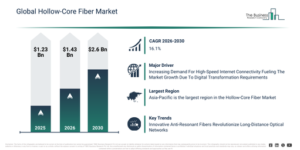
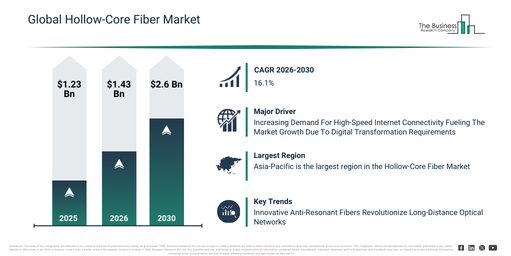
The hollow-core fiber market size has experienced rapid expansion in recent years. It is projected to increase from $1.23 billion in 2025 to $1.43 billion in 2026, exhibiting a compound annual growth rate (CAGR) of 16.4%. Historically, this growth can be linked to challenges inherent in past solutions, including a reliance on traditional solid-core fibers, substantial transmission losses, restricted long-distance bandwidth, signal distortion in conventional fibers, and limited adoption in precision sensing applications.
The hollow-core fiber market size is projected to experience rapid expansion in the upcoming years. It is predicted to reach $2.6 billion by 2030, exhibiting a compound annual growth rate (CAGR) of 16.1%. The expected growth during this forecast period stems from factors such as increasing demand for high-speed optical communication, its uptake in aerospace and defense, the advancement of sensing applications within healthcare and manufacturing, the widening of long-distance telecommunication networks, and progress in developing low-loss and high-power hollow-core fibers. Significant trends over the forecast horizon include ultra-low loss transmission, high-bandwidth long-distance communication, sophisticated optical sensing applications, ultrafast signal transmission, and precise signal guidance.
Download A Free Sample Report For Comprehensive Market Insights:
Hollow-Core Fiber Market Industry Drivers: What Is Driving Revenue Growth?
The rising need for swift internet access is anticipated to fuel the expansion of the hollow-core fiber market moving ahead. Swift internet connections encompass broadband offerings that deliver rapid data transfer capacities, facilitating uninterrupted digital interactions and data movement. The appetite for rapid internet is growing because of hastened digital shifts across sectors, where telecommuting, cloud services, and streaming platforms necessitate strong bandwidth infrastructure to accommodate escalating data usage demands. Hollow-core fiber facilitates high-speed internet connectivity by employing air-filled cores, enabling light signals to traverse more quickly with substantially decreased latency and signal degradation when contrasted with traditional solid-core fibers. This, in turn, supplies the incredibly fast, low-latency framework crucial for intensive high-bandwidth uses and future telecommunications systems. As an illustration, in November 2024, data from the UK Parliament’s House of Commons Library, a government body in the UK, indicated that by January 2024, gigabit-capable broadband reached 78% of UK properties, an increase from 72% in January 2023 and 64% in January 2022. Consequently, the escalating requirement for fast internet access is propelling the expansion of the hollow-core fiber market.
Hollow-Core Fiber Market Segments: Where Are The Largest Growth Opportunities?
The hollow-core fiber market covered in this report is segmented –
1) By Type Of Fiber: Photonic Bandgap Fibers, Anti-Resonant Fibers, Other Specialized Hollow-Core Fibers
2) By Material: Silica, Polymer, Other Materials
3) By Manufacturing Process: Extrusion Process, Draw Tower Process, Lasing And Sintering Methods, Other Advanced Manufacturing Techniques
4) By End-User: Telecom And Information Technology (IT), Healthcare, Manufacturing, Aerospace And Defense, Other End-Users
Subsegments:
1) By Photonic Bandgap Fibers: Bragg Fibers, Kagome Fibers, Tube Lattice Fibers, Hollow-Core Photonic Crystal Fibers
2) By Anti-Resonant Fibers: Single-Ring Anti-Resonant Fibers, Nested-Ring Anti-Resonant Fibers, Negative Curvature Fibers, Tube Lattice Anti-Resonant Fibers
3) By Other Specialized Hollow-Core Fibers: Low-Loss Hollow-Core Fibers, High-Power Transmission Fibers, Dispersion-Managed Hollow-Core Fibers, Custom Geometry Hollow-Core Fibers
Hollow-Core Fiber Market Transformation Trends: Which Innovations Are Driving Change?
Leading companies in the hollow-core fiber market are concentrating on developing innovative solutions, such as low-loss anti-resonant hollow-core fibers, to enable ultra-fast, low-latency, and high-capacity optical networks. Low-loss anti-resonant hollow-core fibers (AR-HCFs) are optical fibers designed with a hollow core that guides light through air rather than solid glass, thereby minimizing scattering and absorption. This design helps reduce signal loss, lower latency, minimize dispersion, and facilitates higher-power, long-distance, high-speed data transmission. For example, in September 2024, Linfiber Technology (Nantong) Co., Ltd., a China-based company, launched its LinearCore hollow-core fiber cable. This cable features an innovative anti-resonant hollow-core fiber (AR-HCF) structure, achieving a loss of 0.5 dB/km in the C+L band. The LinearCore cable offers approximately 30% lower latency compared to standard silica glass fibers and supports ultra-high-capacity transmission, enabling more efficient long-distance, high-speed data transfer with minimal signal degradation. LinearCore also incorporates advanced connector and splicing technologies, including SMF28-HCF connectors and HCF-HCF splicing techniques, ensuring low connection loss (<0.3 dB) and reliable field deployment. Its design permits higher input power, reduces the need for repeaters and amplifiers, and simplifies optical dispersion and nonlinear compensation, leading to lower energy consumption and overall system cost.
Hollow-Core Fiber Market Major Participants And Competitive Dynamics
Major companies operating in the hollow-core fiber market are Microsoft Corporation, Hamamatsu Photonics K.K., Heraeus Covantics GmbH, Prysmian Group, Furukawa Electric Co. Ltd., Hengtong Group Co. Ltd., HUBER+SUHNER AG, Thorlabs Inc., Relativity Networks Inc., YSL Photonics Co. Ltd., Lingxian Technology, GLOphotonics SAS, Guiding Photonics Inc., Yangtze Optical Electronic Co. Ltd. (YOEC), Photonics Bretagne, NKT Photonics A/S, art photonics GmbH, Few-cycle Inc., Linfiber Technology (Nantong) Co. Ltd., IRflex Corporation.
Access The Complete Hollow-Core Fiber Market Report:
Hollow-Core Fiber Market Regional Outlook: Where Are The Largest Opportunities Located?
Asia-Pacific was the largest region in the hollow-core fiber market in 2025, and it is expected to be the fastest-growing region in the forecast period. The regions covered in the hollow-core fiber market report are Asia-Pacific, South East Asia, Western Europe, Eastern Europe, North America, South America, Middle East, Africa.
Get in touch with us:
The Business Research Company: https://www.thebusinessresearchcompany.com/
Americas: +1 310-496-7795
Asia: +44 7882 955267 & +91 8897263534
Europe: +44 7882 955267
Email us at: marketing@tbrc.info
Follow us on:
LinkedIn: https://in.linkedin.com/company/the-business-research-company
YouTube: https://www.youtube.com/channel/UC24_fI0rV8cR5DxlCpgmyFQ
Global Market Model: https://www.thebusinessresearchcompany.com/global-market-model

Wasay has over a decade of experience in market research, data modelling, and analytics, with prior experience at GlobalData and Decision Tree Consulting Services. At The Business Research Company , he leads research operations across syndicated studies, customized consulting engagements, and the Global Market Model platform. His professional experience includes supporting organizations such as Boston Consulting Group, KPMG, and Ernst & Young. Wasay holds a degree in Electronics and Communications Engineering, postgraduate management qualifications from International Management Institute Belgium and Indian School of Business and Entrepreneurship, and completed the Integrated Program in Business Analytics from Indian Institute of Management Indore.