Through market attractiveness analysis, total addressable market evaluation, company benchmarking matrices, interactive Excel dashboards, expanded supply chain intelligence, emerging startup coverage, and detailed product insights, The Business Research Company’s 2026 market reports provide more actionable and strategically valuable research.
Hybrid Fiber Coaxial Market Value Analysis: What Growth Is Expected Over The Forecast Period?
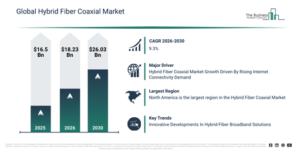
The hybrid fiber coaxial market has experienced rapid expansion in recent years. Its value is projected to increase from $16.5 billion in 2025 to $18.23 billion in 2026, at a compound annual growth rate (CAGR) of 10.5%. The historical growth of this market can be attributed to the expansion of cable television infrastructure, an increase in household broadband adoption, growing investments in last-mile connectivity, the proliferation of digital content consumption, and the existing availability of coaxial network infrastructure.
The hybrid fiber coaxial market is projected to experience robust expansion over the coming years. By 2030, its size is predicted to reach $26.03 billion, demonstrating a compound annual growth rate (CAGR) of 9.3%. This projected growth during the forecast period stems from factors such as increased capital directed towards gigabit broadband networks, a heightened need for connectivity with minimal latency, the spread of smart city infrastructure, intensifying rivalry with full-fiber networks, and the wider adoption of data-heavy applications. Key trends anticipated during this period encompass the broadening of DOCSIS 3.1 network enhancements, a greater rollout of fiber-deeper network designs, an escalating requirement for rapid broadband services, the wider embrace of sophisticated optical nodes, and a stronger emphasis on refining network capacity.
Download A Free Sample Report For Comprehensive Market Insights:
Hybrid Fiber Coaxial Market Opportunity Drivers: What Is Creating New Revenue Potential?
The future growth of the hybrid fiber coaxial (HFC) market is anticipated to be propelled by the escalating demand for internet connectivity. Internet connectivity refers to the capacity and quality of accessing and utilizing the internet via wired or wireless technologies that link devices to the global network. This increasing demand for internet access stems from accelerating digital transformation, the expansion of e-commerce, widespread streaming services, remote work arrangements, online educational platforms, and the proliferation of social and entertainment platforms. The hybrid fiber coaxial market supports this rising demand by providing high-speed broadband through fiber-optic backbones integrated with coaxial last-mile delivery, enabling efficient, long-distance data transmission. For instance, in February 2024, data from the International Telecommunication Union (ITU), a Switzerland-based United Nations specialized agency, indicated that the number of internet users grew from 5.1 billion in 2022 to 5.4 billion in 2023, reflecting sustained global growth in internet adoption. Therefore, the expanding demand for internet connectivity is a key driver for the hybrid fiber coaxial market’s development.
Hybrid Fiber Coaxial Market Segmentation And Category Breakdown
The hybrid fiber coaxial market covered in this report is segmented –
1) By Component: Cable Modem Termination System Or Converged Cable Access Platform, Fiber Optic Cable, Customer Premises Equipment, Optical Node, Optical Transceiver, Amplifier, Splitter
2) By Technology: DOCSIS 3.1, DOCSIS 3.0 And Below
3) By Application: Digital Television (TV), Telephone Network, Broadband, Other Applications
Subsegments:
1) By Cable Modem Termination System or Converged Cable Access Platform (CMTS or CCAP): Cable Modem Termination Systems (CMTS), Converged Cable Access Platforms (CCAP), Integrated CMTS/CCAP Solutions, Edge QAM (Quadrature Amplitude Modulation) Systems
2) By Fiber Optic Cable: Single-mode Fiber Optic Cables, Multi-mode Fiber Optic Cables, Armored Fiber Optic Cables, Loose Tube Fiber Optic Cables
3) By Customer Premises Equipment (CPE): Cable Modems, Set-Top Boxes, Gateway Devices, Wi-Fi Routers, VoIP Adapters
4) By Optical Node: Standard Optical Nodes, High-Density Optical Nodes, Compact Optical Nodes, Modular Optical Nodes
5) By Optical Transceiver: SFP (Small Form-factor Pluggable) Optical Transceivers, SFP+ Optical Transceivers, QSFP (Quad Small Form-factor Pluggable) Optical Transceivers, XFP (10 Gigabit Small Form Factor Pluggable) Transceivers
6) By Amplifier: Optical Amplifiers, Fiber Optic Amplifiers, RF (Radio Frequency) Amplifiers, Inline Amplifiers, Hub Amplifiers
7) By Splitter: Optical Splitters, 2-way Splitters, 4-way Splitters, Tree-and-branch Splitters, PLC (Planar Lightwave Circuit) Splitters
Hybrid Fiber Coaxial Market Innovation Trends Driving Future Development
Prominent entities within the hybrid fiber coaxial market are concentrating on crafting novel solutions, such as hybrid-fiber multi-gigabit broadband solutions, to expand bandwidth capacity and facilitate increased data speeds for both household and business consumers. These hybrid-fiber multi-gigabit broadband solutions integrate fiber optic infrastructure with supporting transmission mediums like coaxial cable or wireless, providing dependable high-speed internet access while utilizing existing network resources. For example, Actelis Networks Inc., a US-based telecommunications equipment company, introduced the GigaLine 800 Hybrid-Fiber in December 2023, presenting an alternative for last-mile broadband networking that merges high-speed fiber capabilities with sophisticated delivery techniques. This system improves bandwidth efficiency and network reliability, ensuring strong scalability to meet growing data requirements, effortless integration with current infrastructure, and optimized performance for IoT and high-density connectivity settings. The solution enhances network performance for both residential and commercial uses by improving last-mile delivery and enabling multi-gigabit speeds.
Hybrid Fiber Coaxial Market Competitive Analysis Of Major Industry Participants
Major companies operating in the hybrid fiber coaxial market are Comcast Corporation, Cisco Systems Inc., ZTE Corporation, Telstra Corporation Limited, Corning Incorporated, CommScope Inc., Skyworks Solutions Inc., Ciena Corporation, Singtel Optus Pty Limited, ADTRAN Inc., Cyient Limited, WideOpenWest Inc., Midcontinent Communications, Sparklight, Hargray Communications Group Inc., Shenandoah Telecommunications Company, PCT International Inc., Vyve Broadband LLC, Teleste Corporation, Astound Broadband, Massillon Cable TV Inc., Cable Television Laboratories Inc., Blue Ridge Communications
Access The Complete Hybrid Fiber Coaxial Market Report:
Hybrid Fiber Coaxial Market Regional Analysis And Leading Geography
North America was the largest region in the hybrid fiber coaxial market in 2025. Asia-Pacific is expected to be the fastest-growing region in the forecast period. The regions covered in the hybrid fiber coaxial market report are Asia-Pacific, South East Asia, Western Europe, Eastern Europe, North America, South America, Middle East, Africa.
Get in touch with us:
The Business Research Company: https://www.thebusinessresearchcompany.com/
Americas: +1 310-496-7795
Asia: +44 7882 955267 & +91 8897263534
Europe: +44 7882 955267
Email us at: marketing@tbrc.info
Follow us on:
LinkedIn: https://in.linkedin.com/company/the-business-research-company
YouTube: https://www.youtube.com/channel/UC24_fI0rV8cR5DxlCpgmyFQ
Global Market Model: https://www.thebusinessresearchcompany.com/global-market-model

Wasay has over a decade of experience in market research, data modelling, and analytics, with prior experience at GlobalData and Decision Tree Consulting Services. At The Business Research Company , he leads research operations across syndicated studies, customized consulting engagements, and the Global Market Model platform. His professional experience includes supporting organizations such as Boston Consulting Group, KPMG, and Ernst & Young. Wasay holds a degree in Electronics and Communications Engineering, postgraduate management qualifications from International Management Institute Belgium and Indian School of Business and Entrepreneurship, and completed the Integrated Program in Business Analytics from Indian Institute of Management Indore.